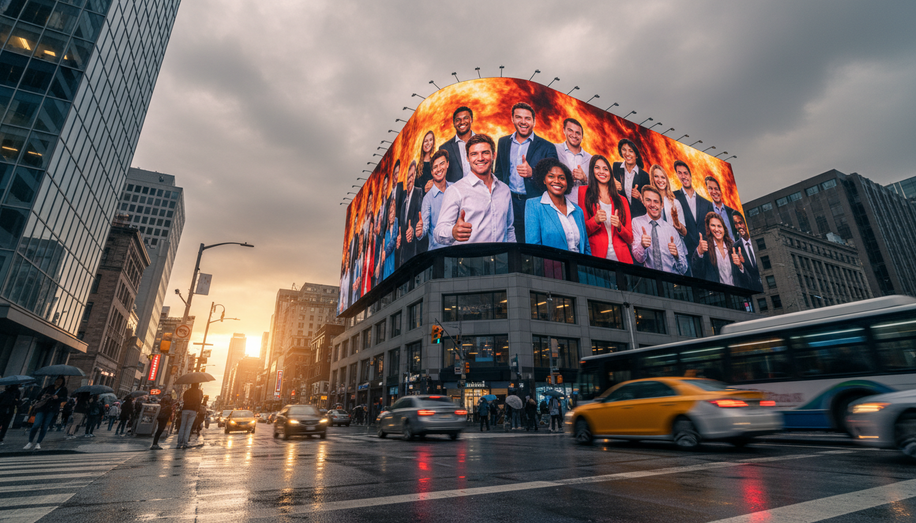

On a congested freeway outside Austin, a bright green billboard cuts through the visual noise: “Build the future with us.” No job titles. No bulleted benefits. Just a bold line, a striking image of a diverse engineering team, and a short URL. For a tech company competing in one of the tightest labor markets in the country, that single board is less about filling a req this week and more about staking a claim in the minds of thousands of potential hires every day.
As the war for talent intensifies, out-of-home advertising is quietly becoming one of recruitment’s sharpest tools. Once relegated to consumer brands and political campaigns, billboards, transit shelters, and digital screens are now being used to reach passive candidates, broadcast culture, and build employer brands at scale. In a landscape where job seekers are bombarded with digital messages and algorithmic noise, OOH offers something surprisingly rare: a high-impact, real-world signal that a company is serious, visible, and investing in its people.
The shift is driven by both supply and demand. On the demand side, employers are scrambling to stand out in crowded sectors like tech, healthcare, logistics, and hospitality. Traditional job postings and programmatic ads still matter, but they blur together in the same feeds and search results. OOH can’t be scrolled past as easily. Physically present in commuters’ routines, it acts as a powerful reminder that career options exist beyond whatever is in a candidate’s inbox.
On the supply side, the medium itself has changed. Digital OOH has made placements more flexible and affordable, enabling shorter flights, targeted geographies, and dynamic creative. Instead of locking into a single board for months, employers can rotate messages around university corridors during graduation season, flood transit routes near rival headquarters after a major layoff, or light up screens around a convention center during an industry conference. The old perception that OOH is only for big-budget brand campaigns is rapidly eroding.
Crucially, the companies getting the most from OOH are not treating it as a “Now Hiring” notice tacked onto a highway. They are building message architectures that mirror the best of consumer branding. Rather than listing open roles, they foreground mission, values, and impact. “Come help decarbonize shipping” or “Careers that change lives, not just job titles” conveys why someone should care in a single glance. The objective is recognition and intrigue, not instant conversion.
That focus on narrative over detail fits the constraints of the medium. As OOH strategists often remind clients, billboards are built for a “60 mile-per-hour message.” Drivers and pedestrians have seconds to absorb a visual and a handful of words. Recruitment marketers who try to squeeze in salaries, benefits, locations, QR codes, and application deadlines end up with clutter that no one reads. The emerging best practice is to let one strong image and one tight line do the heavy lifting, then hand off to digital.
That handoff is where OOH becomes part of a broader recruitment ecosystem rather than a standalone stunt. Short, memorable URLs that redirect to career hubs, clean QR codes on transit and street-level units, and prominent social handles give interested viewers an immediate path to learn more. Once online, candidates can explore detailed job descriptions, employee stories, and application flows that would never fit on a board. Meanwhile, recruitment teams monitor spikes in direct and organic search traffic to gauge impact. It’s rarely perfect attribution, but patterns around campaign launches and specific geographies can be telling.
The creative itself has also evolved to put real people at the center. Stock imagery is giving way to actual employees, photographed or filmed in authentic work environments. A logistics firm might show a warehouse supervisor leading a team huddle under the line “Leaders wanted on every shift.” A hospital system could spotlight nurses with a simple “Here, you’re never just a number.” The message is less about perks and more about belonging and purpose, themes that resonate across generations of workers.
Beyond broad awareness, some employers are deploying OOH with surgical precision to reach specific talent pools. Boards along commuter routes into tech corridors aim at engineers and product managers. Ads ring major military bases to attract veterans into skilled trades. Localized campaigns near community colleges and trade schools position companies as landing spots for early-career workers. For white-collar roles, placements clustered around central business districts, co-working spaces, or high-income residential areas act as a magnet for professionals quietly considering a move.
The medium’s physicality also lends an element of credibility that purely digital efforts sometimes lack. For startups and fast-growing scale-ups, appearing on a prominent board can signal stability and ambition to both investors and prospective employees. In sectors plagued by fly-by-night operators or high churn, a sustained OOH presence reads as a commitment: this employer is not a pop-up, and the roles on offer are backed by an organization investing in its brand.
Still, OOH is not a cure-all for recruitment woes. Poorly targeted placements can waste budget, and clever headlines that don’t connect to a real employee experience can backfire once candidates peek behind the curtain. The most effective campaigns are backed by internal alignment: HR and talent acquisition teams working alongside brand and media planners, with clarity on target audiences, goals, and how success will be evaluated. Piloting in a few key markets, comparing performance of regions with and without OOH in the mix, and listening closely to what candidates mention in interviews can all refine strategy over time.
What’s clear is that in a labor market where choice is abundant and attention is scarce, OOH gives employers a way to step outside the digital scrum and make a tangible statement in the real world. As more companies use these canvases not just to say they are hiring, but to show who they are, the morning commute is quietly becoming one of the most important stages in the battle for talent.