
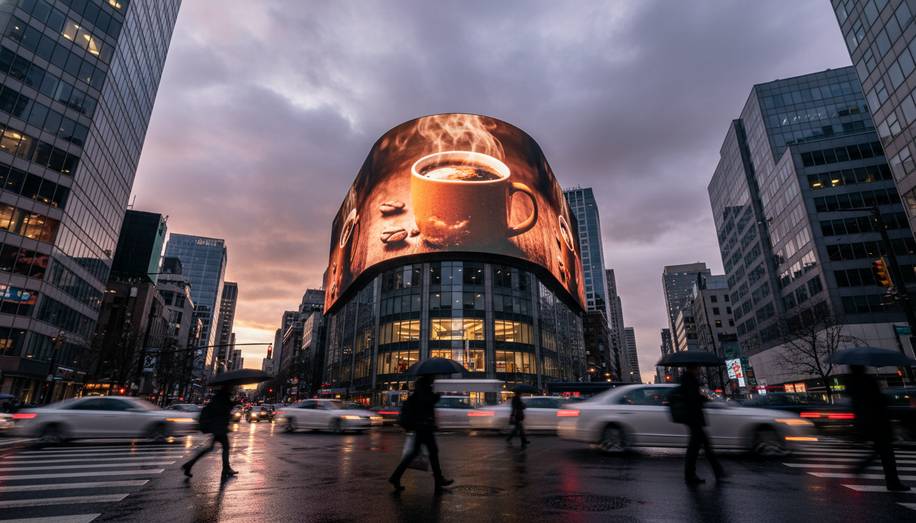

On a gray Monday morning, a digital billboard above a packed commuter platform flashes a simple line: “You’re already doing the hard part. We’ll handle the rest.” For an exhausted crowd wedged between strangers, that message feels oddly personal. The product might be grocery delivery, project management software, or banking—but its power comes from something more fundamental: context. Out-of-home advertising has always been about location, but the real differentiator now is how well creative matches the physical environment and the emotional temperature of the people moving through it.
Context in OOH has two intertwined layers: the visible, physical surroundings and the less tangible cultural and emotional landscape. Physical context includes everything from weather and traffic patterns to sightlines, dwell time, and what else is competing for attention. Cultural and emotional context covers local norms, current events, and the mood of an audience at a specific time and place. When these layers are understood and respected, an OOH ad stops behaving like wallpaper and starts to feel like a relevant part of the environment.
Research into OOH effectiveness underscores why context matters. Studies have shown that out-of-home formats command higher attention and recall than many digital channels, but that advantage is not automatic. High recall rates are strongly associated with creative that is simple, legible within three seconds, and clearly aligned with where and when it appears. A witty line that hits on a busy pedestrian street at lunchtime can fall completely flat if you transpose it to a highway where drivers have a split-second to glance up and no patience for nuance.
The physical environment should be treated as part of the creative brief, not an afterthought. That starts with understanding how people move through a space and what they’re doing in the moments before and after they encounter the ad. High-traffic roads deliver volume, but high-dwell environments like transit hubs, waiting rooms, and sidewalks offer more time to process a message and, in some cases, to interact with it. A static, three-word brand line might be ideal for a freeway board; a slightly richer message, a QR code, or a contextual offer can work in areas where people naturally slow down or stop.
Time of day and day of week add another contextual layer. The same commuter who is anxious and rushed at 8 a.m. might be more relaxed and receptive at 6 p.m. After dark, bright color and motion can feel energizing in a nightlife district but harsh or intrusive in a quiet residential area. Weather and season matter too. A winter campaign for hot drinks that calls out “You deserve something warm right now” works because it recognizes the immediate sensory experience of cold fingers and gray skies. Contextually relevant digital OOH can take this further, dynamically switching creative based on live temperature or rain.
Cultural context is more delicate but often more rewarding. “Speak like a New Yorker” is shorthand for a broader principle: understand the tone, humor, and sensitivities of specific locales. A line that plays as self-deprecating in London could come off as insincere in Los Angeles. Hyper-local creative—referencing a neighborhood landmark, a local team, or a famous intersection—signals that a brand has taken the time to understand the community rather than simply renting its attention. This kind of cultural tuning can deepen brand affinity, particularly when paired with partnerships around local events or festivals that are already shaping the area’s mood.
Audience mood itself is the least visible but perhaps the most critical factor. What does it feel like to be in this place at this time? Are people stressed, bored, excited, or tired? At airports, anxiety and anticipation coexist; in hospital districts, worry and fatigue dominate; near stadiums, energy spikes before and after games. The role of OOH creative is not to ignore these emotional states but to meet them with empathy. A complicated call to action is tone-deaf when people are anxious. A gentle reassurance or a bit of levity can be both memorable and welcome.
Building campaigns that truly adapt to environment and audience mood requires a different workflow than simply resizing a national TV spot for a billboard. Strategists and creatives need to collaborate early around real-world observations: ride the bus, walk past the board, stand in the line. Location data and geospatial tools can map footfall and behavioral patterns, but those insights should translate into concrete creative decisions. Shorter copy in high-speed environments, high-contrast color for cluttered visual fields, and multiple creative variants tailored to different audience flows within the same city are all part of contextual design.
Measurement plays a central role in validating and refining these strategies. QR codes, short URLs, and promo codes can track direct response in pedestrian settings, while mobile location data and footfall analysis can reveal whether proximity-based messages actually increase store visits. Brand lift studies can help determine whether localized, mood-aware creative outperforms generic messaging on awareness and consideration. The emerging pattern from such efforts is that contextually aligned campaigns not only feel better to audiences but also deliver measurable improvements in engagement and brand perception.
The creative challenge, then, is to maintain a unified brand idea while allowing for contextual nuance. OOH works best when it is part of a single, coherent campaign rather than a patchwork of disconnected executions. A central brand conviction—say, “we make everyday life easier”—can be expressed as a blunt reassurance on a stressful commute, a playful message in a leisure district, and a practical offer near a point of purchase. The key is to let the idea dictate how it shows up on each canvas, rather than forcing one-size-fits-all creative into wildly different environments.
As cities grow more complex and media more fragmented, OOH stands out precisely because it is inescapably tied to place. The brands that will get the most from this medium are those willing to treat context not as a constraint but as a creative asset: listening to the streets, reading the room, and designing messages that feel, in that exact moment, as if they were meant only for the people standing there.