
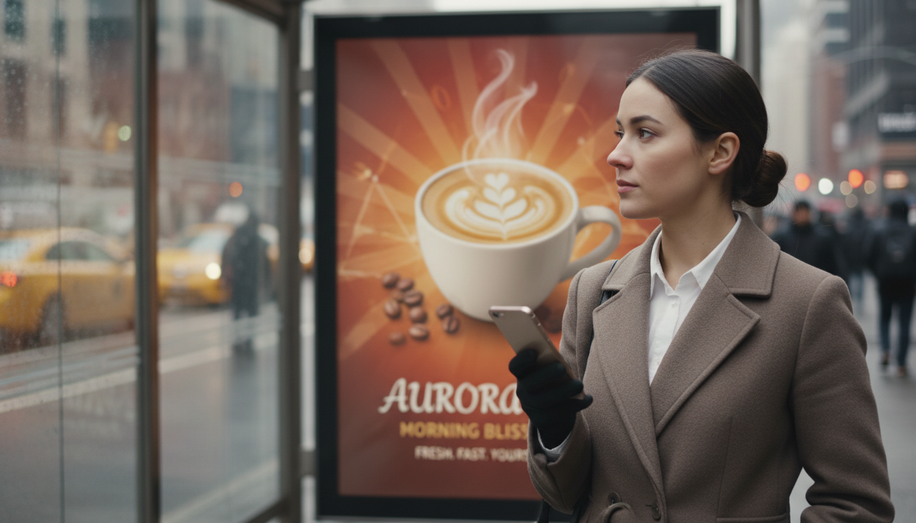

For years, out-of-home advertising has been pigeonholed as a top-of-funnel awareness play — big, bold, unmissable, and supposedly unconcerned with what happens next. But as measurement improves, mobile data converges with location intelligence, and omnichannel campaigns become the norm, that perception is rapidly becoming outdated. OOH is no longer just the spark at the beginning of the journey; it’s a persistent, physical presence that nudges consumers from consideration to conversion and keeps working long after the purchase is made.
The customer journey rarely unfolds as a neat, linear funnel. Instead, it’s a messy loop of discovery, comparison, distraction, and re-evaluation. Against that backdrop, the enduring strength of OOH – its ability to be in the real world where decisions actually happen – has become a strategic advantage. Awareness still matters, but smart brands are now designing OOH plans that follow the shopper, not just fill the top of the funnel.
Once a consumer has encountered an OOH placement and registered a brand or product, the real work begins in the consideration phase. This is where familiarity pays off. The brand that has already appeared in a commuter’s daily environment has quietly earned a place in their mental shortlist. Subsequent OOH exposures reinforce that preference, turning a fleeting impression into a sense of credibility and trust. A digital transit screen that rotates product benefits, price points, or seasonal offers can shift a brand from “I’ve seen them around” to “this is a serious option.”
Crucially, modern OOH is no longer a one-way message board. QR codes, short URLs, and campaign-specific hashtags have turned billboards, street furniture, and place-based screens into gateways to deeper information. A shopper sees a campaign on their way to work, scans the code, and lands on a comparison page, a product configurator, or social proof in the form of reviews and user-generated content. That direct bridge between public space and digital research tightens the link between awareness and active evaluation, making OOH a catalyst for mid-funnel engagement rather than a disconnected branding exercise.
Context is another powerful lever. As planners gain access to richer audience movement data, they can align creative and placements with intent signals and life moments. An OOH campaign for a streaming service near office districts can highlight “switch tonight” content lineups just before commute time. A finance brand can tailor creative near universities to focus on student accounts, while messaging in business districts emphasizes small business products or investment tools. In each case, OOH is doing more than generating recognition; it is presenting relevant reasons to consider, at the exact moment and place when those reasons resonate.
Nowhere is OOH’s evolution more evident than at the point of decision. The same channel that first introduced a brand can be the final nudge that tips a person into purchase. Proximity-based placements—near supermarkets, quick-service restaurants, car dealerships, or retail clusters—connect directly to measurable outcomes like foot traffic and sales. A diner who has been seeing a new restaurant’s billboards along their commute is far more likely to respond to a digital panel promoting a limited-time menu item just a few hundred meters from the door. A grocery shopper repeatedly exposed to a beverage campaign on roadside formats is more easily swayed by in-store digital shelf screens reinforcing price promotions or bundle deals.
At this stage, timing and creative urgency matter. Dynamic digital OOH allows brands to sync messaging with store hours, inventory levels, or real-time triggers such as weather or events. An apparel retailer can switch to “Sale ends today” creative in the hours leading up to closing, while a coffee chain can automatically push iced drinks when temperatures spike. These contextually tuned messages transform OOH into a conversion engine, tying the physical environment to immediate action in a way other channels struggle to match.
Increasingly, that action happens on mobile devices. Location-based attribution and geofencing make it possible to connect OOH exposures with downstream behaviors such as store visits, app downloads, and online transactions. When consumers search for a brand they’ve just seen on a billboard, click a paid search ad, or redeem an offer in-app, OOH is often the uncredited driver that sparked that intent. By integrating OOH with mobile retargeting, brands can now “follow up” on those exposures, reinforcing the message at home, on social feeds, or within navigation apps, blurring the line between offline and online conversion paths.
The journey does not stop at the point of sale, and neither does OOH. Post-conversion, the medium can support onboarding, usage, and loyalty. For subscription services, screens in office towers, transit hubs, or residential elevators can reinforce how to get the most from a plan or highlight new features, reducing churn. For retailers, localized OOH can invite recent customers back for member-only events, exclusive drops, or loyalty point offers, building habits rather than one-off visits. In categories where brand advocacy is powerful, creative that celebrates customers—featuring real buyers, reviews, or social posts—can turn outdoor inventory into a stage for shared identity and community.
OOH also plays a role in reassuring buyers after high-stakes purchases. Seeing a car brand’s presence across major city formats after signing a lease, or spotting ongoing campaigns for a financial institution after opening an account, signals stability and staying power. That visibility validates the decision, making consumers more likely to recommend the brand and less likely to defect when competitors come calling.
For marketers under pressure to prove performance, the message is clear: reducing OOH to a pure awareness line item leaves value on the table. When planned as part of an omnichannel strategy, rooted in real-world movement data and connected to mobile and digital experiences, OOH can shape choices, drive measurable store and site traffic, and sustain engagement long after the purchase. The medium’s physicality, once seen as a limitation in a digital-first world, has become its biggest strength: it shows up where people live, move, and decide, quietly pushing them along the entire funnel—often all the way back to the start.
For marketers seeking to harness this full-funnel power and prove OOH’s tangible impact, platforms like Blindspot offer crucial solutions. By providing robust ROI measurement and attribution, combined with advanced location intelligence and programmatic DOOH management, Blindspot empowers brands to precisely target audiences across their real-world journeys, dynamically adapt messaging, and directly tie OOH exposures to conversion and sustained loyalty. Learn more at https://seeblindspot.com/