
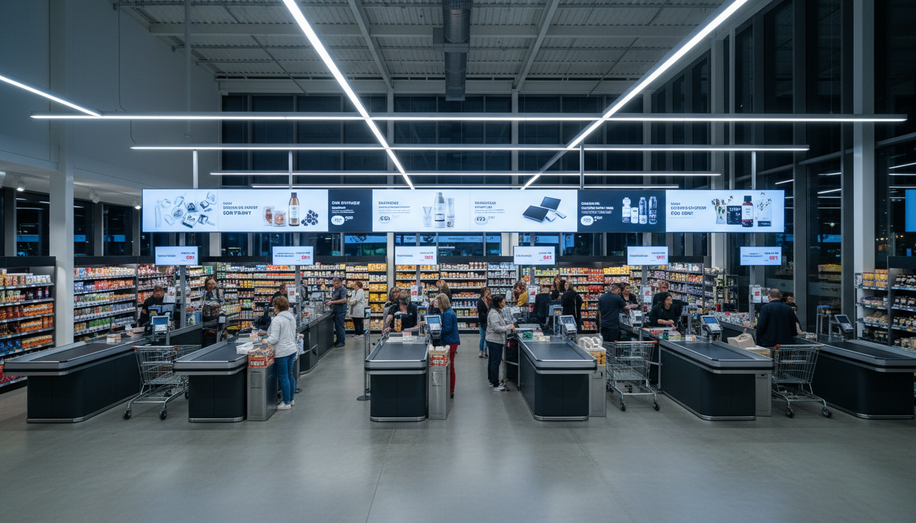

For years, retail media has been framed as a digital story: sponsored product listings, onsite display, paid search and offsite audience extension. But look around any supermarket, pharmacy or shopping centre today and another story is playing out in plain sight. From digital endcaps and aisle screens to EV charger displays and entryway panels, an unseen network of out-of-home (OOH) assets is quietly becoming the physical backbone of retail media networks — and a serious new revenue stream for retailers.
The numbers behind retail media’s rise have been well documented. Globally, RMNs are forecast to exceed US$100 billion in ad spend within the next few years, and in markets like Australia the sector is expected to more than triple in value this decade. Originally driven by e-commerce giants leveraging first-party data to sell sponsored placements, the model is now rapidly extending into bricks-and-mortar. The twist is that in-store and near-store OOH infrastructure is no longer just “store marketing”; it is being productised, packaged and sold as premium retail media inventory.
What makes these screens so powerful is their position at the true last mile of the customer journey. Digital OOH at store entry, in-aisle and at checkout reaches shoppers when purchase intent is at its peak and baskets are still open to influence. Networks like those operated across major US grocery chains, or retail-led platforms powered by OOH specialists in Australia and New Zealand, are tapping into millions of high-intent visits every month. Every impression is delivered in a brand-safe, 100% viewable environment — a compelling contrast to the cluttered feeds and ad-blocked browsers of conventional digital.
The convergence of OOH and retail media is also redefining what “addressable” means in a physical environment. Historically, in-store screens were a blunt instrument: the same loop, the same message, for every shopper. Today, retailers are feeding these networks with real-time and first-party data: loyalty profiles, footfall patterns, time of day, weather, even live inventory. A rainy afternoon can trigger comfort food creatives near the grocery freezer; a low-stock alert can automatically swap out an ad, avoiding wasted impressions and shopper frustration. OOH is borrowing the dynamic optimisation playbook from digital, but applying it to screens that are physically embedded in the shopping journey.
For consumer brands, this evolution offers something they have long struggled to achieve: a clear line between exposure and sale. The combination of in-store OOH with retailer data and RMN platforms gives marketers measurable outcomes. Campaigns running on aisle screens and checkout displays can be matched against loyalty card transactions, basket sizes and product-level sales. Brands can see, for example, the lift in units sold when a campaign runs simultaneously on the retailer’s app, website and in-store network, versus digital-only activity. Early case studies suggest that OOH integrated into retail media plans can drive higher incremental sales than either channel in isolation.
This is reshaping conversations between retailers and suppliers. Instead of negotiating traditional trade marketing or co-op budgets in isolation, many retailers are now bundling onsite digital, offsite audience extension and in-store OOH into cohesive media packages. A launch plan might include sponsored placements on the retailer’s e-commerce site, programmatic display targeted to loyalty audiences, and a takeover of digital aisle screens near the relevant category. The result is a unified story: the shopper is reached while planning, browsing and finally choosing at the shelf, all within a single retailer-controlled ecosystem.
The implications for OOH operators are significant. Those who once sold primarily roadside and classic large-format inventory are repositioning themselves as technology and data partners to retailers. Retail environments, with their high dwell times and positive, purchase-ready mindset, are now premium real estate in their own right. Some OOH companies are powering retailer-branded networks, providing CMS platforms, data integrations and programmatic pipes while the retailer controls the customer relationship and first-party data. Others are aggregating screens around retail footprints — from EV charging bays to mall food courts — giving brands extended reach into the pre-store journey.
The value exchange is clear. Retailers unlock new, high-margin revenue by monetising assets they already own: foot traffic, shopper data and physical space. Brands gain access to contextually rich, high-intent environments with demonstrable sales impact. OOH specialists secure a central role in one of the fastest-growing segments of advertising, moving from “nice-to-have” awareness plays to must-have components of performance-driven retail plans.
Yet this convergence also raises new strategic questions. As more screens light up within stores, the risk of visual clutter is real. The most successful retail media networks are imposing strict governance: curated content standards, limited ad load, and a focus on useful, context-aware messaging rather than indiscriminate promotion. The goal is to enhance the shopping experience, not hijack it. When done well, dynamic wayfinding, recipe inspiration, real-time offers and brand storytelling can make the store feel more relevant and responsive, not more commercialised.
Measurement and interoperability will be another critical battleground. Marketers increasingly expect to plan and buy in-store OOH alongside other digital channels, with comparable metrics and unified reporting. That means standardised impression counting, clean integration with demand-side platforms and the ability to attribute sales across multiple touchpoints. The OOH players that can plug into retail media tech stacks — and speak the language of audiences, outcomes and optimisation rather than loops and slots — will be best placed to capture shifting budgets.
What’s becoming clear is that the rise of retail media is not a threat to OOH; it is an accelerant. Those luminous rectangles above shelves, at checkouts and in car parks are no longer just screens; they are nodes in a much larger, data-infused advertising network owned by retailers and powered, in no small part, by OOH infrastructure and expertise. As retail media matures from a set of online placements into a truly omnichannel proposition, the unseen network in the physical world is stepping into the spotlight — and with it, OOH’s role in the future of commerce is being fundamentally rewritten.
As this data-infused advertising network expands, platforms like Blindspot are critical for unlocking its full potential. By offering real-time campaign performance tracking, precise audience measurement, and robust ROI attribution for DOOH, Blindspot enables seamless integration of physical screens into omnichannel retail media strategies. This ensures marketers can plan, optimize, and measure their in-store OOH alongside digital channels, attributing sales and demonstrating clear business outcomes within the evolving landscape of retail commerce. https://seeblindspot.com/