
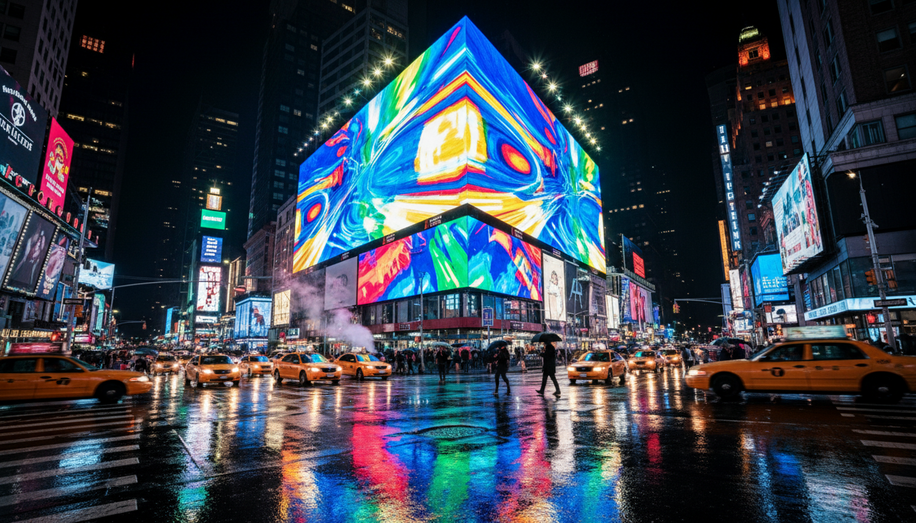

In an era when consumers scroll through dozens of targeted ads daily, when retargeting pixels follow them across the internet, and when artificial intelligence predicts their every click, something remarkable is happening in the advertising world: static billboards are experiencing a genuine renaissance.
The paradox seems counterintuitive at first. As marketers gain access to increasingly sophisticated digital tools—geofencing, programmatic buying, real-time optimization—the humble, unchanging billboard still commands attention and builds brands in ways that ephemeral digital formats simply cannot replicate. This resurgence isn’t a nostalgic throwback but rather a recognition of fundamental truths about human attention and brand building that the digital revolution temporarily obscured.
The core advantage of traditional billboards lies in their unavoidable nature. Unlike digital ads that consumers actively ignore, scroll past, or block entirely, a static billboard presents an inescapable visual statement. A commuter sitting in traffic doesn’t choose to see a billboard—it’s simply there, commanding attention through sheer scale and presence. This forced engagement, repeated hundreds of times as someone travels the same route, creates a brand impression that feels almost ambient. The psychology here is powerful: repetitive, undemanding exposure builds familiarity and trust in ways that intrusive digital interruptions cannot match.
Consider the iconic campaigns that have defined brands for decades. Coca-Cola’s red billboards, Nike’s minimalist statements on highway corridors, luxury brands commanding high-traffic urban intersections—these aren’t relics of a pre-digital past. They remain central to brand identity precisely because they occupy a unique psychological space. They communicate confidence. A brand willing to invest in a static billboard for months or years signals permanence and stability in a way that a programmed digital ad rotating through thousands of variations never can.
The economics of brand building, long understood by major advertisers, explain why static OOH endures. Building iconic brands requires consistency, repetition, and presence over extended periods. While digital channels excel at conversion and immediate response, traditional billboards excel at the foundational work of brand awareness and image-building. The cost-per-impression of a well-placed billboard, amortized over months of constant visibility, remains remarkably efficient for reaching broad audiences in high-value locations.
Furthermore, static billboards offer something increasingly rare in advertising: creative clarity. When a creative must work within the constraints of a static format, messaging becomes crystallized. There’s no room for the cluttered, tag-laden, complicated messaging that sometimes plagues digital advertising. The best billboard creative communicates instantly. It respects the audience’s limited attention and rewards that attention with something memorable.
The strategic placement of traditional billboards also carries weight that programmatic placement cannot replicate. A billboard overlooking a major highway, positioned at the entrance to a neighborhood, or dominating a key commercial district becomes a landmark. It defines territory. Competitor brands notice. Consumers integrate it into their mental maps. This geographic specificity and permanence create brand associations that are difficult to achieve through distributed digital channels.
What’s particularly interesting is that the resurgence of static billboards isn’t occurring in isolation. Rather, it’s part of a maturing media landscape where marketers increasingly recognize that different formats serve different purposes. Digital channels drive engagement and conversion. Social media builds communities. But for foundational brand awareness and iconic messaging, static OOH holds irreplaceable value.
The renaissance of static billboards isn’t evidence that digital marketing failed or that advertising is returning to the past. Instead, it represents a more sophisticated understanding of how brands actually build meaning. In a fragmented media landscape where consumers have endless choices about what to engage with, the billboard’s stubborn refusal to be skipped, ignored, or forgotten has become not a limitation but a profound strength. That’s not nostalgia. That’s strategy.
In this nuanced advertising landscape, platforms like Blindspot become essential, helping marketers maximize the very attributes that make static OOH powerful. By leveraging advanced location intelligence and audience measurement, Blindspot ensures billboards are positioned for maximum unavoidable impact and quantifies the consistent, landmark brand presence, proving the strategic wisdom of this enduring format. Learn more at https://seeblindspot.com/