
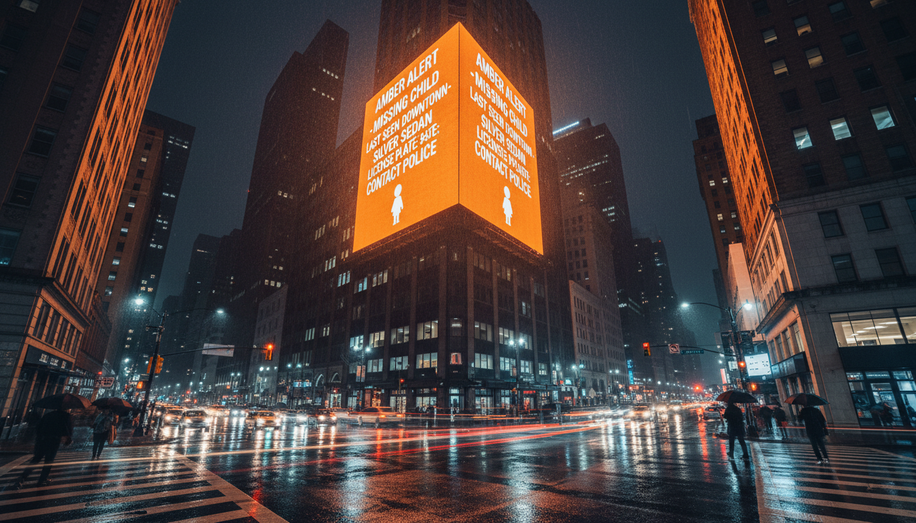

In the shadow of towering digital billboards along bustling highways, a child’s face appears, accompanied by urgent details of an Amber Alert. Within minutes, that image reaches millions of drivers, turning a routine commute into a potential rescue mission. This is not commercial persuasion at work, but out-of-home (OOH) advertising stepping into its vital role as a lifeline for public service and emergency broadcasts, proving its worth far beyond selling products.
When crises strike, speed and reach define survival. Digital billboards, with their ability to update content in seconds, have become indispensable for disseminating life-saving information. Companies like Lamar Advertising have integrated Emergency Alert Systems that broadcast Amber Alerts, FBI notices, FEMA warnings, and Crime Stoppers messages across local, state, or national networks. These displays activate on short notice, overriding commercial content to deliver real-time advisories that traditional media might take hours to propagate. Lamar donates millions in ad space annually to law enforcement and nonprofits, ensuring critical messages blanket communities without delay.
Public-private partnerships amplify this capability. Clear Channel Outdoor’s vast digital network has proven instrumental during hurricanes, heat waves, and natural disasters, pushing evacuation notices, weather alerts, and public safety announcements to high-visibility locations nationwide. In one instance, as storms battered coastal regions, their billboards flashed targeted warnings about flash floods and gas shortages, guiding residents to safety. Similarly, the Out of Home Advertising Association of America (OAAA) collaborates with FEMA through an Alert Message Generator, allowing officials to customize billboard creatives for any emergency—from wildfires to chemical spills—ensuring messages are precise and pervasive.
State governments increasingly rely on these networks. In Texas, OOH companies donate space on digital billboards to warn of approaching storms, flooding, burn bans, water shortages, and industrial hazards, a practice honed through decades of natural and man-made disasters. Missouri Outdoor Advertising Association (MOAA) extends this service to not-for-profits and agencies, advertising critical public messages that foster community resilience. During emergencies, these billboards perform a “huge public service,” as noted by industry observers, bridging gaps left by radio, TV, or apps that not everyone monitors constantly.
The technology underpinning this shift is transformative. Unlike static signs, digital OOH enables instantaneous updates via sophisticated software, harnessing public-private collaborations to push messages where people are most attentive—on the move. High-tech billboards reveal the evolution of OOH from passive displays to dynamic communication tools, capable of geo-targeting alerts to affected areas. For public health campaigns, this means rapid deployment of vaccination drives, mask mandates, or outbreak warnings, reaching demographics often overlooked by digital screens indoors.
Consider the 2024 hurricane season, when states partnered with billboard operators to air tailored messages amid chaos, from evacuation routes to shelter locations. Or routine scenarios like Crime Stoppers campaigns, where donated space helps solve cases by prompting tips from passersby. These efforts underscore OOH’s scalability: a single network can saturate a city, state, or region, delivering unmissable visuals that cut through information overload.
Beyond emergencies, OOH sustains essential community announcements. Nonprofits leverage free inventory for blood drives, missing persons, and anti-littering initiatives, while governments promote voter registration or disaster preparedness year-round. This pro bono commitment—millions in value—builds goodwill and demonstrates OOH’s societal value, often at no cost to taxpayers.
Critics might argue that commercial interests dilute this public good, yet evidence shows otherwise. When lives hang in the balance, operators prioritize alerts, proving digital infrastructure’s dual purpose. As climate events intensify and urban populations grow, OOH’s role will only expand, with innovations like AI-driven targeting on the horizon.
In an era of fragmented media, out-of-home stands as a unifying force—visible, immediate, and impartial. It reminds us that advertising’s infrastructure, built for commerce, excels in service, turning highways into veins of vital information. As emergencies evolve, so too does OOH’s promise: not just to inform, but to protect.