
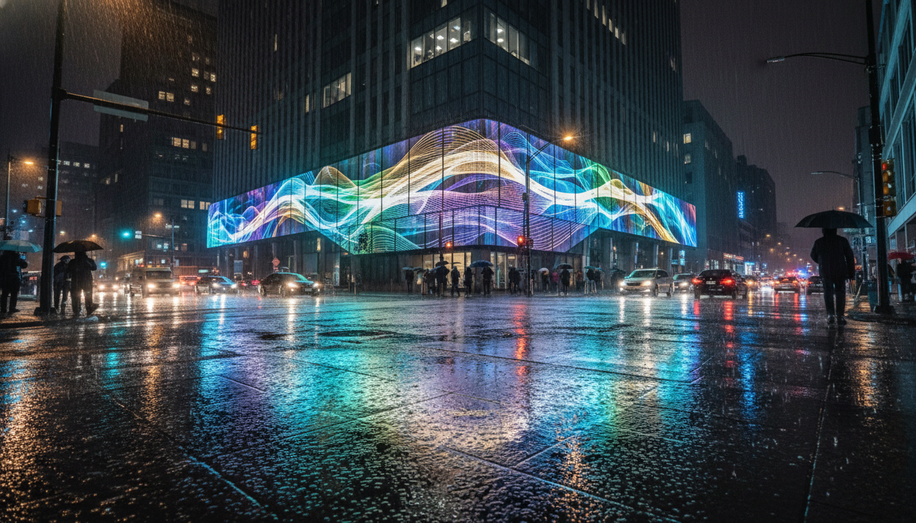

In the evolving landscape of digital out-of-home (DOOH) advertising, the rectangular screen has long dominated as the default canvas, its predictable geometry etched into urban skylines from Times Square to Tokyo’s Shibuya Crossing. Yet a quiet revolution is underway, as innovators shatter this mold to create displays that curve, twist, and integrate seamlessly with architecture, transforming advertisements into living sculptures that redefine cityscapes. These non-traditional shapes and installations not only capture attention in ways flat panels never could but also elevate public spaces, blending commerce with art to foster deeper audience engagement.
Consider the rise of curved and wrapped LED screens, which wrap around building facades or structural pillars like digital skin, injecting depth and motion into static environments. Unlike their flat counterparts, these displays create a panoramic illusion, pulling passersby into the narrative rather than observing from afar. In high-traffic zones, such as bustling plazas or highway underpasses, a curved screen might undulate along a corner, its seamless pixel flow mimicking the fluidity of water or wind, commanding views from multiple angles and amplifying visual impact. Architects and developers are now collaborating with LED specialists from the design phase, embedding these forms into new constructions to ensure they enhance rather than clash with the built environment. This integration turns advertising into an architectural feature, where screens become load-bearing elements or sculptural accents, enriching urban aesthetics without overwhelming them.
Pushing further, custom shapes defy convention altogether—tall, slender towers that pierce the sky like digital obelisks, or fragmented mosaics that assemble into brand icons. Imagine a narrow, vertical display slicing through a lobby, its elongated form ideal for scrolling narratives or kinetic animations that play with vertical space, drawing eyes upward in a world accustomed to horizontal billboards. Anamorphic 3D illusions take this to mesmerizing extremes, projecting impossible geometries that appear to leap from the surface, such as a towering soda can tipping precariously over a pedestrian walkway or a virtual athlete bursting through a screen on a sports arena exterior. These installations leverage advanced LED technology for pixel-perfect precision, enabling real-time adaptability to weather, events, or audience data, ensuring relevance in the moment.
Beyond mere visuals, these unconventional formats incorporate interactivity and multisensory elements, evolving DOOH from passive signage to immersive experiences. Touch-sensitive curved walls in transit hubs invite commuters to swipe through product demos, while synchronized installations across a building’s multiple facades create 360-degree storytelling, enveloping viewers in a branded universe. In one striking example, wrapped screens on landmark structures have hosted campaigns where lights pulse in rhythm with music or respond to nearby foot traffic, forging emotional connections that flat rectangles simply can’t replicate. This shift aligns with broader trends in programmatic DOOH, where content updates instantaneously without the logistics of static vinyl, allowing brands to pivot from weather-triggered messages to live event tie-ins.
The benefits extend to urban enhancement, as these designs prioritize harmony over intrusion. Media owners and agencies report heightened dwell times and recall rates, with curved displays boosting engagement by up to 30% in comparative studies, thanks to their dynamic presence. In residential or mixed-use developments, architecturally integrated screens serve dual purposes: advertising revenue streams fund public amenities, while their organic forms—think undulating waves along a waterfront promenade—contribute to placemaking. Cities like Dubai and Singapore lead here, commissioning installations that double as public art, such as massive, irregularly shaped LED spheres in parks that display cultural exhibits by day and ads by night, proving DOOH can beautify rather than blight.
Challenges remain, from higher upfront costs for bespoke engineering to maintenance in harsh outdoor conditions, but advancements in modular LED panels mitigate these, offering flexibility for retrofits on existing structures. As 2025 trends forecasted rapid adoption, 2026 sees widespread deployment, with advertisers ditching static billboards for these versatile canvases that support diverse formats, from video loops to AR overlays. Brands like global tech giants and luxury houses are early adopters, commissioning totems, helicoids, and even floating orbs that hover via drone tech in controlled spaces, each pushing creative boundaries while respecting spatial contexts.
Ultimately, breaking the rectangle signals DOOH’s maturation into a medium of architectural innovation. By daring to sculpt light into non-traditional forms, the industry not only captivates but also reimagines cities as interactive galleries, where every glance yields discovery. As collaboration between creators, builders, and tech providers deepens, these installations promise to weave advertising into the urban fabric, making the ordinary extraordinary.