
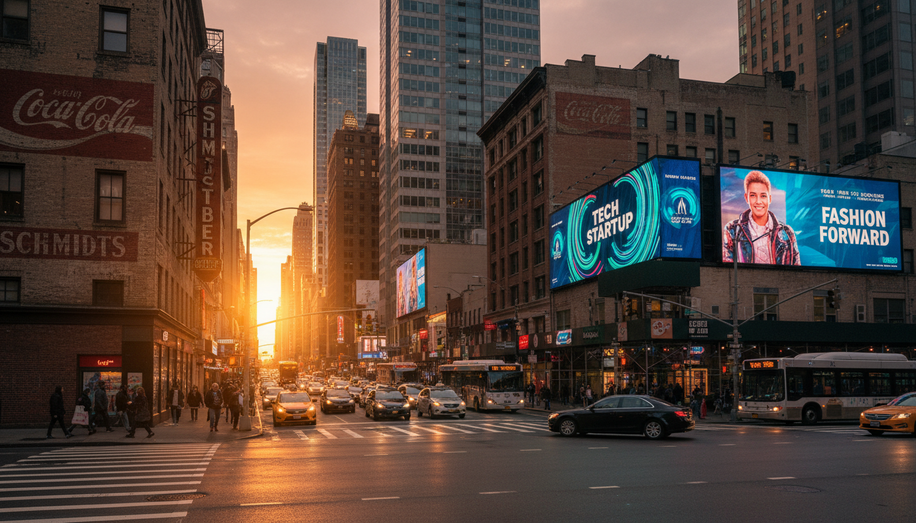

In the bustling streets of 1830s New York, Jared Bell unveiled the first outdoor poster, a vibrant hand-painted spectacle promoting a circus extravaganza that captivated passersby and marked the dawn of out-of-home (OOH) advertising as a mass medium. This humble beginning evolved from rudimentary wall postings into a sophisticated industry, propelled by lithographic innovations in 1796 that enabled colorful, reproducible prints on smooth stone plates, transforming simple announcements into artistic announcements visible from afar. By the mid-19th century, exterior ads adorned street railways, and leased billboards emerged around 1867, with nearly 300 posting companies operating by 1870, signaling OOH’s rapid commercialization.
The late 1800s solidified OOH’s structure through industry self-regulation. In 1872, the International Bill Posters’ Association of North America formed, followed by the Associated Bill Posters’ Association of the US and Canada in 1891—now the Out of Home Advertising Association of America (OAAA)—to standardize practices, promote ethical standards, and coordinate nationwide services. National brands like Palmolive, Kellogg, and Coca-Cola seized the moment around 1900, mass-producing billboards that blanketed America, turning urban landscapes into branded canvases and fueling a boom in standardized structures. These early campaigns weren’t mere promotions; they embedded products into public consciousness, with Coca-Cola’s iconic “Yes Girl” design clinching the first OBIE Award in 1942, a testament to OOH’s creative pinnacle amid hand-painted artistry.
The 20th century brought mergers, measurements, and cultural milestones that amplified OOH’s reach. The 1925 fusion of the Poster Advertising Association and Painted Outdoor Advertising Association into the OAAA, alongside the creation of General Outdoor Advertising Company, professionalized the sector. Innovations like the 1934 Traffic Audit Bureau (TAB)—later Geopath—provided verifiable audience data, reassuring advertisers of their investments. Public service efforts, initiated by an educational committee in 1913, underscored OOH’s societal role, while the 1962 invention of ad-funded bus shelters expanded formats beyond billboards to street furniture and transit.
Iconic campaigns etched lasting legacies. In 1975, Outdoor Advertising, Inc. (OAI) tested billboard efficacy with Miss America Shirley Cochran’s image plastered nationwide; her name recognition skyrocketed 940 percent, proving OOH’s unmatched visibility in an era dominated by painted and paper posters. Tobacco brands, barred from broadcast after 1972, flooded OOH until a 1999 agreement with state attorneys general curtailed such ads, redirecting the medium toward broader consumer goods. Yet challenges persisted: the 1965 Highway Beautification Act restricted interstate billboards, confining them to commercial zones with strict size and lighting rules, forcing adaptation.
The 1970s vinyl revolution replaced labor-intensive hand-painting, offering durable, weather-resistant wraps that slashed installation times and ushered in environmental shifts, like 2010’s ecoflex posters. Digital out-of-home (DOOH) ignited in the 1990s, with early tech experiments paving the way for 2005’s first digital networks. By the early 2000s, static displays yielded to LED screens on billboards, transit hubs, retail spaces, and immersive 3D installations, enabling real-time updates tied to weather, time, or data. These weren’t just upgrades; they revived OOH’s dynamism, allowing brands to rotate messages, daypart creatively, and engage audiences in airports, buses, and office towers with unprecedented flexibility.
Throughout its century-plus arc, OOH campaigns have transcended commerce to shape culture. Circus posters of the 1830s sparked entertainment fever; Coca-Cola’s bold visuals normalized refreshment in daily life; Cochran’s billboards demonstrated measurable fame amplification. Even regulatory pivots, like tobacco bans, highlighted OOH’s influence on policy and ethics. Today, DOOH networks in high-traffic nodes deliver hyper-targeted, visually arresting experiences, blending tradition with tech—vinyl echoes of hand-painted origins now pulsing with data-driven precision.
This evolution underscores OOH’s enduring power: from stone obelisks in ancient Egypt to glowing digital facades, it commands attention where people live, work, and move. Groundbreaking campaigns didn’t just sell products; they mirrored eras, from industrial expansion to digital disruption, leaving indelible marks on skylines and collective memory. As formats diversify into cinema, alternative media, and place-based screens, OOH’s legacy endures as the original influencer of public spaces, proving its adaptability across a transformed media landscape.
As OOH continues its remarkable evolution, particularly into the data-driven era of DOOH, platforms like Blindspot are crucial for maximizing its impact. By offering real-time performance tracking, precise audience measurement, and programmatic campaign management, Blindspot empowers brands to optimize site selection, deliver hyper-targeted experiences, and definitively prove ROI, ensuring OOH remains an indispensable, quantifiable force in shaping collective memory. Discover more at https://seeblindspot.com/