
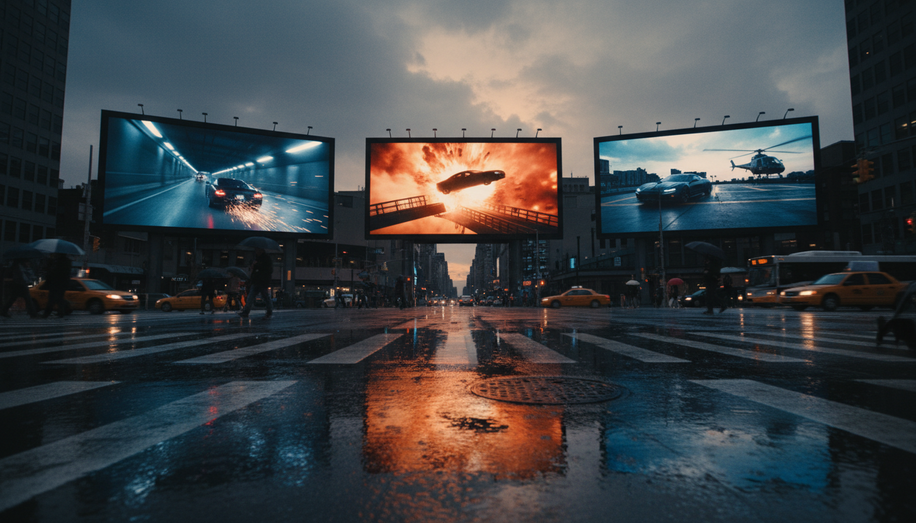

In the fast-paced world of out-of-home (OOH) advertising, where a single glance can make or break a campaign, sequential storytelling emerges as a masterful technique to captivate audiences over time. By designing narrative arcs across multiple panels, billboards, or digital screens, brands transform static displays into dynamic journeys that unfold as commuters drive highways, pedestrians navigate city streets, or shoppers weave through urban environments. This approach leverages the natural movement of audiences, turning passive exposure into an immersive experience that builds anticipation and embeds messages deep into memory.
The power of sequential OOH lies in its ability to mimic the structure of a compelling story: an intriguing setup, rising tension, and a satisfying payoff. Consider the classic example from the 2017 film *Three Billboards Outside Ebbing, Missouri*, where sequential roadside billboards drive the plot, highlighting how real-world OOH can propel narratives forward. Brands have long drawn inspiration from this, as seen in Adidas’s Nite Jogger campaign in India. Spanning 20 digital billboards along a commuter route, each panel advanced a running figure in a GIF-like motion, creating the illusion of perpetual movement that mirrored the audience’s own journey and reinforced the shoe’s performance promise.
Strategic placement forms the backbone of these campaigns. Billboards must align with audience flow—highways for drivers encountering panels every few miles, urban corridors for pedestrians passing sequential digital signs. Spacing is crucial: too close, and the story resolves prematurely; too far, and continuity fades. Whistler Billboards emphasizes highways and commuter routes, where viewers naturally progress through the narrative, fostering curiosity as each panel reveals the next chapter. This contextual immersion amplifies engagement, as the environment itself becomes part of the plot.
Psychologically, sequential storytelling taps into innate human wiring. People crave narrative closure, turning a fleeting billboard glance into an active quest to “solve the puzzle.” By breaking a message into parts, brands spark anticipation—first a tease, then amplification, finally resolution—boosting recall and differentiation from single-shot ads. Research shows this can enhance memorability, with repetition across placements reinforcing the core message while standing out in cluttered media landscapes.
Real-world executions illustrate diverse strategies. BMW and Audi’s billboard “duel” exemplifies playful rivalry: Audi’s challenge—”Your move, BMW”—prompted a cheeky response nearby, “Checkmate,” sparking viral buzz through unexpected dialogue. In digital OOH, electronic triptychs deliver layered messages; one campaign’s three sequential images morph a simple scene into a profound call-to-action, proving that unity across panels creates impact greater than isolated efforts. PUMA took this further in a multi-story Instagram-to-Reel sequence adapted for OOH potential: the first panel teases an exclusive discount, the second provides redemption proof, and the third injects urgency, guiding viewers from awareness to action.
Effective sequential campaigns follow proven narrative frameworks. The Tease-Amplify-Echo model starts with intrigue—a mysterious visual or question—builds emotional depth in the middle, and closes with a call-to-action. Mini-series formats, like Nike’s athlete journeys, unfold personal stories across placements, inviting repeat encounters. For OOH, weather triggers add dynamism; Rain-X activated digital screens only during rain, sequentially building relevance near retailers, while Aperol Spritz appeared in sunny spots to evoke summer vibes. These programmatic elements ensure timeliness, syncing stories with real-world conditions.
Designing for multi-location arcs demands meticulous planning. Begin with a clear narrative spine: define characters, conflict, and resolution tailored to the brand. Map audience paths using traffic data to sequence placements precisely—perhaps escalating drama from suburban entry points to city centers. Visual continuity is key: consistent colors, motifs, or evolving icons link panels without overwhelming text. Digital OOH elevates this with motion or interactivity, as in Adidas’s animated progression, but even static vinyls shine when paced for motion blur.
Challenges abound, from coordinating inventory across providers to measuring lift beyond impressions. Yet successes abound. Sequential OOH not only drives foot traffic—Rain-X placements near stores converted relevance into sales—but fosters shareability, as intrigued passersby photograph and post incomplete tales online. Emerging trends like AI-optimized sequencing and immersive activations, such as HOKA’s desert-block takeover with real-time visuals, hint at hybrid futures blending physical paths with digital extensions.
Ultimately, the sequential storyteller redefines OOH as theater in motion. By crafting arcs that audiences inhabit, brands forge emotional bonds that linger long after the final panel fades from view. In an era of fragmented attention, this patient art of unfolding narratives proves that the journey, not the destination, captivates most.
Achieving this multi-location narrative precision, however, demands sophisticated tools for meticulous planning and execution across diverse OOH inventory. Blindspot directly addresses these challenges, providing location intelligence for optimal site selection and programmatic DOOH management to seamlessly coordinate sequential campaigns, ensuring narrative continuity and audience flow. This enables brands to track real-time performance and measure ROI, transforming the art of sequential storytelling into a consistently impactful and data-driven strategy. Learn more at https://seeblindspot.com/