
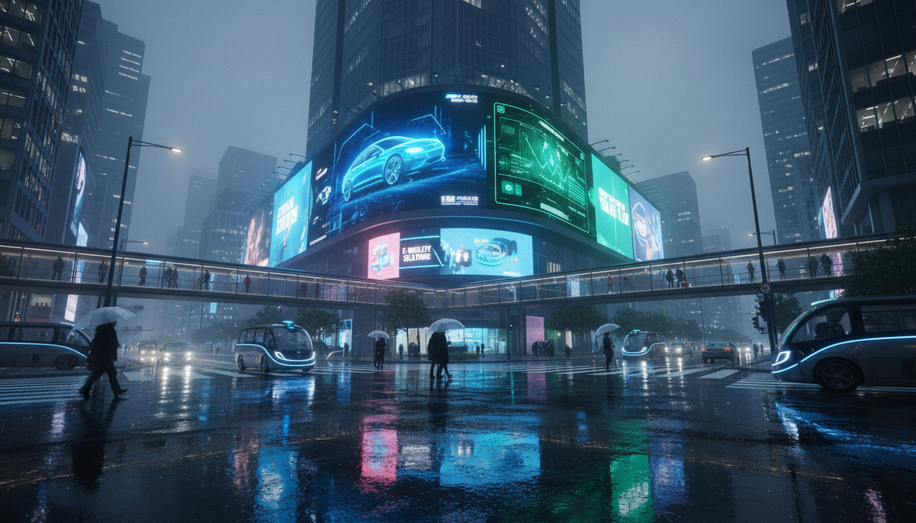

In the bustling arteries of modern metropolises, out-of-home (OOH) advertising is undergoing a profound transformation, weaving itself into the fabric of smart city infrastructures and data ecosystems. No longer mere static displays vying for fleeting glances, these billboards now pulse with intelligence, drawing on real-time urban data to deliver hyper-relevant messages that resonate with citizens on the move. As cities deploy sensors, IoT networks, and AI-driven systems to optimize traffic, energy, and safety, OOH evolves from a one-way broadcast into a dynamic dialogue, enhancing both commercial impact and civic life.
At the heart of this shift lies seamless integration with connected infrastructure. Smart city billboards, powered by AI, analyze traffic patterns, weather conditions, and demographic data to tailor content instantaneously. In Tokyo’s Shibuya district, for instance, screens adjust ads based on crowd age and gender, boosting engagement rates significantly, while New York’s Times Square deploys interactive displays that respond to passersby, blending tourism promotion with real-time urban vibes. These systems tap into municipal IoT grids—streetlights, transit signals, and environmental sensors—to synchronize messaging. A billboard might shift from a coffee promotion during morning rush hour to public safety alerts during emergencies, proving its dual role as advertiser and informant.
Data ecosystems amplify this relevance. Urban infrastructures generate vast streams of information, from pedestrian flows to event schedules, which OOH platforms harness for precision targeting. IoT-enabled management allows operators to respond to conditions in real time, reducing costs and refining campaigns through audience behavior insights. Facial recognition and AI personalize content without invading privacy—segmenting by broad profiles to show family-oriented ads near parks or business pitches at corporate hubs. This data-driven approach yields measurable results: real-time performance tracking reveals engagement metrics, enabling advertisers to optimize on the fly and outshine static alternatives.
Interactivity takes engagement further, turning passive viewers into participants. Touchscreen-enabled billboards offer hybrid displays—one panel for ads, another for maps, directories, or transit updates—fostering two-way communication. Augmented reality overlays immerse users, projecting digital elements onto the real world via smartphones, while dynamic content adapts to time, location, or even viewer reactions, creating “flow” and control as defined in digital marketing frameworks. In one viral example, interactive OOH transforms intersections into hotspots, where ads amuse crowds between cycles, blending technology, public space, and human curiosity to elevate urban semiotics.
Sustainability and efficiency underscore the appeal. Energy-efficient displays minimize consumption, aligning with smart cities’ green mandates, while adaptive algorithms cut visual clutter by prioritizing pertinent content. Partnerships between billboard networks and city agencies expand this synergy, sharing data for synchronized alerts or event tie-ins, blurring lines between advertising and infrastructure. In essence, OOH becomes a node in the “people, process, data, and things” framework of smart urbanism, contributing to livable environments.
Challenges persist, from data privacy concerns to equitable access in diverse neighborhoods, yet the trajectory points to deeper fusion. Emerging trends promise AI-enhanced personalization, environmental sensor integrations, and machine learning for predictive content. Cities like those piloting Infinitus signage are already leveraging outdoor digital networks for citizen communication, proving OOH’s role in dynamic public realms.
As smart cities proliferate—projected to house nearly 70% of the global population by 2050—this evolution positions OOH not as an intruder, but as an enhancer of urban harmony. Advertisers who master these integrations stand to capture attention in unprecedented ways, fostering brand loyalty amid the data symphony of tomorrow’s streets. The message is clear: in smart ecosystems, relevance isn’t optional—it’s engineered.