
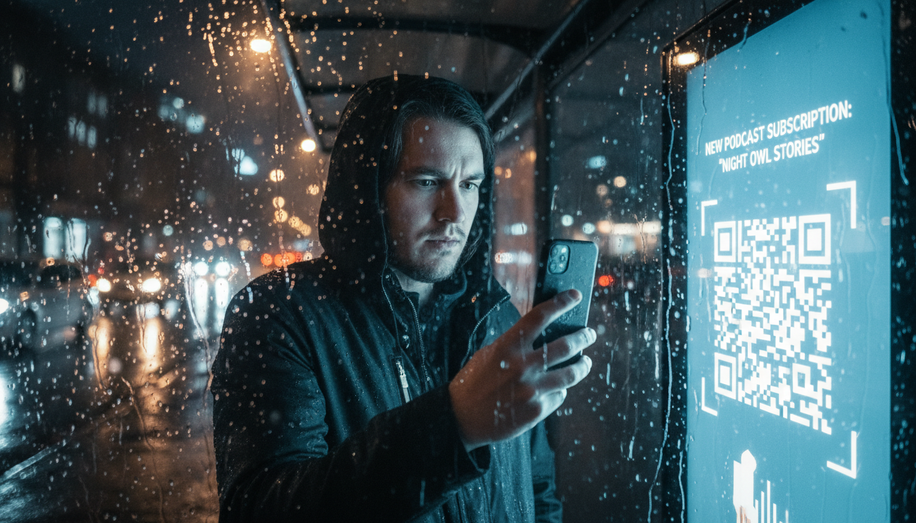

In the bustling corridors of urban life, where commuters scroll through apps amid the hum of city streets, out-of-home (OOH) advertising has evolved from a passive billboard into a dynamic discovery engine, propelling users straight from physical encounters to digital downloads and subscriptions. No longer confined to brand awareness, OOH now bridges the tangible world of posters and screens with the intangible realm of app stores and streaming platforms, leveraging immediacy and interactivity to convert fleeting glances into lasting engagements. This transformation is fueled by strategies that capitalize on OOH’s unskippable presence—immune to ad blockers and pop-ups—prompting 65% of consumers to search online immediately after exposure, with 40% visiting a website or brand within minutes.
At the heart of this physical-to-digital pivot lies the QR code, a simple yet potent gateway that has redefined OOH’s call to action. Scanned by smartphones at bus stops, subway platforms, or retail hubs, these codes deliver users instantly to app download pages or subscription funnels, bypassing search friction. QR-based OOH campaigns boast conversion rates of 0.5% to 4%, depending on placement, and double to quadruple response rates compared to print equivalents. A fast-food chain’s three-month push across 10,000 digital screens at transit points generated over 20 million monthly impressions, resulting in a 15% surge in app downloads and a 20% sales lift for new menu items as scanners landed on a microsite with exclusive offers. Placed near “activity zones” like shopping districts or campuses, these ads amplify mobile app installs by catching audiences in high-intent moments, when devices are already in hand.
Digital out-of-home (DOOH), now comprising two-thirds of OOH spend, supercharges this immediacy with real-time interactivity and animation that demands attention. Unlike static prints, DOOH’s animated or interactive elements—think pulsing buttons or gamified prompts—drive 76% of viewers to take action, from website visits to purchases. Teens and Gen Z, steeped in social sharing culture, are particularly responsive, sharing DOOH content that boosts virality and secondary digital touchpoints. Pairing DOOH with mobile yields a 38% uplift in engagement, making it ideal for app promotions where exposure data links directly to in-app events. Telecom brands, for instance, integrate DOOH with carrier promotions to track impressions to subscriptions, using location-triggered messaging that syncs with SIM activations and in-store footfall.
Beyond direct scans, OOH ignites branded searches and multi-channel synergy, turning ambient exposure into deliberate discovery. Nearly half of consumers (46%) search for a brand online post-OOH sighting, while 26% head straight to websites, nudging them toward app stores or sign-up pages. This offline spark delivers 10% to 50% increases in branded search volume, with search campaigns seeing 20% to 40% lifts when OOH supports them. For streaming services and podcasts, OOH builds “mental availability” that complements TV or TikTok efforts, yielding 15% to 40% performance gains. Holt Renfrew’s DOOH campaign across 200 urban screens, measured via mobile exposure radii, drove nearly 400,000 store visits at a 7% weekly rate—proof that similar tactics can funnel traffic to digital equivalents like app-based loyalty programs.
Measurement tools have demystified this bridge, providing advertisers with attribution once elusive in OOH. Platforms now deliver in-flight analytics for app downloads, in-app purchases, and subscriptions by geo-validating exposed audiences against digital behaviors. Sales lift studies compare exposed versus control zones, isolating OOH’s incremental impact—essential for performance marketers proving ROI on subscription drives. Programmatic DOOH adds precision, enabling real-time optimizations based on audience signals, weather, or events, while privacy-compliant data extends reach to mobile retargeting. These capabilities have propelled OOH’s global market toward $58.8 billion by 2034, with digital formats accelerating at over 10% CAGR.
Yet, the true power of OOH as a discovery engine lies in its contextual relevance. Ads timed for rush hour or near universities prompt podcast subscriptions by evoking immediate curiosity—”Tune in now via app”—while transit screens tease streaming trials with “Scan for free episode.” This ambient persuasion fosters trust, outperforming online-only campaigns, and primes paid social by increasing familiarity. In a fragmented media landscape, OOH’s mass reach—98% weekly exposure in markets like the UK—ensures no one misses the spark.
As brands chase direct response in apps and streams, OOH stands out for its ability to command undivided attention in the real world, channeling it seamlessly online. With costs per impression often lower than TV or video, and annoyance scores far below digital interrupts, it’s no wonder OOH is reclaiming its role not just as a broadcaster, but as the ignition for digital conversions that stick. In this hybrid era, the billboard isn’t shouting—it’s handing over the phone.