
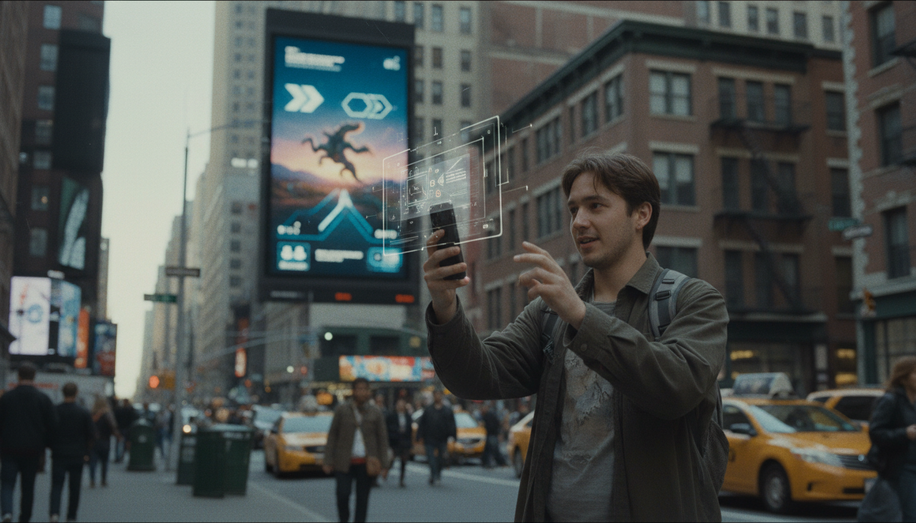

In the bustling heart of a city, a static billboard catches the eye of a hurried pedestrian. But with a quick scan of a smartphone camera, that flat image bursts into life—holograms dance, virtual flames erupt, or fantastical creatures emerge from the screen, pulling the viewer into an immersive world. This is the power of augmented reality (AR) overlays transforming out-of-home (OOH) advertising from passive displays into dynamic, interactive encounters.
Once limited by technology and cost, AR in OOH has exploded in accessibility thanks to web-based platforms and spatial computing. Digital screens replacing traditional billboards now serve as gateways to AR experiences, triggered by QR codes or simple camera scans, no app download required. Marketers can turn any urban surface—a subway poster, bus shelter, or city mural—into a portal for branded storytelling, fostering deeper emotional connections than conventional ads ever could. Users receive instant feedback, like seeing their virtual blood donation save a life in the NHS campaign, creating lasting positive associations.
Burger King’s audacious “Burn that Ad” campaign in Brazil exemplifies this disruptive potential. Spotting a rival’s billboard, such as McDonald’s, consumers fired up the BK app to point their phone and watch AR flames consume the competition, revealing a Whopper coupon in its place. The stunt drove one million app downloads in a month and boosted in-app sales by 56.4 percent, proving AR’s knack for virality and direct action.
Pepsi Max’s “Unbelievable” bus shelter in London took immersion to street-level theater. Commuters peering through what looked like ordinary glass saw AR overlays of UFO invasions, asteroid showers, and tentacled monsters rising from the pavement, all synced to a live street feed. The campaign amassed over six million YouTube views and became one of the platform’s top ads, blending surprise with shareability to amplify social buzz.
More recent innovations highlight AR’s evolution toward seamless, app-less integration. Red Bull promoted its World Series Cliff Diving with WebAR on the 8th Wall platform; scanning a QR code let users witness a vertigo-inducing 70-foot dive from their phone, capturing the event’s scale without attendance. Similarly, BON V!V Spiked Seltzer placed QR-triggered vending machines in Los Angeles and San Diego murals, where passersby tapped to summon a 3D model stocked with virtual cans, merging retail fantasy with real-world promotion.
Even wine brands are pouring into AR OOH. Jackson Family Wines’ Siduri campaign, crafted with Rock Paper Reality and Microsoft’s Mixed Reality Capture Studio, brought founder Adam Lee as a photorealistic hologram to in-store billboards and bottles. A QR scan unleashed interactive chats with the winemaker, elevating a simple aisle ad into a personal encounter.
Financial services aren’t left behind. Ally Bank’s Monopoly-themed treasure hunt spanned 36 game-board squares across six U.S. cities. Scanning revealed Mr. Monopoly dispensing AR points and cash prizes, drawing 100,000 plays with 86 percent completion rates— a masterclass in gamification that demystified banking while entertaining.
Transit hubs and stations amplify these effects. National Geographic’s Rotterdam campaign let commuters “step into” AR adventures—playing with dinosaurs or spacewalking—via digital screens, marking the society’s 125th anniversary with unforgettable escapism. Vodafone’s AR billboards and murals create “surprise and delight” moments, dominating public spaces with immersive visuals that redefine engagement metrics.
Fast fashion and beauty brands push boundaries too. Maybelline’s world’s-largest AR mirror at Kyiv’s Gulliver Mall spanned 4,000 square meters, letting shoppers virtually try mascara in real-time, turning a mall screen into a personalized try-on station. Ralph Lauren transformed Times Square into a pulsating FOOH (fixed out-of-home) spectacle for Polo 67 fragrance, capturing New York’s energy through dynamic AR layers.
These campaigns underscore AR’s tangible ROI: heightened dwell time, social shares, app installs, and sales lifts. By overlaying digital interactivity on physical OOH, brands bridge the gap between sight and participation, making ads not just seen but lived. Challenges remain—technical glitches in varying light or device compatibility—but advancing web AR minimizes barriers, positioning it as OOH’s next frontier.
As cities digitize, expect AR overlays to proliferate, from transit ads in subways to holographic retail portals. The result? OOH evolves from background noise to foreground conversation, where a glance sparks an adventure, and every scan sells a story.