
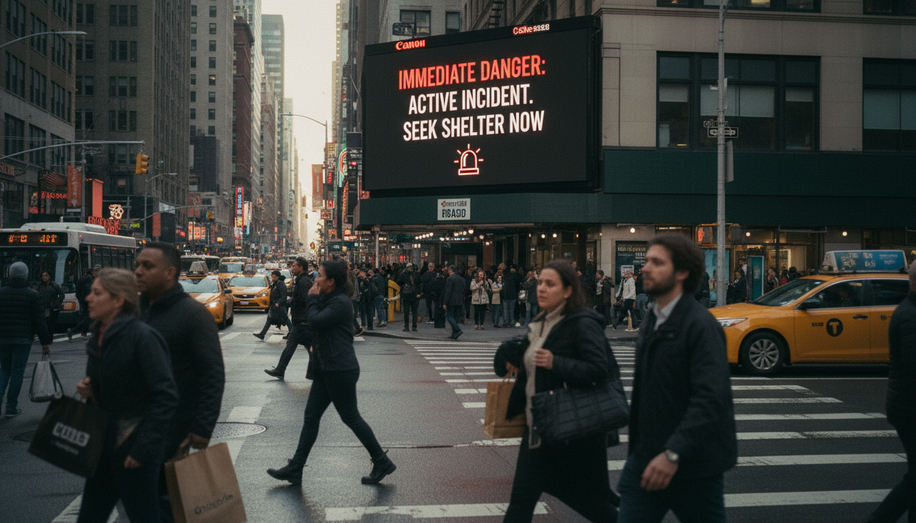

In the shadow of disaster, when digital notifications flicker unnoticed amid the chaos of smartphones and social feeds, out-of-home (OOH) advertising stands as an unyielding beacon, delivering urgent public safety messages to millions in real time. Towering billboards, transit wraps, and digital displays command attention on highways, streets, and public squares—precisely where panicked drivers, evacuating families, and shelter-bound pedestrians need guidance most. This physical immediacy has proven indispensable during hurricanes, pandemics, and public health emergencies, transforming OOH from a commercial tool into a lifeline for crisis communication.
The Federal Emergency Management Agency (FEMA) has long recognized OOH’s strategic value, partnering with billboard operators to flash weather warnings, evacuation routes, and shelter locations across storm-prone regions. During major hurricanes, these displays cut through power outages and overloaded networks, reaching 98 percent of drivers stuck in traffic or pedestrians at bus stops—dwell times that force engagement when every second counts. Unlike scrollable apps or buried alerts, OOH’s permanence ensures messages linger, embedding critical instructions subconsciously as people navigate gridlock or flee rising floods.
Public health crises amplify OOH’s role even further. The COVID-19 pandemic showcased its power through public-private collaborations, where digital billboards updated in real time with vaccination sites, mask mandates, and testing locations. Cruise lines like Royal Caribbean, battered by the Centers for Disease Control’s “No Sail Order” and branded as “floating petri dishes,” countered with OOH campaigns blanketing airports, ports, and urban arteries. Ads proclaimed enhanced cleaning protocols, testing regimes, and ventilation upgrades, restoring passenger confidence at key decision points and stabilizing an industry on the brink of collapse. This visible accountability not only saved brands but also reinforced broader public safety messaging, coaxing hesitant commuters toward safer behaviors.
OOH’s lifesaving potential shines in viral threats too. When the Tide Pod Challenge spurred teens to ingest laundry detergent in a reckless social media stunt, Procter & Gamble unleashed a rapid OOH blitz. Digital billboards and bus shelters near schools and malls featured NFL star Rob Gronkowski warning, “Use Tide Pods for washing, not eating,” amplifying platform takedowns and earned media to curb hospitalizations. The street-level presence pierced online echo chambers, protecting vulnerable youth where digital fatigue failed. Similarly, during the 1982 Tylenol tampering crisis, Johnson & Johnson’s recall messages dominated major thoroughfares, signaling transparency and rebuilding trust so effectively that the brand recaptured 30 percent market share within months.
Natural disasters underscore OOH’s impartial reach for government alerts. In wildfire-prone California or flood-ravaged Midwest states, amber alerts and evacuation orders rotate dynamically on geo-targeted digital screens, fed by real-time data from emergency services. Nigeria’s Outdoor Advertising Association ranks OOH second only to television in prompting immediate action—ideal for crises demanding compliance, like sheltering in place or avoiding contaminated zones. Modern advancements fuse OOH with programmatic precision: geotargeting pinpoints affected areas, as seen when grocery chains alerted nearby customers to food safety recalls without sparking widespread panic. Chicago experiments demonstrated this uplift, with strategically placed screens driving 45,000 responses; scaled to evacuations, the impact could save countless lives.
Critics question OOH’s efficacy in ad-saturated cities, fearing message overload, but data refutes this: its forced visibility yields higher notice rates than fleeting digital ads, especially when integrated with mobile follow-ups. Viewers of OOH campaigns are 17 percent more likely to engage brands via phone, turning awareness into action. During recovery phases, this resonance rebuilds emotional trust—Royal Caribbean’s safety pledges lingered on daily commutes, embedding reassurance amid uncertainty.
Environmental emergencies further highlight OOH’s equity. Austin Resource Recovery’s 2021 composting campaign slashed contamination by over half through year-long billboards, benches, and transit ads tailored to diverse neighborhoods, proving OOH drives behavior change across socioeconomic lines. A PLOS Climate study affirms creative OOH boosts engagement on climate messaging, with larger displays earning significantly more interaction than digital alone—vital as wildfires and floods intensify.
Yet OOH thrives not in isolation but through crisis-ready infrastructure. Public-private partnerships preload digital networks for instant swaps: flu shots one hour, tsunami warnings the next. Real-time monitoring tools, akin to those in advertising crisis plans, enable swift updates, minimizing reputational or human costs. As climate volatility and geopolitical shocks escalate, OOH evolves from luxury to resilience infrastructure—unpowered by grids yet amplified by data, bridging fleeting online discourse with enduring public safety imperatives.
In an age of information overload, OOH’s bold, etched-in-steel presence ensures urgent alerts rise above the noise, guiding societies through peril with unmatched reliability.