
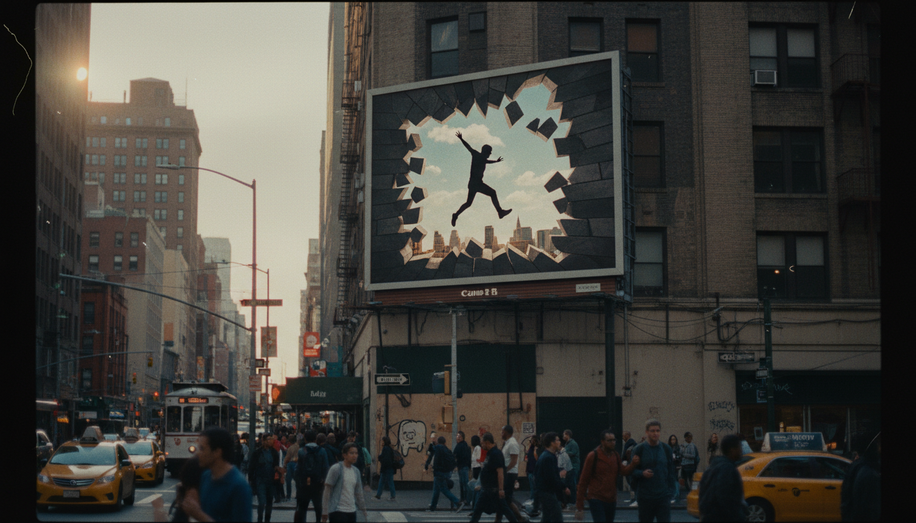

In the fast-paced world of out-of-home advertising, where drivers glance for mere seconds and pedestrians navigate urban chaos, static billboards must wield extraordinary power to pierce the visual noise. Enter the static masterpiece: traditional OOH creatives that harness optical illusions, forced perspective, and negative space to forge illusions of depth, motion, and intrigue without a single pixel flickering or LED glowing. These techniques transform flat vinyl into dynamic experiences, proving that ingenuity, not technology, remains the ultimate captivator.
Optical illusions form the bedrock of this renaissance, tricking the brain’s survival-wired instinct to detect movement and depth. Designers simulate motion on still surfaces through directional lines, repetition, and blurred edges, creating a sense of speed and flow that mimics cinematic action. A beverage can with streaking water droplets or an athlete’s limbs dissolving into dust trails implies explosive energy, drawing the eye across the board in rhythmic progression. This isn’t mere artistry; it’s psychology in action. The human brain, attuned to motion for predator detection, latches onto these cues amid highway blur, boosting visibility and recall in environments where digital screens dominate.
Forced perspective elevates this further, manipulating scale and angles to make objects leap from the plane. By distorting images—stretching them unnaturally for a specific vantage point—the illusion of three-dimensionality emerges when viewed head-on. Shadows, highlights, and vanishing points reinforce depth cues, fooling binocular disparity: the slight offset between each eye’s view that our minds fuse into solidity. Static 3D billboards, often called anamorphic wonders, employ this without screens; a towering figure appears to burst forward, interacting with passing traffic as if defying gravity. Consider a product scaled massively in the foreground against a receding background—the brain perceives layers where only ink lies, enhancing storytelling and immersion.
Negative space, the often-overlooked void, amplifies these effects with elegant restraint. Rather than cluttering every inch, savvy creators embrace emptiness to sculpt focus and ambiguity. A bold silhouette of a car against vast white expanse uses surrounding negativity to imply velocity, the mind filling gaps with imagined motion. Or picture a watch face where the dial floats amid infinite black, its edges sharpened by absence, compelling viewers to pause and decode. This technique leverages Gestalt principles—the brain’s tendency to organize incomplete visuals into wholes—making ads memorable through cognitive engagement. In high-clutter zones like city squares, negative space cuts through, anchoring the brand message amid simplicity.
These methods shine in strategic contexts. For motion-tied products like energy drinks or automobiles, simulated speed via lines and blur captures fleeting glances on freeways. Forced perspective thrives in pedestrian-heavy spots, where optimal angles align with foot traffic, extending illusions into real-world interplay—a wolf snarling from the board seems to eye passersby. Negative space suits long-term campaigns, rewarding repeat exposures as commuters unravel layered meanings. Yet success demands precision: test at full scale, as subtleties vanish from afar; prioritize contrast for legibility; limit to one dominant trick per board to avoid overload.
Real-world triumphs underscore the potency. Burger King’s molded flame billboard uses physical cutouts and shadows for fiery depth, while static anamorphic campaigns distort gems or tigers to erupt from frames, garnering millions in earned media. Even non-digital builds, like physically altered edges creating pop-out effects, prove cost-effective alternatives to LEDs, broadening access for brands.
Critically, these static innovations counter digital fatigue. In an era of scrolling feeds, OOH’s physicality offers tangibility, and illusions amplify it without power sources. They demand viewer participation—shifting angles reveal the magic—fostering deeper connections than passive screens. Challenges persist: weather erodes vinyl illusions, and poor installation foils perspectives. Yet best practices mitigate this—anchor calls-to-action centrally, ensure scalability, and blend with environments for contextual punch.
As OOH evolves, the static masterpiece reasserts dominance. By wedding optical illusions, forced perspective, and negative space, advertisers craft not just ads, but perceptual events. These techniques remind us: in a world craving novelty, the most captivating visuals often emerge from stillness, ingeniously bent to life’s rhythm.