
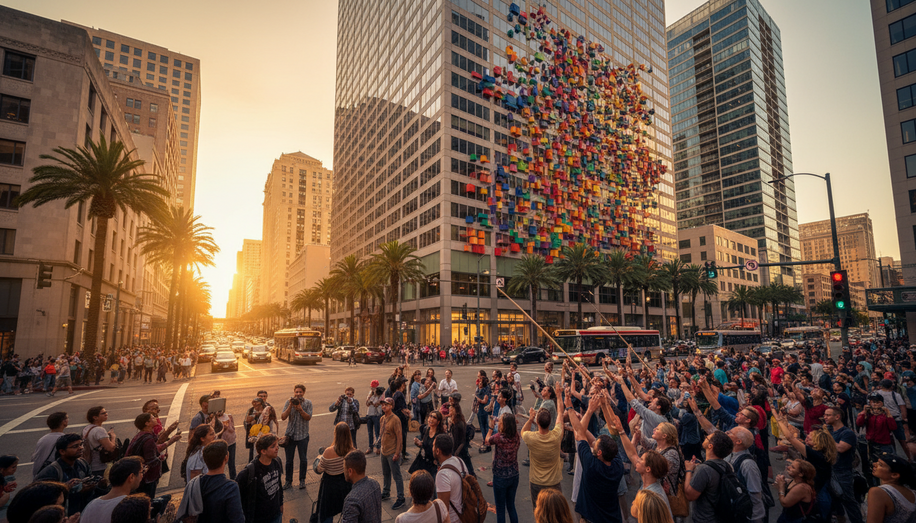

In an era dominated by glowing screens and augmented realities, out-of-home advertising is rediscovering its analog roots, proving that physical ingenuity can forge deeper connections with audiences. Campaigns that invite touch, provoke emotion, or hijack everyday spaces without a single pixel are not only captivating but also enduringly effective, turning passive passersby into active participants.
Consider Primark’s “Walking Billboard” at the King of Prussia Mall near Philadelphia, a bustling American shopping hub. To celebrate a flagship store reopening, the brand distributed oversized shopping bags emblazoned with bold Primark branding, challenging shoppers to carry them through the mall for a chance to win a $500 shopping spree. What began as a simple incentive evolved into a spectacle: participants paraded like human billboards, drawing crowds and paparazzi hired by the campaign to amplify the celebrity-like buzz. Shoppers didn’t just see the ad—they embodied it, feeling the weight of the bags while associating Primark with affordable glamour and excitement. This tactile interaction blurred the line between consumer and promoter, creating organic buzz in a physical space where digital fatigue holds no sway.
Equally visceral was the Frankfurt Fire Department’s stark warning against venturing onto frozen waters. Realistic images of people trapped beneath ice sheets appeared on public surfaces near lakes and rivers, so lifelike they sent chills through onlookers. By simulating peril without words or tech, the installation forced viewers to confront the danger viscerally—imagining the cold grip of ice, the struggle for breath. Laws and signs had failed to deter fatalities, but this ambient shock therapy resonated, leveraging human empathy and fear to drive home a life-saving message. It’s a masterclass in sensory design, where the ad’s power lies in its unfiltered realism.
Engie’s “Solar Graffiti” in Mexico City’s crime-ridden Álvaro Obregón District took environmental and social activism to luminous heights. Local graffiti artists applied solar-powered films to walls, crafting murals that glowed at night using nothing but sunlight harvested by day. In a neighborhood plagued by nightly assaults—one every 25 minutes—and robberies, these free, renewable light sources transformed a dark corner into a beacon. Within four months, crime in that spot vanished, and the area became a local talking point. Far from mere decoration, the graffiti served a dual purpose: illuminating paths to deter danger while promoting clean energy. This clever fusion of art, utility, and ambient placement showed how physical innovation can yield measurable societal impact, all powered by nature itself.
Public Inc.’s campaign for Toronto’s Center for Independent Living (CILT) employed a brilliantly subversive tactic at transit shelters. A glass door sealed one shut, stranding riders outside while a poster inside queried, “Feeling left out?” Below, it revealed that over 400,000 Torontonians with disabilities experience exclusion daily. Denied entry to what should have been a refuge, commuters tasted a sliver of that isolation firsthand. The momentary frustration sparked empathy, making the message unforgettable. By physically manipulating a familiar space, the ad turned inconvenience into insight, proving that experiential disruption can outshine any screen-based appeal.
Visit Flanders commemorated World War I soldiers with a statue sculpted from battlefield mud and sand, erected in the scarred fields of Flanders. Rain slowly eroded it, dissolving the figure back into the earth within days—a poignant metaphor for fleeting lives lost. This ephemeral installation revived collective memory without fanfare, generating 3.6 million in earned media, 21 million Twitter impressions in its first week, and reaching over 100 million people across 65 countries. Tourism to Flanders Fields rose 9% the following year. Here, ambient media harnessed weather as a co-creator, blending history, nature, and transience into a silent yet global conversation.
These examples underscore a timeless truth: the most engaging OOH doesn’t demand gadgets but exploits the physical world—the heft of a bag, the bite of simulated cold, the glow of sunlight, the slam of a door, the dissolve of rain. In high-traffic zones or overlooked nooks, such campaigns command attention through surprise and participation, fostering shareable moments that ripple organically. Ambient executions like these boast 68% higher engagement than traditional ads and boost brand recall by 30%, as they embed messages into lived experiences.
As urban landscapes grow denser and digital noise louder, non-digital OOH offers a counterpoint: authentic, multisensory encounters that linger. From deterring crime with sunlight to dissolving statues that honor the fallen, these activations remind us that creativity thrives when it meets the world head-on, no screens required. Brands embracing this analog renaissance not only stand out but redefine interaction, proving physicality remains advertising’s most primal force.