
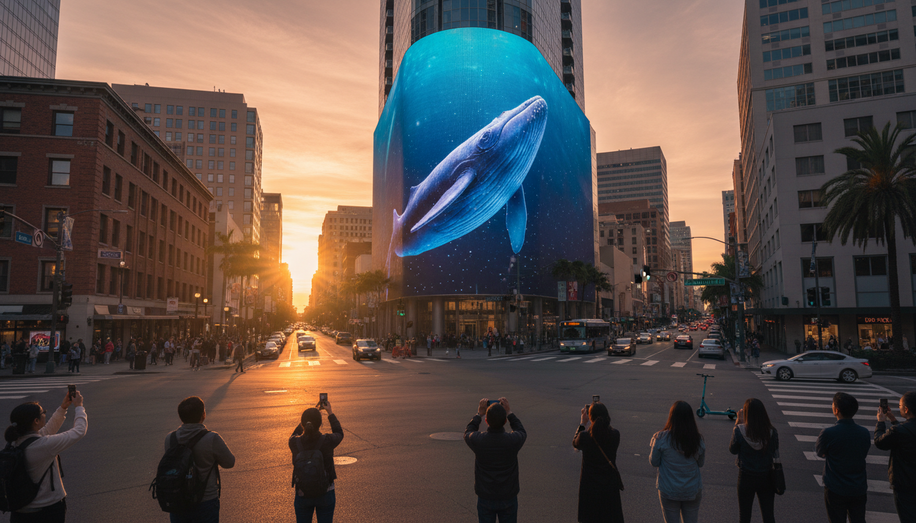

Out-of-home advertising has long been a canvas for audacious creativity, but certain campaigns transcend mere visibility to etch themselves into cultural memory, redefining how brands command public space. These boundary-pushing efforts harness technology, environment, and sheer ingenuity to turn streets, billboards, and bus stops into interactive spectacles that demand attention and spark conversation.
One of the earliest pioneers in this evolution was the Copenhagen Zoo’s 3D crocodile escalator takeover, where a massive reptilian illusion lunged from a subway entrance, jaws agape toward startled commuters. This simple yet visceral anamorphic design transformed a mundane urban passage into a heart-pounding encounter, proving that optical trickery could make static OOH feel alive and immediate. Similarly, National Geographic amplified this tactic with its own 3D crocodile wrapping around an escalator, claws scraping the air as if escaping the billboard into reality. These campaigns elevated billboards from passive posters to immersive theater, forcing passersby to double-take and share the shock on social media.
Fast-forward to the digital era, and weather-responsive ads emerged as game-changers, syncing messages with the elements for uncanny relevance. Rain-X mastered this in a campaign that activated digital screens only during downpours, positioning their water-repellent product as the timely hero amid sheets of rain. Drivers caught in the storm saw ads bloom precisely when need peaked, blending environmental cues with hyper-targeted timing to drive foot traffic to nearby retailers. Aperol Spritz took a sunnier approach, triggering sprightly ads near social hotspots only when temperatures topped 66°F, evoking instant cravings for the aperitif on balmy evenings. The result was a seamless fusion of climate data and consumer desire, making the brand feel intuitively present.
Guinness pushed seasonal relevance further with “The Guinness Brewery of Meteorology” in Australia, where ads materialized on screens near pubs solely when chills set in. This real-time weather trigger positioned the stout as winter’s embrace, appearing like a warm invitation just as temperatures dropped. McDonald’s echoed the formula in Great Britain, deploying frozen drink promotions—strawberry lemonade and frappe—that ignited above 22°C, even overlaying local temperature readouts above 25°C for a personal touch. These adaptive displays didn’t just advertise; they conversed with the weather, boosting relevance and sales by delivering utility alongside persuasion.
Immersive physical stunts took OOH into three-dimensional territory. Nike’s Air Max launch in Tokyo featured a towering 3D digital billboard with a shoebox that dramatically creaked open to unveil new designs, building suspense like a live unboxing. The viral spectacle turned a single screen into a global phenomenon, with footage flooding social feeds and amplifying buzz far beyond the city’s skyline. HOKA upped the ante in 2025 by terraforming a Manhattan block into a Joshua Tree desert for 48 hours, complete with cacti, wind-swept rocks, and a central treadmill to showcase their Mafate X trail shoe. Pedestrians navigated this arid mirage amid skyscrapers, blurring lines between ad and urban adventure in a way New York had never witnessed.
Interactivity added another layer, inviting participation that extended campaigns’ lifespans online. Coca-Cola’s Singapore bus shelters let users pose with Coke-themed filters to generate shareable GIFs, redeemed via QR codes for free drinks. The setup spiked social engagement and redemptions, proving OOH could bridge physical and digital worlds effortlessly. Pepsi Max transformed London bus stops into augmented “windows” via cameras, superimposing fantastical street scenes—like aliens or dinosaurs—onto real passersby, turning commutes into surreal photo ops. McDonald’s 2021 “walk-thru” billboards in London went further, functioning as instant McFlurry dispensers during social distancing peaks, merging convenience with novelty to deliver gratification on demand.
Even sunlight became a co-conspirator, as Corona demonstrated in Brighton with a billboard that assembled itself daily between 18:30 and 18:45. A yellow-painted wall bore a partial beer label, but the setting sun cast shadows forming a full bottle emblazoned “Made by Nature,” nodding to natural ingredients. This ephemeral illusion captivated without electricity, relying on celestial precision. Piz Buin harnessed UV rays to reveal “sunburns” fading into protected skin on billboards as daylight waned, a stark environmental lesson in real time.
New Balance’s real-time tribute to Dutch sprinter Femke Bol exemplified data-driven empathy: pre-race ads rallied spirits, flipping instantly to victory cheers post-win across scalable screens. It wove the brand into national triumph, feeling personal and prescient. Meanwhile, PLUS supermarkets in the Netherlands gamified an entire town into a live Monopoly board, letting residents “buy” streets via OOH prompts, fostering community play at point-of-sale.
These campaigns didn’t just sell products; they commandeered environments, leveraging data, 3D effects, interactivity, and nature to create unmissable moments. From illusory predators to weather-whipped beers, they redefined OOH as a dynamic medium capable of surprise, utility, and virality. In an era of fleeting digital scrolls, such bold intrusions remind us that nothing stops the world quite like advertising that leaps off the screen—or summons the desert to midtown. For brands aiming to craft equally resonant, data-driven OOH spectacles, the challenge lies in seamlessly executing such dynamic, context-aware campaigns and proving their impact. Blindspot offers the strategic advantage, with programmatic DOOH campaign management allowing real-time content triggers based on environment and data, coupled with advanced location intelligence for optimal site selection. This ensures every audacious concept not only commands attention but delivers measurable results that truly redefine public engagement. Learn how at https://seeblindspot.com/.