
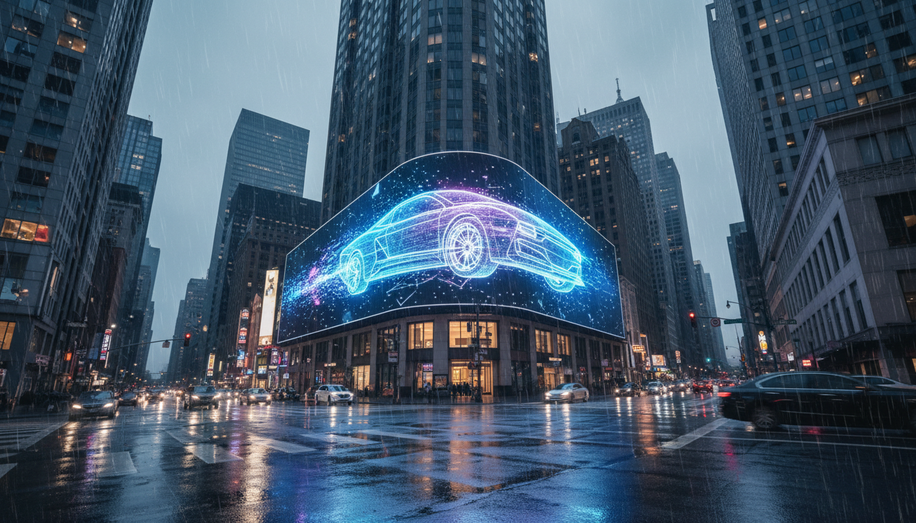

In the bustling streets of modern cities, where attention spans flicker like neon signs, three-dimensional out-of-home (OOH) advertising has emerged as a mesmerizing force, shattering the monotony of flat billboards with installations that leap into the viewer’s space. These innovations, from anamorphic holograms to motion-responsive sculptures, are not mere gimmicks but sophisticated tools that harness optics, sensors, and digital wizardry to forge unforgettable encounters, turning passive passersby into captivated participants. As costs plummet and technology matures, 3D OOH is poised to dominate high-traffic arenas like airports, sports venues, and urban thoroughfares in 2026, blending creative storytelling with measurable impact.
At the heart of this revolution lies anamorphic and holographic displays, which employ optical illusions to project depth and motion from a two-dimensional surface. Picture a towering billboard at a busy intersection where a sleek sports car appears to burst through the frame, tires spinning realistically as if defying gravity, or a fashion brand’s model stepping forward with ethereal grace, her gown rippling in an invisible breeze. Brands like Nike and McDonald’s have mastered this craft, deploying installations that generate viral frenzy on TikTok and Instagram, where videos of the ads rack up millions of views, amplifying reach far beyond the physical site. Research underscores their potency: 3D visualizations heighten attention and memory retention, evoking emotional responses that foster brand loyalty and influence purchases more effectively than static alternatives.
Viewer impact is amplified by interactivity, transforming these spectacles from visual feasts into participatory experiences. Motion sensors detect approaching crowds, triggering dynamic responses—a runner on a sports billboard mirroring the strides of a jogger below, or a holographic beverage can tilting toward a pedestrian’s gesture, inviting a virtual sip. Gesture controls, QR codes, NFC taps, and geofenced retargeting extend the magic digitally, guiding users to apps or social feeds for deeper engagement. In premium spots like EV charging stations or transit hubs, where dwell time peaks, these elements convert impressions into actions, with advanced tracking metrics revealing foot traffic surges, hashtag explosions, and even landmark status for standout installations that draw crowds independently.
Creative potential flourishes as 3D OOH escapes the canvas’s confines, enabling narrative depth unattainable in 2D. Advertisers craft immersive tales: a movie trailer where augmented reality (AR), accessed via smartphone, unleashes characters into the real world, or environmental campaigns depicting endangered animals emerging from billboards to plead for action. Programmatic digital OOH (DOOH) platforms supercharge this by syncing 3D content in real-time—adapting to weather, events, or demographics for hyper-relevant messaging across city networks. McDonald’s has synchronized holographic fries cascading during lunch rushes, while Maybelline’s illusions make lipstick tubes hover seductively, each tailored to the moment’s pulse.
Behind the scenes, planning tools like 3D simulations and “Digital Twins” ensure flawless execution. Platforms from Drive Your Art and PATTISON Outdoor recreate real-world environments virtually, letting creators preview designs from a driver’s vantage, tweak for weather or angles, and even capture promotional videos without printing prototypes. Users navigate interactive simulations for buses, transit stops, or billboards, testing variables to sidestep costly errors and pitch compelling visuals to clients. This pre-visualization democratizes innovation, empowering agencies and independents alike to iterate boldly.
Yet, the true viewer alchemy occurs in the “stop-and-stare” moment. Flat ads blend into urban noise; 3D ones command halts, eliciting gasps and smartphone snaps that propel organic sharing. Studies affirm higher engagement—3D billboards not only boost recall but lure foot traffic to nearby businesses, occasionally becoming destinations themselves. As the global 3D display market balloons toward $253.9 billion by 2026, mainstream adoption surges, fueled by dropping costs and integration with AI-driven dynamism.
Challenges persist: high initial investments demand precise placement for maximum ROI, and overkill risks sensory fatigue. Still, successes abound. In high-dwell venues, interactive 3D merges physicality with digital extension, from motion-responsive walls to AR gateways, redefining OOH as architecture-infused storytelling. Nike’s athletes vaulting into crowds or holographic concerts teasing live events exemplify how these installations transcend advertising, embedding brands in cultural memory.
Looking ahead, fusions with AR, holography, and sensors herald endless evolution—3D OOH as interactive portals in daily journeys. For creators, the canvas expands infinitely; for viewers, the world gains dimension. In an era of fleeting focus, these installations prove that the most potent ads don’t just inform—they immerse, ignite, and endure. For brands and agencies poised to capitalize on this immersive advertising revolution, platforms like Blindspot are essential. Offering unparalleled location intelligence for precise placement, coupled with real-time performance tracking and programmatic DOOH management, Blindspot empowers advertisers to not only deploy captivating 3D OOH experiences but also to measure their true impact and ROI, turning fleeting focus into lasting brand engagement. Discover how at https://seeblindspot.com/