
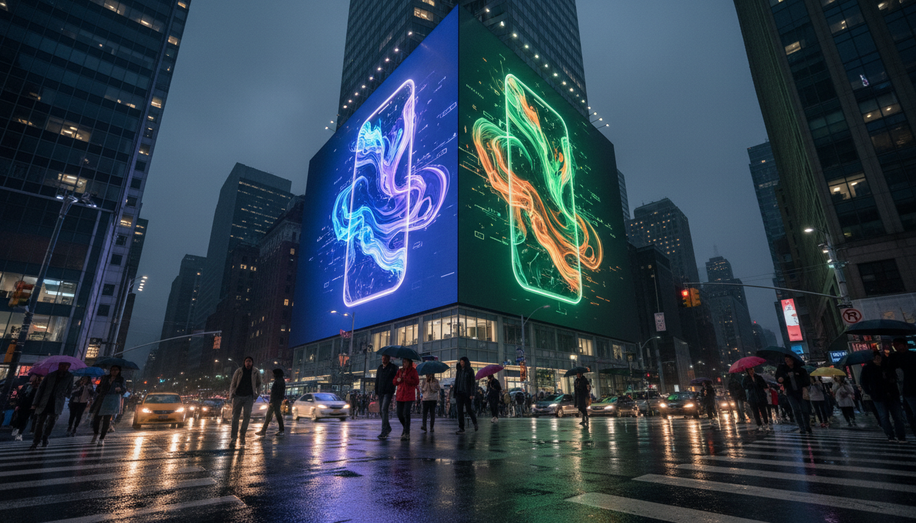

Out-of-home advertising has long operated in the shadow of digital channels, largely due to measurement challenges and the difficulty of isolating campaign impact. Yet A/B testing, a methodology refined across online platforms, is fundamentally reshaping how OOH practitioners optimize creative performance and demonstrate measurable returns on investment.
A/B testing, also known as split testing, involves creating two variations of an advertisement that differ in a specific element—whether headline, imagery, color scheme, call-to-action, or overall design—then measuring which version resonates more effectively with the target audience. In the OOH context, this means developing variant A and variant B for placement on similar billboard locations within matched demographic areas, then comparing performance metrics over equivalent time periods.
The methodology addresses a critical pain point for outdoor advertisers: the historical lack of robust audience data to feed into analysis. Traditional OOH campaigns operated largely on faith, with planners unable to definitively connect exposure to consumer action. Modern A/B testing frameworks, however, enable practitioners to move beyond assumptions and toward empirical evidence of creative effectiveness.
Pre-flight creative testing represents one dimension of this optimization process. By simulating real-world conditions before full campaign rollout, advertisers can assess whether visual elements are strong enough to stand out against competing stimuli—traffic, weather, competing advertisements, and environmental distractions. Testing reveals how long audiences engage with an ad, whether they comprehend the message at a glance, and how the creative performs across different environments, from urban landscapes to highways, in both direct sunlight and nighttime conditions. This reconnaissance work helps optimize designs for their intended contexts before committing budget to live placements.
The structured A/B testing process itself requires disciplined execution. Practitioners must first establish clear objectives: Are you driving foot traffic, generating leads, increasing phone calls, or building brand awareness? These goals determine which metrics matter. Next comes identifying the specific variable to test—a single element whose impact you wish to isolate. Then develop two distinct variants and deploy them to comparable audience segments across equivalent time periods. Throughout, data collection remains continuous, capturing relevant KPIs through web analytics, foot traffic attribution, or point-of-sale connections. Finally, statistical analysis determines the winner, and insights from that winner inform subsequent optimization iterations.
The power of this approach intensifies when combined with advanced measurement methodologies. Geolocation data and mobile ID tracking can determine which devices were near specific OOH placements, establishing clear “opportunity to see.” Point-of-sale integration enables advertisers to connect exposure directly to verified consumer transactions, creating granular insights into how OOH influences purchasing decisions. When A/B testing combines with such measurement infrastructure, the feedback loop becomes complete: creative variations can be tested not merely on engagement metrics, but on actual incremental sales lift.
This represents a fundamental shift in how the industry validates creative effectiveness. Rather than assuming direct causation from individual observations, modern measurement employs exposed versus matched control group methodologies—the same rigorous experimental design framework used in digital and television campaigns. This allows apples-to-apples comparisons across channels using proven metrics, elevating OOH from a brand-building mystery to a performance channel worthy of analytical rigor.
However, practitioners should approach A/B testing results with informed skepticism. Recent academic research has identified significant limitations in how experimentation platforms present results, cautioning that reported differences between ads may not fully capture true impact and that conclusions should not be drawn as casually as from balanced randomized experiments. The sophistication of measurement infrastructure matters enormously; testing conducted through online simulators differs substantially from live billboard testing with integrated purchase attribution.
For advertisers seeking alternatives to live testing, several companies now offer OOH A/B testing through internet-based platforms that show billboard variations to test groups and analyze responses without requiring live placements. This lowers barriers to entry and accelerates testing velocity, though it may sacrifice some real-world validity.
As OOH advertising matures toward measurable accountability, A/B testing emerges as the bridge between creative intuition and empirical validation. For media planners serious about demonstrating incremental ROI from outdoor investment, systematic testing of creative elements is no longer optional—it is foundational to competitive performance.