
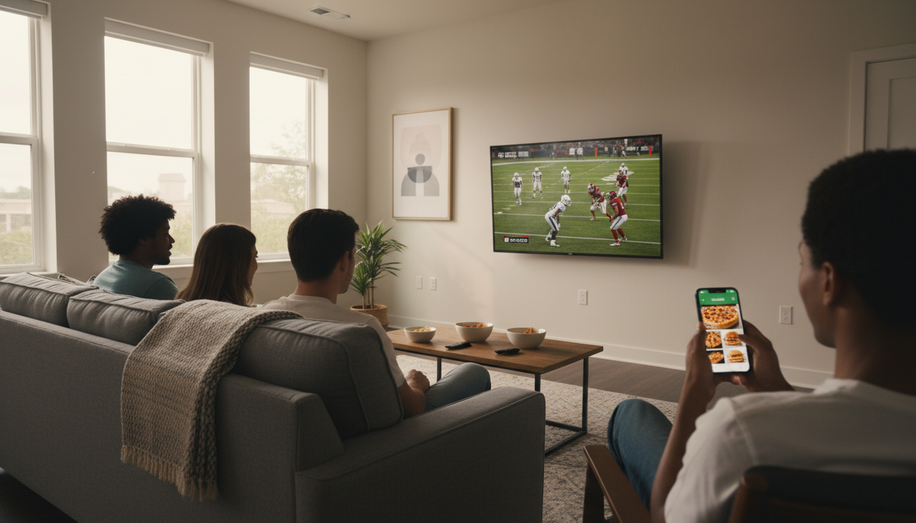

DoorDash, the popular food delivery service, has made the bold decision to forgo a Super Bowl 60 advertisement, opting instead for a robust social media campaign tied to the February 8, 2026, showdown at Levi’s Stadium in Santa Clara, California. This marks a significant shift for a brand that has become a familiar face during the Big Game’s national broadcast, having aired spots in four of the last five years. In an exclusive statement to Adweek, Gina Igwe, DoorDash’s vice president and head of consumer marketing, explained the rationale: the company is prioritizing real-time engagement on digital platforms where fans are already conversing during the game.
The choice reflects a strategic pivot amid escalating costs and evolving viewer habits in out-of-home (OOH) and broadcast advertising landscapes. Super Bowl ad inventory sold out months ago, with NBCUniversal commanding upwards of $8 million for a 30-second spot—a price tag that balloons when factoring in production expenses often exceeding $2 million to $5 million, celebrity endorsements, and post-game amplification efforts. DoorDash’s absence stands out in a fiercely competitive food delivery category, where rivals Uber Eats and Instacart have confirmed their participation, continuing Uber Eats’ streak into its sixth consecutive year with celebrity-driven humor. For DoorDash, this isn’t about retreat but redirection: “We assess our Super Bowl strategy every year based on where culture is moving and how people are actually engaging,” Igwe noted. She emphasized that while a 30-second TV spot remains potent, it represents only one slice of a larger ecosystem, with social media emerging as the “second screen” for live interaction.
Historically, DoorDash’s Super Bowl investments yielded high-profile results. Last year’s ad, crafted by Wieden + Kennedy Portland and the brand’s in-house agency Superette, featured comedian Nate Bargatze promoting the DashPass membership program. It contrasted sharply with the 2024 campaign, which ambitiously promised giveaways from every advertiser in the game, culminating in a Texas man claiming a $500,000 prize and earning the ad industry’s Cannes Lions Titanium Grand Prix. Those successes underscored the brand’s knack for blending humor, celebrity appeal, and interactivity—tactics now mirrored across the 2026 lineup, where over 30 brands have confirmed spots featuring trends like AI-generated visuals, deepfake celebrities, and augmented reality tie-ins.
Yet DoorDash’s social-first approach aligns with broader industry currents, particularly for OOH advertisers eyeing measurable ROI beyond linear TV. Super Bowl 60 hype is already building around Bad Bunny’s Apple Music-sponsored halftime show, drawing inevitable tie-ins from musicians, athletes, and influencers. Confirmed participants like OpenAI with a 60-second spot, Bosch marking a rare engineering category entry, and Skittles staging a live stunt at a fan’s home via Gopuff delivery signal a landscape favoring innovation over repetition. Uber Eats, for instance, plans on-site events alongside its ad, echoing DoorDash’s past experiential plays but amplifying them through broadcast reach. Instacart’s inclusion further heats the delivery wars, positioning DoorDash’s skip as a calculated bet on organic buzz.
Igwe hinted at “much more to come closer to kickoff,” suggesting the social campaign will leverage real-time conversations, user-generated content, and perhaps hashtag challenges or AR filters—formats that extend engagement far beyond the broadcast window. This mirrors post-Super Bowl amplification strategies costing another $1 million to $5 million, including digital buys and influencer partnerships, which many brands now deem essential for sustained impact. In an era of fragmented viewing across Peacock streaming and regional NBC feeds targeting markets like New York and Los Angeles, DoorDash’s focus on the “conversation unfolding during the game” could prove prescient, especially as younger demographics favor mobile over traditional TV.
For OOH specialists, DoorDash’s move underscores a pivotal tension: the Super Bowl’s unparalleled mass reach—bolstered by Super Bowl 59’s record viewership—versus the precision of digital channels. While TV ads guarantee exposure to millions, social platforms enable dynamic, data-driven interactions, from behavioral targeting to personalized messaging. Competitors like Svedka are pushing boundaries with AI collaborations, featuring Fembot and BroBot in spots blending human creativity with machine-generated elements, complete with dance contests for fan cameos. DoorDash, by sitting out the $8 million slot, frees resources for these extended ecosystems, potentially achieving higher engagement rates without the premium broadcast price.
Industry observers see this as emblematic of maturing Super Bowl strategies. Nostalgia, celebrity pairings (think Kylie Kelce for Dove or Victoria Justice for Svedka), and tech integrations dominate trackers, but skips like DoorDash’s highlight risk aversion in a high-stakes environment. As NBCU cashes in on sold-out inventory, brands must weigh fleeting glory against sustained cultural relevance. DoorDash’s gamble bets on the second screen’s immediacy, where fans dissect plays, halftime performances, and yes, the ads themselves in real time. If executed sharply, it could redefine success metrics for food delivery marketers, proving that sometimes, the best play is the one not run during the game.