
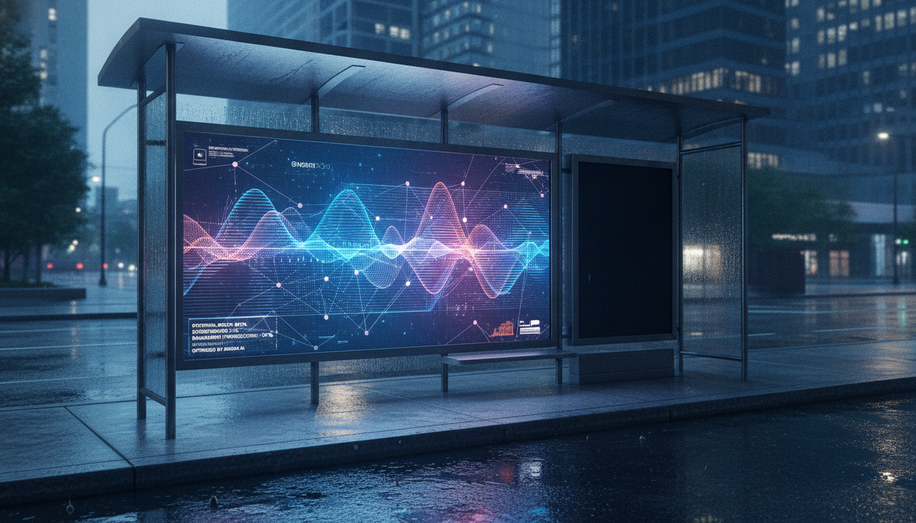

Modern Out-of-Home (OOH) and Digital Out-of-Home (DOOH) advertising demands immediate visual impact, as billboards must capture consumer attention in a matter of seconds. To avoid costly ad waste on ignored or unreadable screens, brands are increasingly turning to advanced predictive platforms that simulate human gaze behavior prior to launch. These AI-powered visual attention tools offer instant heat-mapping, readability scores, and eye-tracking simulations, allowing creative teams to optimize their designs and maximize brand visibility before campaigns ever go live in the physical world.
Neurons
Designed to take the guesswork out of creative testing, Neurons is a powerful consumer neuroscience platform that predicts user attention, emotional response, and cognitive load with over 95% accuracy. Built on the world’s largest proprietary eye-tracking and brain-scan database, the platform leverages advanced deep learning models to simulate how audiences perceive and process OOH and DOOH media in real-time. Marketers can instantly upload static designs or video assets to generate heatmaps, clarity scores, and focus trajectories, revealing within seconds if key copy or branding elements get lost. The system also offers actionable visual recommendations to help design teams optimize layout, contrast, and visual hierarchy.
Attention Insight
Specializing in pre-launch design analytics, Attention Insight uses a deep convolutional neural network trained on over 5.5 million eye fixations to generate predictive attention heatmaps. The platform features a dedicated testing model specifically trained on massive datasets of print and digital poster designs to accurately mimic how pedestrians and drivers engage with outdoor advertising. Users can quickly analyze OOH layouts to measure the precise percentage of attention captured by specific areas of interest (AOIs), such as logos, slogans, or calls to action. By offering instant clarity scores and side-by-side variation testing, the tool helps media buyers validate their creative strategy with objective data.
EyeQuant
Combining artificial intelligence with decades of neuroscientific research, EyeQuant provides instant predictive attention and visual clarity modeling for creative assets. The platform simulates human “System 1” processing—the subconscious, immediate visual reaction that occurs in the first three seconds of exposure—which is highly critical for high-impact OOH and transit media. Marketers upload billboards or digital screens to receive detailed heatmaps, luminance contrast maps, and readability scores that indicate how effectively an ad will cut through physical clutter. Through its automated analysis, the platform helps creative teams adjust design elements like size, color, and positioning to ensure maximum saliency.
expoze.io
Developed by neuro- and data scientists, expoze.io is an online attention prediction platform that allows advertisers to pre-test static and video marketing assets with 95% accuracy. The platform generates rapid, highly validated heatmaps without requiring participants, making it an agile choice for fast-paced DOOH campaign production. By utilizing customizable “Areas of Interest” (AOIs), design teams can quantify exactly how much visual attention key branding elements will secure in real-world street environments. The cloud-based software also integrates directly with existing design pipelines through robust APIs, enabling automated, high-volume testing of ad creative variations.
Dragonfly AI
By mimicking how the human brain and visual cortex process differences in light, contrast, and shape, Dragonfly AI offers predictive attention technology designed to optimize creative performance across physical and digital spaces. The platform assigns a numerical saliency value to every pixel of an uploaded image or video, generating real-time visual heatmaps that predict exactly where the viewer’s gaze will land in those crucial first milliseconds. For OOH advertising, Dragonfly AI provides “scene testing” capabilities that allow marketers to preview and evaluate ad designs within simulated real-world environments, such as on-street digital screens. This instant feedback loop helps brands maximize brand linkage and eliminate ad waste by ensuring critical messages are never ignored.
Lumen Research
As a pioneer in attention measurement, Lumen Research offers a predictive attention model trained on extensive real-world eye-tracking panels that go far beyond standard viewability metrics. The platform maps out visual engagement by calculating the precise probability of an ad being seen and the actual duration of visual attention, measured in “attentive seconds per thousand impressions.” For OOH and DOOH media planning, their technology simulates environmental factors like screen positioning, competing ads, and audience dwell times to forecast actual campaign performance. By translating visual design into outcome-linked attention metrics, the system enables advertisers to buy, design, and optimize outdoor creatives specifically for high-attention placements.
Final Thoughts
Optimizing OOH creative assets is no longer a matter of design intuition, but a measurable science driven by predictive AI. By utilizing advanced eye-tracking simulations and clarity scoring prior to campaign launch, advertisers can confidently deploy high-impact billboards that cut through real-world environmental clutter. Integrating these tools into the creative workflow ultimately drives stronger brand recall, higher engagement, and a far greater return on outdoor media investments.
Frequently Asked Questions
How accurate are predictive AI eye-tracking heatmaps compared to live human testing?
Most modern predictive AI attention models achieve between 90% and 95% accuracy when validated against real eye-tracking studies. These platforms are trained on millions of real-world human gaze points and visual fixations, allowing them to reliably simulate subconscious human visual processing in milliseconds. While they do not replace the deep qualitative insights of a live focus group, they offer a highly reliable and cost-effective alternative for rapid pre-launch creative optimization.
Can these AI tools analyze video files for DOOH screens or only static images?
Yes, several advanced platforms like Neurons, expoze.io, and Dragonfly AI fully support video analysis for digital out-of-home creatives. The AI processes these video files frame by frame to map out how attention shifts over time as the visual assets play. This allows design teams to ensure that key branding elements, logos, and call-to-actions are placed in high-attention zones at the exact moments they appear on screen.
Do these platforms take real-world environmental clutter into account when predicting OOH ad performance?
While some tools evaluate designs in isolation, leading platforms offer custom scene-testing features that allow you to analyze the ad creative within simulated physical environments, such as on a roadside billboard or in-store display. This context-aware modeling evaluates how surrounding elements, street architecture, and competing signage impact the overall saliency of the design. Additionally, some platforms integrate placement characteristics like screen size, viewing distance, and average scroll or travel speed into their predictive attention formulas.
How do these creative testing tools help improve overall ROI on OOH media buy?
By identifying design flaws, illegible copy, and overlooked call-to-actions before an ad is printed or uploaded, these tools help prevent wasted media spend on ads that go unnoticed. Ensuring that crucial branding elements are positioned in high-attention zones drastically improves brand recall, message clarity, and overall engagement. Ultimately, pre-testing your creatives ensures that every dollar spent on physical screen placements is fully optimized to capture actual consumer eyes.