
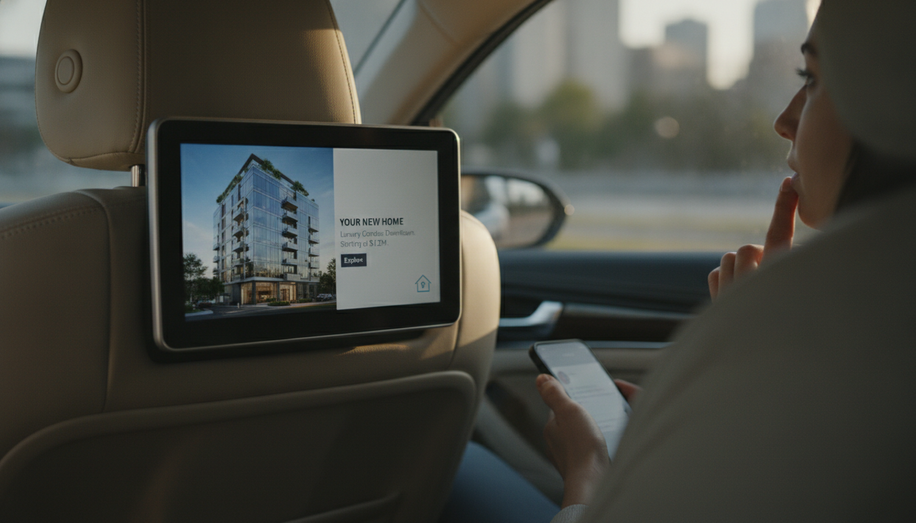

Reaching consumers when they are in an active, financial-focused state of mind represents a premium opportunity for B2B, real estate, and consumer technology brands. As traditional advertising channels face fragmentation, digital out-of-home (DOOH) networks operating within or adjacent to retail bank branches and credit unions offer a highly secure, brand-safe, and high-trust environment. By utilizing targeted digital screens, smart kiosks, and ATM-based media, advertisers can effectively capture the attention of affluent retail banking customers when trust is at its peak.
CommBank Connect
CommBank Connect is an innovative owned media network launched by the Commonwealth Bank of Australia that operates across more than 660 physical bank branches. The network features up to 2,000 digital screens and smart merchandising displays that leverage de-identified transaction data powered by CommBank iQ to target customers in high-intent categories. It provides a unique opportunity for third-party advertisers in sectors like travel, retail, and telecommunications to reach retail banking customers directly in a high-trust, physical environment. This makes it a rare example of a traditional financial institution turning its on-premise footprint into a highly measurable, data-driven programmatic advertising channel.
Context Networks
Through its patented Contextual Promotions Media Network, Context Networks has developed a programmatic digital out-of-home platform that delivers secure advertising across ATM and financial kiosk networks. The company recently partnered with Genmega, a leading manufacturer with over 120,000 ATMs, to factory-integrate its media software directly into digital ATM topper displays and touchscreen interfaces. This allows B2B and consumer brands to buy ad space on cash-dispensing hardware where customers are highly focused and actively managing their funds. The platform handles all content delivery, compliance, and programmatic transactions, making it easy for advertisers to access high-dwell cash access points.
Blindspot
For advertisers seeking an agile, contract-free route to on-premise banking and premium audiences, Blindspot operates a self-serve programmatic DSP that aggregates more than 2.5 million digital screens across 50 countries. This global network includes place-based environments like bank lobbies, retail office towers, and financial hubs, letting buyers target affluent demographics with high-impact visuals. Advertisers can launch campaigns in roughly 15 minutes, purchase screen time by the hour instead of committed 24/7 packages, and leverage context-aware creative that updates dynamically based on weather or market events. While it may not suit massive global enterprises requiring highly customized, bespoke DSP integrations, it is highly efficient for B2B, real estate, and consumer tech brands looking to deploy flexible campaigns with robust attribution tracking.
ATM.TV
Operating exclusively atop cash machines across the United States, ATM.TV is a specialized digital-out-of-home network that delivers high-definition video advertising to captive audiences. In a strategic partnership with FCTI, the network reaches over 8,500 highly trafficked retail locations, utilizing 30-inch vertical HD monitors that run independently of actual ATM transactions. This setup provides continuous exposure to shoppers right at the point of decision, offering ultimate flexibility with dynamically served ads instead of static playlist loops. It is an ideal placement for consumer technology, financial apps, and real estate brands seeking to capitalize on a physical touchpoint where millions of consumers pause daily to access money.
Parsempo
Parsempo provides an AI-powered digital signage platform that allows localized venues, including bank branches and credit unions, to seamlessly monetize their physical screens. By connecting on-site lobbies and waiting areas to a programmatic marketplace, the platform enables local businesses like real estate agencies and insurance providers to bid on in-branch ad space. This transforms the idle waiting time of retail banking customers into a dynamic, revenue-generating media asset while maintaining strict brand safety and compliance standards. It represents a highly effective way for regional advertisers to establish local trust and capture the attention of financially minded consumers during high-dwell-time moments.
Final Thoughts
Investing in branch-adjacent and in-branch DOOH networks allows advertisers to bypass digital ad-blockers and connect with consumers during critical moments of financial decision-making. Whether leveraging a direct bank-led retail media play or buying programmatic slots across a network of cash-access kiosks, these platforms provide the high viewability and audience context that modern campaigns require. As more financial institutions digitize their physical spaces, the intersection of out-of-home placement and transactional intent will remain a cornerstone of highly effective local marketing.
Frequently Asked Questions
Are in-branch DOOH networks secure enough to run on restricted bank networks?
Most programmatic DOOH operators circumvent bank security concerns by utilizing cellular IoT connections that are entirely separate from the bank’s local area network (LAN). This allows third-party media players to receive content, report playbacks, and run campaigns dynamically without accessing or compromising sensitive financial infrastructure.
How do advertisers measure the effectiveness of bank branch and ATM DOOH campaigns?
Modern programmatic platforms offer advanced attribution metrics, including foot traffic studies to measure physical store visits, and digital conversion tracking to monitor lift in web traffic, app sign-ups, and sales. By comparing exposed and unexposed control groups, advertisers can precisely calculate the offline-to-online return on their ad spend.
Can brands customize their creative dynamically on these financial DOOH networks?
Yes, programmatic integrations allow for context-aware and dynamic creative optimization (DCO) that swaps out ad assets in real time based on external triggers like local weather, real-time stock market movements, or time of day. This ensures that a consumer technology or real estate brand can present a highly relevant offer precisely when the customer’s interest aligns.
Why is a high-dwell waiting environment in a bank branch superior to standard street billboards?
Unlike roadside billboards where the exposure is brief and often distracted, bank branches and ATM queues offer a captive environment with significant dwell times, often exceeding several minutes. Consumers in these spaces are already thinking about their personal or business finances, creating a psychological alignment that makes them highly receptive to trust-based B2B, real estate, and financial technology offers.