
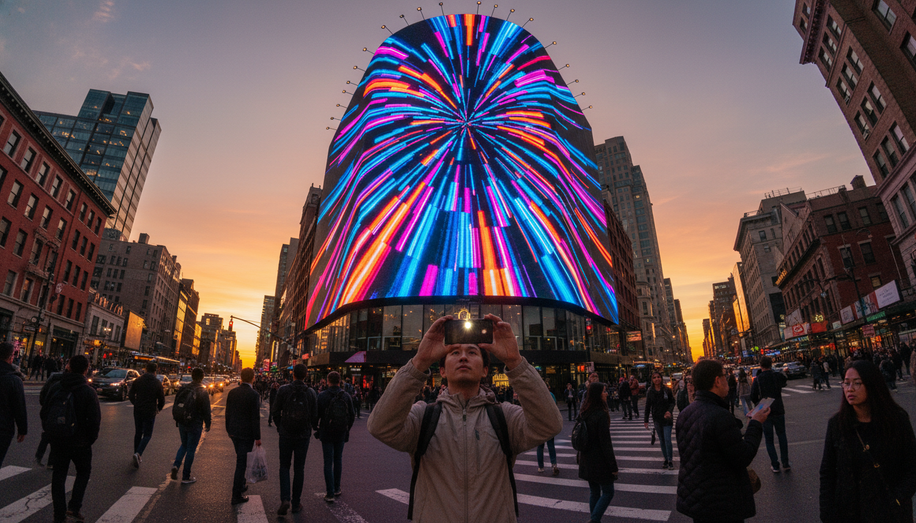

For years, out-of-home advertising has been defined by its physicality: towering billboards, eye-level posters, and murals that compete for attention in busy urban environments. Now, augmented reality is quietly rewriting those rules, turning static surfaces into digital portals that consumers can unlock simply by pointing their smartphones at an ad.
At its core, augmented reality overlays computer-generated imagery—3D models, animation, video, sound—onto the real world as seen through a camera-equipped device. In the context of OOH, that means a standard 6-sheet might sprout a hovering logo, a street mural might come alive with motion and sound, or a transit poster might open into an interactive product demonstration. What once required imagination can now be visualized on-screen, anchored to the exact physical structure the brand has bought.
This shift is happening at the intersection of two mature technologies: ubiquitous smartphones and increasingly sophisticated AR platforms. Consumers no longer need to download a bespoke app to interact with an augmented billboard. Web-based AR experiences can be triggered via QR codes, social filters on platforms like Instagram and Snapchat, or image recognition through tools such as Google Lens. The friction has dropped to a simple, intuitive sequence: scan, point, interact.
For advertisers, that low-friction trigger is critical. The average person walking past a poster may spare only a second or two of attention. AR experiences are designed to extend that fleeting glance into a deeper, voluntary engagement. A static film poster can launch a trailer that appears to play within the frame of the billboard itself. A cosmetics ad can open an AR “mirror” that lets users virtually try on shades. A tourism campaign can transform a city wall into a window onto distant landscapes, complete with soundscapes and interactive hotspots.
The creative possibilities are broad, but they follow a common pattern: AR adds a virtual layer of space and time that traditional OOH simply doesn’t have. A fixed 48-sheet suddenly gains infinite “pages” of content, revealed only when the viewer chooses to explore. Brands can tell more complex stories without cluttering the physical design, preserving the impact of a bold, simple visual while hiding richer experiences just below the surface.
This virtual layer brings another advantage the OOH sector has historically struggled with: measurable engagement. Traditional outdoor impressions are modeled estimates based on traffic counts and visibility studies. AR-enabled campaigns add a digital feedback loop. Every scan, dwell time, interaction, and repeat visit can be tracked, often with location and device data attached. Advertisers can see, in real time, which creatives are being activated, how long people stay, and what they do next—visit a website, share on social, redeem an offer.
In a landscape shaped by the pandemic and the rise of e-commerce, this hybrid of physical reach and digital measurability is especially attractive. AR makes it possible to bridge the gap between the street and the online store, turning a bus shelter into a shoppable experience or a mall poster into a virtual showroom. Retailers that once relied on in-store browsing can now simulate “try before you buy” in the moments when people are commuting, walking, or waiting in public spaces.
Behind the scenes, delivering a smooth AR OOH experience requires careful collaboration. Media owners, creative agencies, and AR developers need to work together from the outset. The physical design must function as both an eye-catching ad and a reliable “image target” that AR systems can recognize quickly under varied lighting and angles. Assets such as 3D models and animations must be optimized to load fast over mobile networks. And brands must choose the right delivery mechanism, weighing the accessibility of WebAR and social filters against the richer functionality of custom apps.
Timelines reflect that complexity. Industry practitioners often quote a six- to eight-week window from initial concept to launch, covering strategy, content creation, platform setup, and real-world testing. That testing phase is crucial: an AR experience that performs flawlessly in the studio can falter in the wild if it struggles with glare, shadows, or older smartphones. Advertisers are learning that the most effective AR OOH campaigns are not necessarily the flashiest, but the ones that are reliable, intuitive, and contextually relevant to where people encounter them.
There are, of course, challenges. Not every passerby will be willing to scan a QR code or open their camera app, especially if the value exchange is unclear. Data connectivity and battery anxiety can still be barriers. And brands must be mindful of privacy concerns when collecting location and interaction data. The most successful campaigns tackle these issues head-on by making the benefit of engagement obvious—a discount, exclusive content, a shareable moment—and by communicating clearly what data is collected and why.
Even with these hurdles, the momentum is unmistakable. As AR becomes embedded in everyday tools and social platforms, pointing a phone at the world around us is starting to feel natural rather than novel. For OOH, that normalization is transformative. Posters, billboards, transit wraps, and murals are no longer just backdrops or branding surfaces; they are triggers for layered experiences that continue on the consumer’s own device, in their own time.
What emerges is a new role for out-of-home media: not just to broadcast a message at scale, but to open a doorway. The big canvas on the street still does what it has always done—build awareness, create presence, signal brand ambition. The AR overlay adds something OOH has been missing: interactivity, personalization, and a measurable path from passing glance to meaningful engagement. Harnessing this potential for deeper, measurable engagement is where advanced platforms become indispensable. For brands leveraging AR to transform OOH, Blindspot offers the real-time campaign performance tracking, audience measurement, and ROI attribution needed to understand precisely how these interactive experiences translate into business value. By bridging the gap between physical activations and digital insights, Blindspot empowers advertisers to optimize their AR OOH investments with unparalleled precision. Learn more at https://seeblindspot.com/