
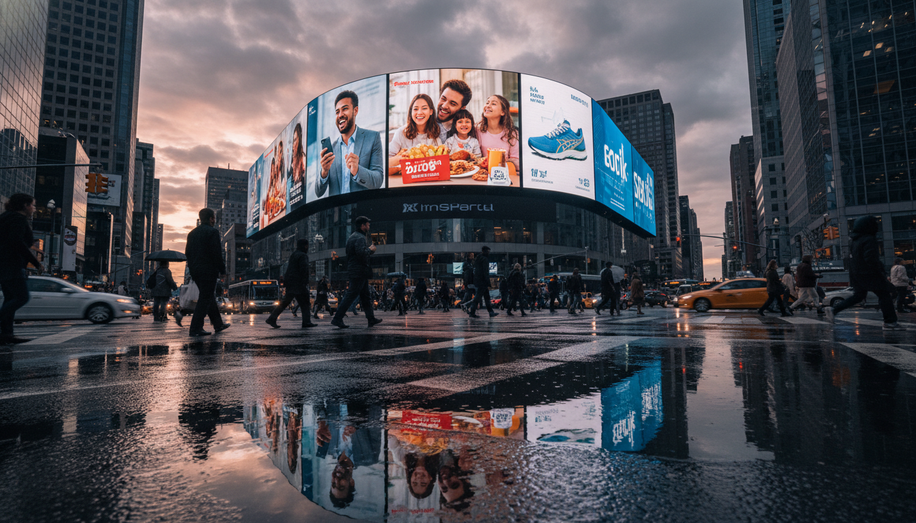

Programmatic digital out-of-home is pushing OOH far beyond its roots in fixed-location, one-message-fits-all exposure. By fusing automated buying with rich data signals, programmatic DOOH is giving brands the ability to reach specific audiences with tailored creative at the exact moments and in the exact places they are most likely to be receptive. For an industry long defined by big canvases and broad reach, this shift toward precision and personalization is redefining what “out-of-home” can do in the media mix.
At its core, programmatic DOOH applies the same real-time, software-driven infrastructure that underpins digital display and video to physical screens in public spaces. Rather than negotiating individual placements and fixed schedules with media owners, advertisers use demand-side platforms to set parameters: which audiences they want, where and when they want to reach them, how much they are willing to pay, and what contextual triggers should activate specific messages. When those conditions are met, impressions are automatically purchased and creative is delivered across a universe of digital billboards, transit shelters, retail networks, urban panels and more.
Crucially, this is still a one-to-many medium. A single ad play may be seen by dozens or hundreds of people, not a single logged-in user. As a result, impression definitions, measurement standards and targeting methods look different from those in online channels. Instead of cookies or device IDs, programmatic DOOH leans on aggregated, anonymized data sources: mobile location data, traffic and transit volumes, census and neighborhood demographics, point-of-interest maps, and even environmental signals like weather, air quality or event schedules. These inputs power audience models that can predict when and where particular segments are likely to be present around a given screen.
That is where audience-based planning comes in. Rather than starting with a short list of “must-have” locations, many campaigns now begin with a clearly defined audience. Behavioral, demographic and geographic attributes are used to build segments: young professionals commuting into central business districts, parents with school-age children, fitness enthusiasts frequenting gyms and health-food stores, or travelers moving through airports on peak business routes. Sophisticated platforms then analyze how densely these audiences cluster around available inventory, ranking screens and dayparts by their likelihood to deliver those desired impressions.
This approach is shifting the conversation from “Which billboards can we afford?” to “Which screens most efficiently reach our audience at scale?” Concepts such as audience reach percentage and location indexing are gaining traction, allowing buyers to prioritize placements where their segments over-index and to reallocate budget dynamically as patterns change. A lunchtime campaign targeting office workers, for example, can weight spend toward urban panels, transit hubs and quick-service restaurant networks that the data shows are buzzing with the right people between 11 a.m. and 2 p.m., while dialing down investment on the same screens during quieter hours.
Layered on top of this targeting is a growing capacity for creative personalization. DOOH cannot serve one message to one individual in the way that a personalized email or in-app ad can, but it can adapt in real time to the characteristics and context of the audience in front of it. Weather triggers are now common, with ads switching automatically when it starts to rain, temperatures spike or pollen counts rise. Time-of-day and day-of-week logic enables brands to tailor messaging to commuter patterns, weekend shoppers or late-night travelers. Proximity to specific points of interest—gyms, pharmacies, stadiums, campuses—can cue relevant calls to action that feel timely and useful rather than generic.
In practice, this means a fitness brand can push performance-focused creative near office towers in the early morning and after work, while serving more lifestyle-oriented messaging around suburban shopping centers on weekends. A quick-service restaurant can highlight breakfast offers near transit nodes in the morning, lunch combos in the early afternoon and family meal deals in residential neighborhoods in the evening, all controlled from a central platform that optimizes spend and creative rotation across thousands of screens.
The implications for campaign performance and measurement are significant. Programmatic DOOH lends itself to outcome-based buying models that were previously difficult in OOH. By tying exposure data to footfall patterns, store visits or even online conversions—always in an aggregated, privacy-compliant way—advertisers can start to understand which screens, creative variants and triggers are driving tangible business results. That feedback loop, in turn, informs optimization: underperforming placements can be paused, budgets can be shifted to higher-indexing inventory, and creative can be refreshed or versioned to better resonate with specific audience clusters.
For OOH specialists and broader media teams, the rise of programmatic DOOH is collapsing silos. DOOH impressions can now be planned and managed alongside connected TV, mobile and online video within the same DSP environment, making it easier to orchestrate cross-channel frequency and to sequence messages across on- and offline touchpoints. A person who encounters a brand on a digital billboard during their commute may later be retargeted on their mobile device within a geofenced radius or served complementary creative on streaming platforms, all informed by a unified audience strategy.
This convergence is not without challenges. Fragmented inventory, inconsistent measurement standards and varying definitions of impressions across markets can complicate planning. Ensuring data quality and maintaining consumer privacy as location signals and mobility data are leveraged at scale requires industry-wide discipline. Media owners must balance the flexibility demanded by programmatic buyers with the need to protect yield across their networks. And creative teams are being asked to think modularly, producing assets that can be swapped, versioned and triggered based on a matrix of conditions rather than a single, static flight.
Yet the momentum is clear. As brands look for channels that combine the brand-building power of high-impact visuals with the accountability and control of digital, programmatic DOOH is emerging as a natural fit. Its ability to target audiences with increasing precision, personalize messaging to real-world context and optimize spend in real time is unlocking new value in a medium that has long been prized for its scale but constrained in its flexibility.
The next phase will likely see even tighter integration of DOOH with omnichannel identity frameworks, more sophisticated use of predictive modeling to anticipate audience flows, and greater experimentation with interactive and responsive formats. For advertisers and agencies willing to lean into the data and rethink how they plan out-of-home, programmatic DOOH offers a path to make every screen, in every location, work harder for the audiences that matter most.