
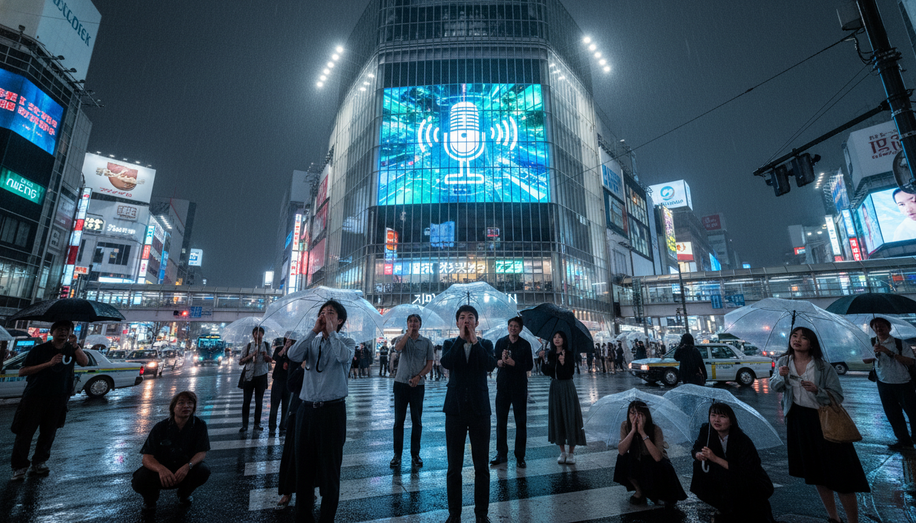

Static billboards are learning to talk back. As voice technology moves beyond smart speakers and smartphones into public spaces, out-of-home (OOH) advertising is evolving from a one-way broadcast into a live, two-way conversation with people on the street.
The most visible sign of this shift is the emergence of voice-activated billboards and street furniture. Equipped with microphones, speakers and AI-driven conversational systems, these displays invite passersby to ask questions, request offers or explore brand stories in real time. The underlying technology is similar to virtual assistants like Alexa or Google Assistant, but adapted for noisy, unpredictable outdoor environments and designed for quick, focused interactions rather than long chats.
In practice, a voice-activated OOH installation might prompt someone with a simple line—“Ask me about tonight’s lineup” outside a music venue, or “Say ‘new flavors’ to discover what’s inside” on a digital billboard for a beverage launch. When a person responds, speech recognition software transcribes their query, natural language processing interprets intent, and an AI engine serves up an audio reply, on-screen visuals or a dynamic offer. The result is a conversational exchange that feels more like a brief interaction with a knowledgeable host than a traditional ad impression.
Brands are turning to this format for several reasons. The first is memorability: when people actively participate in an ad, they are far more likely to remember it. Shifting someone from passive viewer to active participant creates a sense of agency and novelty that static formats struggle to match. Research in interactive and experiential OOH consistently points to higher recall, longer dwell times and more word-of-mouth when audiences are invited to engage, rather than simply observe.
Voice-activated OOH also unlocks deeper storytelling. A 10-second visual loop can only say so much. But a conversational interface allows audiences to choose their own path through a narrative. A film studio can let fans ask about characters or plot teasers; a travel brand can act like a street-side concierge, answering questions about destinations and surfacing tailored recommendations. Each exchange becomes a micro-experience that extends the brand’s story beyond taglines and key visuals.
The data dimension is equally compelling. With appropriate consent and privacy safeguards, voice interactions offer a real-time window into what people actually want to know. The questions they ask—about price, product variants, local availability, event details—can guide everything from creative optimisation to retail stocking and media planning. Instead of relying solely on impression counts and modeled exposure, marketers can see which prompts trigger responses, which topics spark follow-up questions and how engagement varies by location or time of day.
This emerging field is also blending with other interactive OOH innovations. Voice can complement augmented reality activations, triggering visual overlays when someone says a keyword while pointing their phone at a poster. It can work alongside gesture recognition on digital screens, creating multimodal experiences where people speak, move and tap in a seamless flow. In multisensory campaigns that already use sound, scent or touch, voice adds a layer of agency, transforming audio from background ambience into a responsive channel.
Outdoor environments, however, present unique challenges. Ambient noise complicates speech recognition, requiring directional microphones, smart filtering and carefully designed prompts that encourage short, predictable phrases. Privacy is another concern: brands and media owners must be transparent about when microphones are active, what is being captured, how it is processed and whether any data is stored or shared. Clear signage, opt-in mechanics and strict adherence to local regulations will be essential if audiences are to trust conversational OOH.
There is also a creative learning curve. Voice interactions in public have to be fast, intuitive and context-sensitive. Someone standing at a bus shelter or walking past a digital screen has seconds, not minutes, to decide whether to engage. That puts pressure on copywriting, audio design and prompt strategy. The most effective executions will likely feel playful and low-friction—“Ask me one question” or “Say ‘yes’ for a surprise”—rather than demanding complex commands or lengthy dialogue.
Measurement frameworks are still evolving. Marketers can already track basic metrics such as number of interactions, completion rates, repeat queries and engagement patterns by time and location. The next step is tying these signals to broader outcomes: lift in brand awareness, footfall to nearby stores, coupon redemptions, app downloads or search activity. As the ecosystem matures, expect more standardisation around attribution, potentially supported by technologies like blockchain to improve transparency and verify that real people, not bots, are driving engagement.
For OOH media owners, voice activation represents both an opportunity and a strategic decision. It can differentiate premium digital inventory, support higher-value experiential campaigns and deepen partnerships with brands looking for standout moments in crowded urban environments. But it also requires investment in hardware, connectivity, AI platforms and on-the-ground maintenance—plus training for sales and creative teams who are more accustomed to thinking in visuals than in conversational flows.
What is already clear is that the line between audio, digital and outdoor advertising is blurring. Interactive audio ads have trained listeners to respond to voice prompts in headphones and cars; voice-activated billboards are extending that behavior into public spaces. As consumers grow increasingly comfortable talking to technology, from their living rooms to their dashboards, speaking to a screen at a bus stop or a kiosk in a shopping mall will start to feel less unusual and more expected.
The long-term promise of voice-activated OOH lies in its ability to humanise outdoor advertising. A poster that answers questions, a transit shelter that guides you to your destination, a stadium screen that chats about the next act on stage—these are more than placements; they are services wrapped in brand storytelling. For an industry built on capturing attention in fleeting moments, turning those moments into conversations could mark one of the most significant shifts in OOH since the advent of digital screens.
As OOH steps into this conversational future, understanding the true impact of these interactive experiences becomes paramount. This is where platforms like Blindspot become essential, offering advanced real-time campaign performance tracking and ROI measurement to connect voice-activated engagements directly to business outcomes, ensuring that every conversation translates into quantifiable value. By providing robust audience measurement and attribution, Blindspot empowers marketers to navigate the evolving landscape of interactive OOH with precision and confidence. https://seeblindspot.com/