
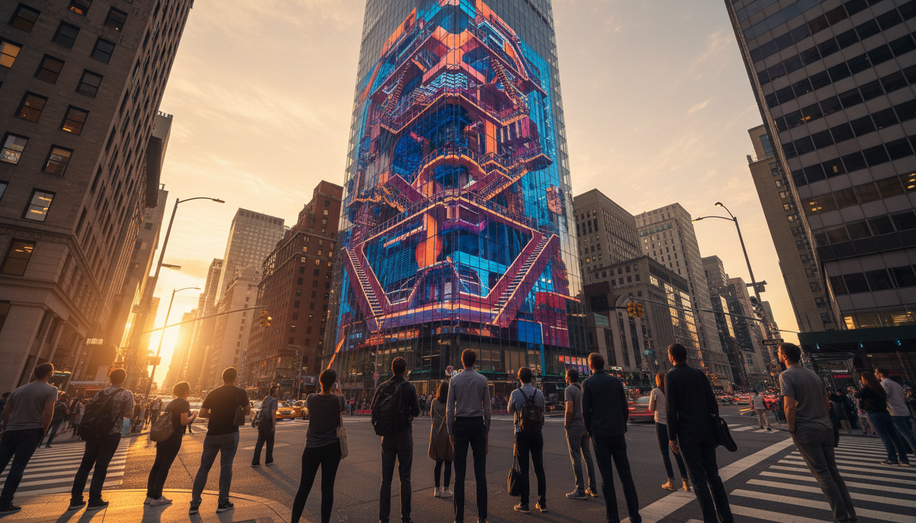

In the relentless urban sprawl, where billboards battle for fleeting glances amid honking traffic and pedestrian rushes, optical illusions have emerged as a secret weapon in out-of-home (OOH) advertising. These mind-bending visual tricks don’t just capture attention—they hijack the brain’s wiring, turning passive passersby into active participants in a perceptual game. By exploiting principles of perspective, depth, and motion, clever designers craft campaigns that feel alive, urging viewers to double-take, snap photos, and share the spectacle across social media. As OOH evolves from static posters to dynamic spectacles, optical illusions stand at the forefront, proving that the most unforgettable ads aren’t seen—they’re experienced.
The power of these illusions lies in their ability to subvert expectations. Our brains are hardwired to interpret visual cues like shadows, scale, and convergence lines as indicators of three-dimensional space. When advertisers twist these cues, the result is a delightful disorientation that demands engagement. Take the classic anamorphic billboard, where a distorted image on a flat surface snaps into perfect clarity from a specific angle—often the driver’s seat on a highway. London’s Transport for London once deployed a campaign for its Cycle Superhighways featuring a cyclist that appeared to burst from the billboard, complete with a “phantom” shadow stretching across the pavement. Motorists slammed on brakes, not out of fear, but sheer astonishment, with the ad racking up millions of organic shares online. This isn’t mere gimmickry; it’s neuroscience-backed persuasion. Studies from visual perception experts, echoed in design primers like Reagan Outdoor’s creative guide, show that such illusions boost recall by up to 30 percent compared to standard imagery, as the brain works overtime to resolve the paradox.
Pushing boundaries further, modern OOH integrates technology to amplify these effects. Digital out-of-home (DOOH) screens pulse with illusions that respond to real-time conditions, like wind or sunlight, creating hyper-realistic distortions. A standout example hails from Indonesia, where Lestari Ads highlights campaigns weaving local motifs—think towering wayang puppets that seem to loom over Jakarta’s skyline, their elongated limbs defying gravity through forced perspective. Viewed from the monorail, the figures “reach out” toward commuters, blending cultural resonance with visual wizardry. Superpixel’s analysis of optical illusions in marketing notes how manipulating light, color, and shape tricks the eye into perceiving motion where none exists, turning a static LED wall into a portal of intrigue. Brands like Coca-Cola have mastered this with 3D bottle illusions that “pour” liquid cascading down building facades, visible only from street level, prompting selfies that double as free publicity.
What makes these campaigns highly shareable is their inherent virality. In an era where 85 percent of social media shares stem from visual content, illusions provide instant “wow” moments primed for TikTok and Instagram Reels. Grand Visual’s exploration of interactive OOH underscores how sensors can trigger illusions—pass your phone near a billboard, and an augmented shark fin slices through the surface, chasing your reflection. This interactivity transforms viewers from spectators to co-creators, fostering emotional bonds that static ads can’t match. DepositPhotos’ blog on visual intrigue points out that illusions ranging from static “impossible” staircases to kinetic patterns exploit the brain’s blind spots, making the ad memorable long after the walk-by. The result? Amplified reach: a single illusionary billboard in Times Square for Oreo cookies, with cookies “crumbling” in mid-air via perspective shifts, generated over 50 million impressions through user-generated content alone.
Yet, wielding optical illusions demands precision to avoid pitfalls. Overly chaotic designs risk confusion rather than captivation, as Alliance Media warns in its OOH design guide—aim for serenity amid the trickery. Cluttered elements dilute the illusion, while high-contrast colors and bold typography ensure the brand message lands amid the mind-bend. Rebound Ads emphasizes adapting to local contexts; in bustling Asian megacities, illusions incorporating street-level props—like a Jakarta campaign where a floating nasi goreng bowl hovers above a food cart—forge instant relatability. Done right, these tactics not only halt the scroll of daily life but propel campaigns into cultural conversations, as seen in Zeely’s breakdown of DOOH innovations using motion and perspective for “real-world viewing rewards.”
As OOH advertising hurtles toward a future dominated by AI-driven personalization and immersive AR overlays, optical illusions will only sharpen their edge. They’re not just creative flourishes; they’re evolutionary tools that redefine visibility in a saturated landscape. By daring to deceive the eye, brands don’t just advertise—they astonish, ensuring their message lingers like a half-solved puzzle in the viewer’s mind. In the high-stakes game of street-level storytelling, the illusionists are winning, one double-take at a time.