
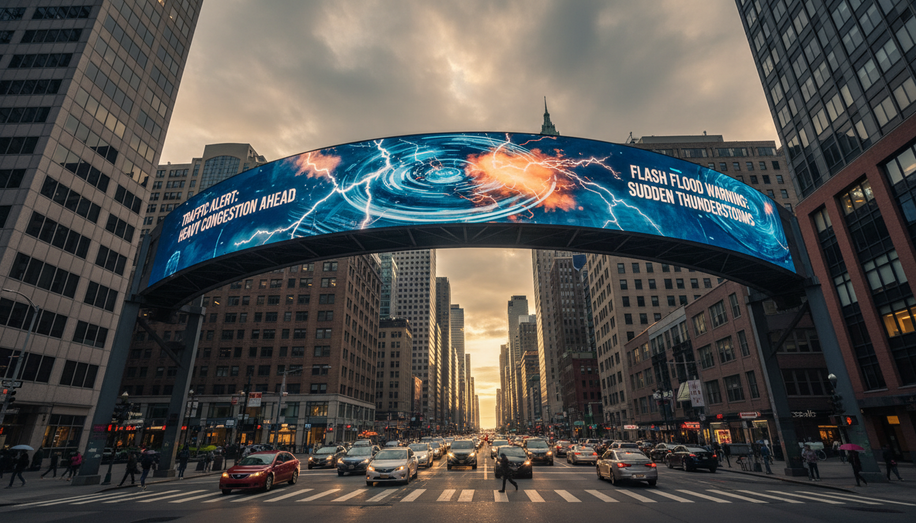

In the bustling streets of modern cities, where pedestrians and drivers alike navigate a constant stream of information, digital out-of-home (DOOH) advertising is evolving beyond predictable schedules. No longer confined to time-of-day rotations—such as breakfast promotions in the morning or evening commutes—DOOH now harnesses real-time data to react instantaneously to live events, breaking news, and shifting weather patterns, delivering hyper-relevant messages that capture fleeting attention.
This shift represents a leap from static creativity to dynamic creative optimization (DCO), where ad content adapts fluidly through modular templates. Headlines, images, and calls-to-action swap out automatically based on live inputs, eliminating the need for pre-built assets for every scenario. Powered by programmatic platforms, these systems pull from diverse data feeds—weather APIs, social media trends, sports scores, traffic sensors, and event calendars—to ensure ads align perfectly with the moment. For instance, a beverage brand might deploy digital billboards that spotlight iced drinks on scorching afternoons and hot cocoa during sudden chills, resulting in a reported 30% sales uplift during one such campaign.
Weather responsiveness stands out as a prime example of this contextual prowess. Real-time meteorological data triggers immediate creative changes, turning potential disruptions into opportunities. On rainy days, umbrellas or cozy indoor escapes dominate screens; sunny spells might promote outdoor gear or ice cream. This isn’t mere opportunism—it’s precision marketing that resonates with immediate consumer needs, far surpassing time-based triggers like rush-hour messaging. Sources like Blindspot emphasize how weather-integrated DOOH boosts engagement by syncing visuals with environmental reality, while Broadsign notes its role in programmatic environments for automated, scalable adaptation.
Extending to live events and news cycles amplifies impact even further. During major sporting spectacles like the Super Bowl or World Cup, billboards can flash live scores, player stats, or event-tied promotions, drawing fans into the action. A sports apparel brand, for example, could pivot from generic ads to highlight a star player’s jersey mid-game, capitalizing on heightened emotions. Similarly, breaking news—be it stock market fluctuations or cultural moments—feeds into dynamic templates. Social media trends monitored in real time allow campaigns to echo viral conversations, such as tying a fashion retailer’s display to a celebrity endorsement blowing up online. Blood donation drives have leveraged live appointment availability feeds to show slot updates, transforming passive viewers into immediate responders.
The technology enabling this reactivity is robust and multifaceted. Data providers supply streams including audience demographics, dwell times, footfall patterns, vehicle flows, and even camera sensors for interactive elements. Platforms like those from SeeBlindspot or Screenverse integrate these with A/B testing, allowing real-time optimization: if one weather-triggered variant outperforms another, the system iterates on the fly. This closed-loop learning refines future displays, enhancing ROI through better measurement and fraud prevention. Unlike traditional OOH, which locks in content weeks ahead, DOOH’s agility supports sequenced storytelling across locations— a morning news recap billboard feeding into an afternoon event promo nearby.
Advertisers reap strategic advantages from this evolution. Production costs drop as templates replace bespoke creatives, while time-to-market accelerates for timely relevance. Campaigns become measurable, with metrics like engagement duration and sales correlations tied directly to data triggers. A fast-food chain, once limited to meal-time swaps, now layers in event data: promoting game-day wings during a local match or sunny picnic bundles when forecasts clear. Pearl Media highlights how this real-time customization drives consumer behavior shifts, attracting new audiences who perceive brands as intuitively responsive.
Challenges persist, of course. Data privacy regulations demand careful handling of demographics and location signals, and integration requires sophisticated partnerships with reliable providers. Yet, the upside is clear: DOOH transcends commoditized scheduling to become a cultural mirror, reflecting the world’s pulse. As urban screens proliferate— in transit hubs, retail zones, and high-traffic corridors—this capability positions OOH not as background noise, but as a dynamic conversation partner.
Brands embracing these tools report stronger awareness and conversions, proving that relevance born of the moment outperforms rote repetition. In an era of fragmented attention, DOOH’s real-time reactivity isn’t just innovative—it’s essential, redefining how advertisers connect in the physical world. As data ecosystems mature, expect even deeper integrations, from AI-driven predictions to augmented reality overlays triggered by unfolding narratives. The billboard that knows the weather, the score, or the headline isn’t futuristic; it’s here, reshaping streets into stages for living stories.