
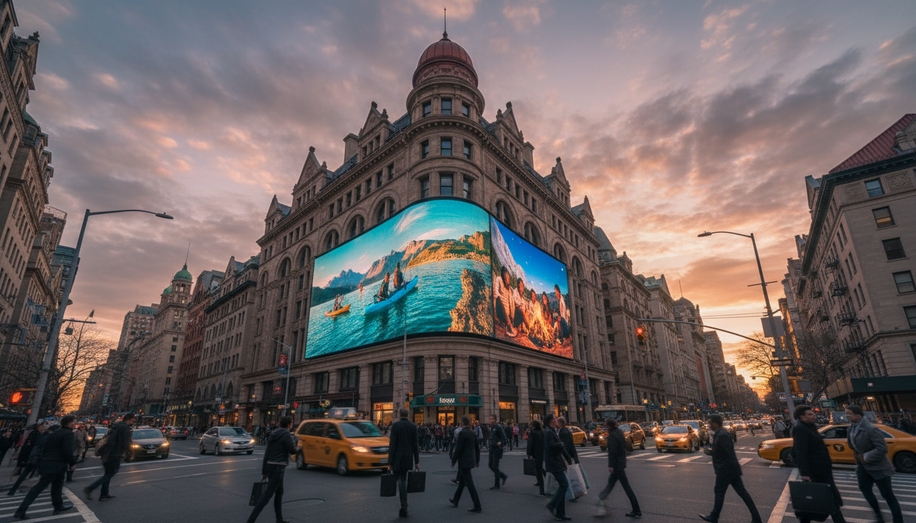

Out-of-home advertising has become a transformative force in destination marketing, moving far beyond simple billboards to become a sophisticated, data-driven channel that attracts travelers and stimulates local economies. As cities and tourism boards compete for visitor attention in an increasingly crowded marketplace, OOH campaigns deliver the unfiltered visibility and real-world engagement that digital channels struggle to match.
The effectiveness of OOH in tourism marketing lies fundamentally in its unavoidable nature. Unlike digital advertisements that viewers can skip or block, out-of-home messaging reaches potential travelers in their everyday environments—whether commuting, shopping, or traveling through transit hubs—without requiring opt-in or active engagement. This consistent exposure creates lasting brand impressions at scale. Major travel brands including Hotels.com, Expedia, and VRBO have recognized this advantage, ranking among the top OOH advertisers in 2024. The investment is strategic: travel’s share of OOH ad spend has surged dramatically from 3.8 percent in 2023 to 5.7 percent in 2024, reaching 8 percent in early 2025, making it the top vertical for OOH spending.
Strategic placement in high-traffic areas amplifies destination marketing impact. Tourist hotspots such as airports, transit hubs, and city centers offer premium visibility precisely where travel decisions are being made. Destinations can target specific feeder markets by placing media in regions where potential visitors concentrate—for example, a Caribbean island strategically advertising in Boston, Hartford, and Buffalo to capture the attention of nearby travelers likely to visit. This geographic precision ensures marketing budgets reach audiences most inclined to travel to specific destinations.
The performance metrics validate this approach convincingly. Research from the Out of Home Advertising Association of America and Comscore found that OOH drives online activation rates five to six times higher than expected, outperforming television, video, radio, banner ads, and print when measuring digital engagement. Mobile click-through rates increase by up to 15 percent through OOH campaigns, while overall effectiveness reaches 90 percent of U.S. residents monthly, with 65 percent taking action after seeing an advertisement. These numbers demonstrate that OOH successfully converts awareness into measurable tourist behavior.
Cost efficiency strengthens the case for OOH investment. The medium delivers significantly lower cost per thousand impressions than connected television, paid social, or display advertising, with average CPMs ranging from two to nine dollars USD. This cost advantage enables destination marketers to achieve mass reach in high-traffic environments without proportional budget increases, making OOH particularly valuable for tourism boards managing limited budgets.
Innovation in OOH formats has expanded possibilities for destination engagement. Interactive campaigns incorporating QR codes guide tourists toward travel apps and hotel bookings, while augmented reality experiences bring landmarks to life. Dynamic digital billboards near airports and transit ads can be triggered by weather or location data, enabling real-time creative adaptation. These technological enhancements create memorable brand interactions that inspire travel decisions. Visit Seattle’s “I Know A Place” campaign exemplifies creative collaboration, deploying a branded treat truck to key feeder cities like Dallas, Minneapolis, and Sacramento rather than relying solely on traditional signage.
Modern OOH advertising bridges offline and online marketing ecosystems effectively. By matching mobile advertising IDs to campaign exposure, tourism boards can measure visitation uplift and identify which audiences prove most likely to act after seeing an out-of-home advertisement. Geofencing and retargeting technologies capture device IDs from individuals exposed to advertisements, enabling destinations to reach these audiences again across social media, apps, and search engines. This multi-channel strategy reinforces messaging and increases engagement without disrupting daily routines.
The economic implications extend beyond immediate tourism increases. OOH advertising simultaneously promotes local businesses catering to tourists—restaurants, cafés, adventure tourism operators, shopping districts, and entertainment venues. This ecosystem approach strengthens entire destination economies by driving traffic across diverse sectors.
As travel demand continues surging and consumers plan their next experiences, destination marketers increasingly recognize that out-of-home advertising represents not merely a top-of-funnel awareness tool but rather a performance-driven, scalable channel built for modern travel marketing. Through strategic placement, innovative formats, and integration with digital ecosystems, OOH campaigns successfully transform inspiration into action, moving travelers from initial interest to booking decisions while simultaneously boosting local economies.