
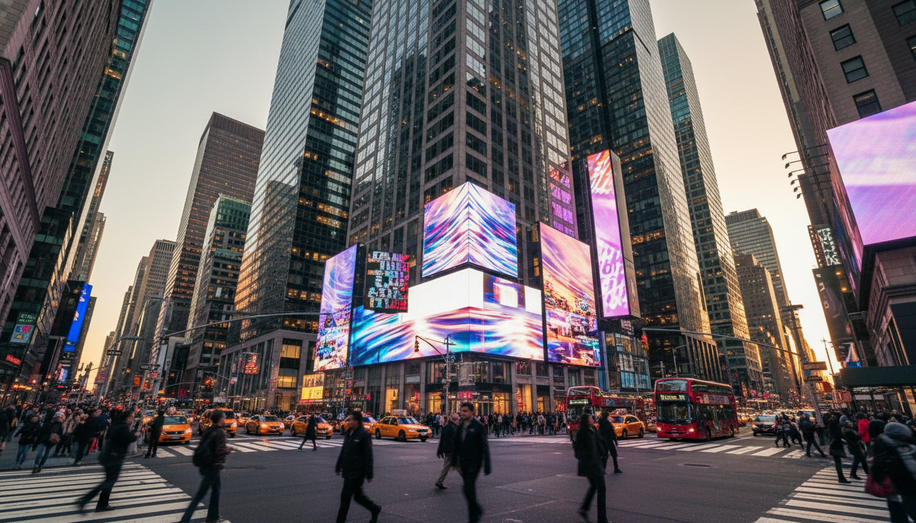

In the split-second rush of urban life, a billboard’s ability to pierce through the mental fog hinges on more than mere size or visibility—it’s rooted in the hardwired mechanics of human perception. Out-of-home (OOH) advertising leverages behavioral science to command attention, shape emotions, and lodge messages into long-term memory, turning passive passersby into primed consumers. Strategic placement and creative elements like color, composition, and brevity don’t just catch the eye; they exploit the brain’s dopamine-driven attention system and cognitive shortcuts, making OOH uniquely potent in an ad-saturated world.
Consider the psychology of placement first. High-traffic locations—think bustling highways, transit hubs, or Piccadilly Circus—aren’t chosen randomly. They tap into the brain’s alerting responses, which spike for unexpected sensory cues in familiar environments. When a consumer navigates daily routines, like commuting or waiting at a bus stop, OOH benefits from “dwell time,” extended exposure that static digital ads rarely match. This isn’t interruption; it’s integration into the physical world, where fewer competing messages vie for focus compared to a webpage cluttered with banners. Research underscores that high-dwell spots, such as traffic jams or queues, yield higher-quality attention than sheer volume alone, as stationary viewers have no escape from the visual assault. Context amplifies this: a sports drink ad near a gym or an event poster in a tourist district feels relevant, boosting acceptance through environmental priming.
Visuals seal the deal by hijacking the brain’s reticular activating system, the filter that prioritizes novel stimuli amid noise. Large-scale formats demand notice— a 14-by-48-foot billboard looms unavoidable, its sheer scale imprinting imagery before conscious processing kicks in. Motion in digital OOH, like changing displays, triggers even stronger responses, outpacing static online creatives by mimicking rewarding surprises that release dopamine. Composition plays a starring role here. Human faces, especially those making eye contact, draw gazes instinctively, as we’re evolutionarily tuned to read social cues. Bold imagery evokes narratives instantly—humor, inspiration, or urgency—fostering emotional bonds that drive loyalty and purchase intent. Simplicity reigns supreme under cognitive load theory: clutter overwhelms, but clean hierarchies—image dominating, text supporting—enhance retention.
Color emerges as a subconscious powerhouse, evoking precise emotions without a word. Red screams urgency and hunger, as in McDonald’s golden arches; Coca-Cola’s bold red pulses with energy. Cool blues build trust, while high-contrast pairings—like yellow on navy—boost readability from afar and lift recall by up to 38%. These aren’t aesthetic whims; consistent palettes across campaigns cement brand recognition by 80%, wiring familiarity into the psyche. Warm tones stimulate in fast-paced highway settings, while calming hues reassure in residential zones, aligning hue with habitat for maximum impact.
Message brevity ties it all together, countering the seven-second attention window of OOH encounters. Studies mandate “seven words or less” for headlines, prioritizing bold, processable text over verbose copy. Short slogans reinforce through repetition—commuters passing the same board twice daily benefit from spaced exposure, the gold standard for memory consolidation via the mere exposure effect. This builds trust subconsciously: familiarity breeds liking, turning fleeting sights into enduring recall. Social proof amps it further—ads flaunting influencers or crowds trigger FOMO, nudging behavior through our herd instincts.
Yet effectiveness demands synergy. A vivid creative in a mismatched spot fizzles; a brilliant location with bland design vanishes. Brands succeed by auditing audience psychology: high-traffic for awareness, dwell zones for persuasion. Emotional storytelling trumps facts—narratives resonate in parks or malls, sparking connections that digital scrolls rarely forge. Subliminal cues, from symbolic visuals to color-coded priming, whisper to the subconscious, presetting positive brand vibes.
Ultimately, OOH’s edge lies in its analog authenticity amid digital fatigue. It doesn’t chase clicks; it claims space in reality, wielding psychology to influence behavior at scale. As consumers barrel through life, the right visuals in the right place don’t just advertise—they reprogram perceptions, one glance at a time.