
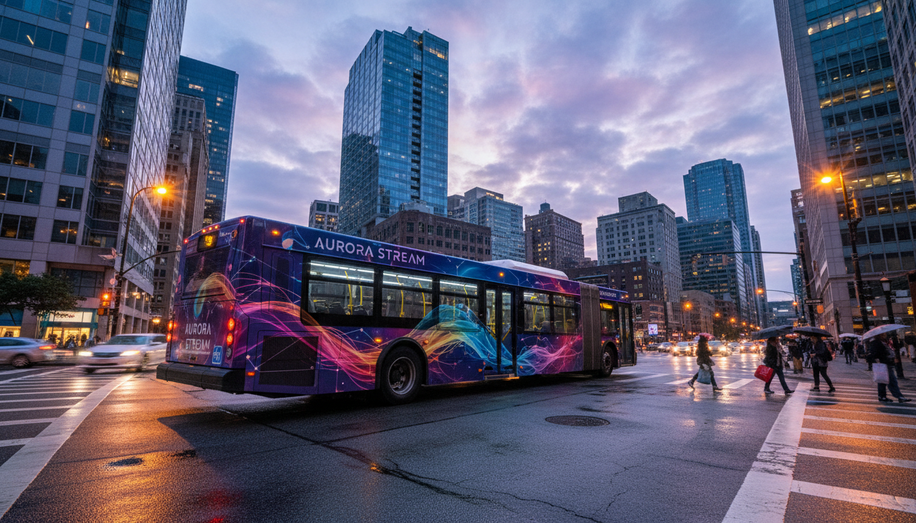

Vehicle wraps have emerged as one of the most effective and efficient forms of out-of-home advertising, transforming ordinary buses and fleet vehicles into moving billboards that command attention across urban, suburban, and rural landscapes. The creative potential of full bus wraps extends far beyond simple brand visibility, offering advertisers a dynamic canvas to craft compelling narratives that resonate with diverse audiences during their daily routines.
The scale of reach achievable through bus wrap advertising is genuinely impressive. A single wrapped bus generates between 40,000 and 70,000 impressions daily, with some studies indicating that vehicles can attract 400 to 600 impressions per mile. Over a four-week campaign period, this translates to more than a million impressions per vehicle in major metropolitan areas. Bus advertising reaches over 48 million adults in an average two-week span, making it one of the most far-reaching marketing platforms available. What distinguishes this medium from static outdoor advertising is the inherent mobility—as buses traverse busy city streets, residential neighborhoods, and commercial districts, they extend brand exposure across geographic territories that would otherwise require multiple fixed advertising placements.
The strategic advantages of full vehicle wraps lie in their ability to deliver geographically targeted campaigns with precision. Unlike traditional billboards confined to fixed locations, buses travel consistent routes, allowing advertisers to concentrate messaging in high-traffic areas and neighborhoods where target audiences congregate. This mobility ensures that advertisements reach potential customers during their commutes, shopping trips, and leisure activities, creating multiple touchpoints throughout the day. The consistent visibility of a wrapped vehicle reinforces brand messaging through repeated exposure, a psychological principle that significantly enhances brand recall and recognition.
From a financial perspective, vehicle wraps demonstrate remarkable cost efficiency. The cost per thousand impressions (CPM) for bus wraps ranges from just $0.48 to $2.67, depending on location and campaign duration. This represents a substantial advantage compared to other advertising channels, including cable television at $25.98 CPM and direct mail at $58.71 CPM. Even when compared to digital advertising, which averages $13.51 CPM, vehicle wraps deliver superior value without requiring the digital infrastructure or ongoing content development costs. This affordability makes mobile fleet advertising accessible to businesses of all sizes, from local restaurants to national brands launching new product lines.
The creative dimension of full bus wraps deserves particular emphasis. A comprehensive wrap that covers the entire vehicle surface provides advertisers with an unprecedented amount of real estate to communicate complex brand narratives. Rather than condensing messaging into a single line of text, creative teams can develop multi-layered designs that tell stories, showcase product variety, or create immersive brand experiences. Successful campaigns have leveraged this creative freedom to drive tangible business results—local restaurants have reported noticeable increases in foot traffic, while clothing brands have generated significant buzz around new product launches through strategically placed bus advertising.
The effectiveness of bus wrap campaigns extends beyond traditional impression counts. Businesses implementing targeted bus advertising initiatives have reported increased website traffic, enhanced social media engagement, and a measurable uptick in customer inquiries. These secondary metrics demonstrate that vehicle wraps function as complete marketing tools rather than simple awareness vehicles.
However, maximizing impact requires strategic consideration of design, placement, and route selection. High-visibility designs that capture attention from both drivers and pedestrians are essential, as is careful analysis of bus routes to ensure alignment with target demographic distribution. During peak commuting hours, when foot traffic and vehicle density increase, wrapped buses achieve optimal exposure.
As businesses continue seeking cost-effective methods to build brand awareness and drive consumer action, full vehicle wraps represent a proven solution. The combination of expansive creative potential, broad geographic reach, exceptional cost efficiency, and measurable results positions mobile out-of-home advertising as an increasingly vital component of integrated marketing strategies. For advertisers ready to transform their fleets into moving canvases, the opportunity to influence millions of impressions daily awaits. To truly maximize the strategic advantage of mobile OOH, platforms like Blindspot offer advanced capabilities to pinpoint ideal bus routes through precise audience measurement and location intelligence, ensuring campaigns reach target demographics with unparalleled accuracy. This optimization allows advertisers to not only track real-time campaign performance but also attribute tangible ROI, transforming potential into verifiable business growth. Learn more at https://seeblindspot.com/