
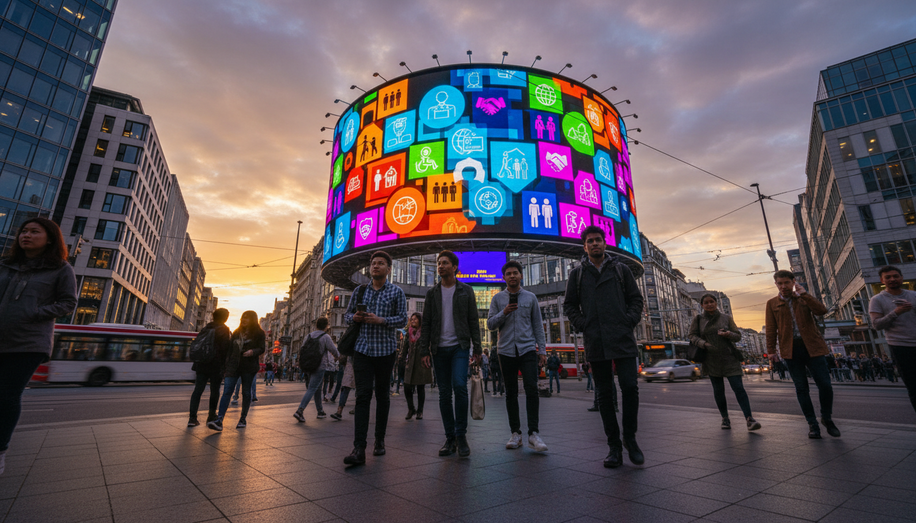

In the bustling urban landscapes where out-of-home (OOH) advertising captures millions of eyes daily, a profound shift is underway: designing campaigns not just for the majority, but for every viewer. Accessibility and inclusivity in OOH are no longer optional enhancements; they represent a moral imperative, a legal necessity, and a smart business strategy that broadens reach and fosters goodwill. As public spaces grow more diverse, advertisers must confront the reality that up to 15 percent of the global population lives with disabilities, demanding visuals, messaging, and installations that accommodate visual, cognitive, and physical impairments.
Consider the visual realm first, where traditional billboards and digital displays dominate. For individuals with low vision or blindness, high-contrast colors and oversized fonts are foundational. Industry experts recommend text at least 15 inches tall on digital billboards to ensure legibility from 500 feet away, a standard that inherently aids those with mild impairments by prioritizing simplicity and clarity. Beyond size, high-contrast displays—pairing dark text on light backgrounds or vice versa—cut through glare and distance, making content pop for elderly viewers or those with conditions like macular degeneration. Innovative digital signage solutions now integrate screen readers, converting on-screen text to speech via text-to-speech technology, while audio descriptions narrate images and prompts guide navigation. These features, once confined to indoor digital interfaces, are migrating outdoors, ensuring that a visually impaired pedestrian at a transit hub hears a campaign’s call-to-action just as clearly as a sighted counterpart.
Hearing impairments introduce another layer, compelling advertisers to rethink audio-dependent elements. Outdoor digital screens increasingly synchronize audio announcements with visual reinforcements: subtitles scroll alongside spoken messages, flashing icons signal alerts, and animated graphics convey urgency without sound. In emergency scenarios or promotional bursts, this dual-channel approach guarantees no one is left out—vital in high-traffic areas like airports or shopping districts where OOH delivers time-sensitive information. Regulations reinforce this: local zoning and safety codes often mandate that signage avoids obstructing visibility or posing hazards, implicitly calling for inclusive designs that enhance rather than impede access for all.
Physical accessibility extends these principles to the built environment. OOH installations must comply with standards like the Americans with Disabilities Act (ADA), which dictate minimum heights, clear pathways, and unobstructed approaches. Pedestrian routes to interactive kiosks or digital walls require at least 36-inch widths, with 60-inch turning spaces every 200 feet to allow wheelchair users to maneuver comfortably. Braille interfaces on touch panels or adjacent buttons enable tactile navigation, allowing users to select options or trigger voice prompts independently. Placement matters profoundly: signs too high or recessed exclude those with mobility aids, while proximity to roads demands setbacks to prevent hazards, aligning safety with inclusivity. In residential or scenic zones, where zoning curtails size and location, these adaptations preserve aesthetics without sacrificing reach.
Cognitive considerations demand equal rigor, simplifying messaging for those with intellectual disabilities, dyslexia, or processing challenges. OOH thrives on brevity—designs should strip away clutter, using plain language, logical hierarchies, and minimal animations to avoid overload. Publicity symbols, such as the wheelchair icon or hearing access emblem, signal compliance upfront, building trust and encouraging engagement. For digital formats, user-friendly interactions prevail: large, tactile buttons and intuitive flows reduce frustration, complying with global standards that emphasize universal design.
The stakes are high. Beyond ethics, inclusive OOH drives tangible gains. Accessible campaigns boost engagement by tapping underserved audiences, enhance brand reputation as socially responsible, and sidestep legal pitfalls from non-compliant installations. Clear Channel and Eflyn Electronics exemplify this evolution, embedding accessibility widgets and multi-sensory tools into their networks, proving that innovation pays dividends in public trust. Yet challenges persist: varying local regulations—from California’s highway setbacks to municipal size caps—require vigilant adaptation. Environmentally sustainable materials, like recyclable substrates, further align with progressive mandates, ensuring longevity without compromise.
Ultimately, designing for all transforms OOH from a visual spectacle into a communicative bridge. As cities prioritize inclusive public spaces, advertisers who lead this charge—integrating screen readers, braille, contrasts, and compliant placements—don’t just meet standards; they redefine connection in a shared world. The message is clear: exclusion is outdated, while accessibility endures, captivating every passerby and elevating the medium itself.
Blindspot’s location intelligence and audience analytics empower advertisers to identify optimal sites for accessible OOH installations, ensuring compliance with physical accessibility standards and effectively reaching diverse populations. By leveraging programmatic DOOH campaign management, brands can seamlessly deploy inclusive content to screens equipped with features like screen readers and high-contrast displays, transforming OOH into a truly universal communication channel. https://seeblindspot.com/