
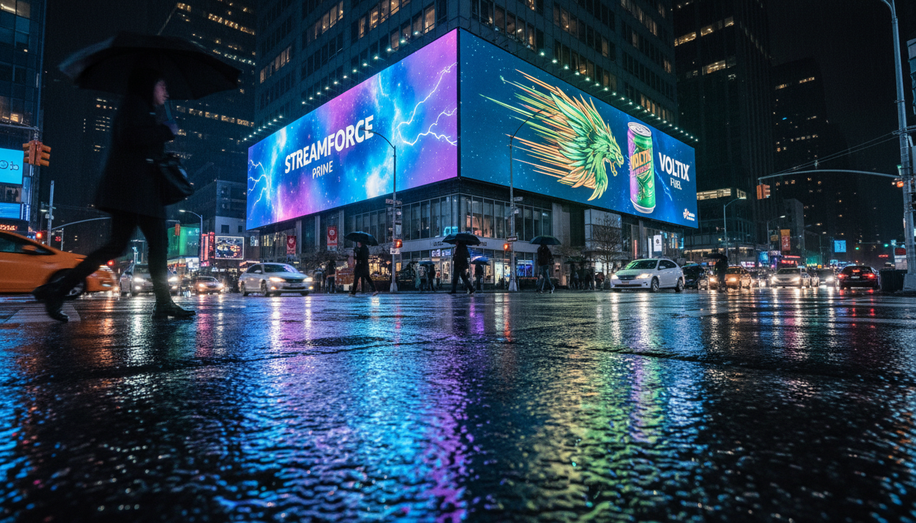

In the high-stakes world of out-of-home advertising, where every square foot of billboard space commands premium rates, brands are increasingly turning to collaboration as a force multiplier. Collaborative and co-branded OOH campaigns harness the power in numbers, pooling resources to slash costs, explode reach, and weave synergistic narratives that resonate far beyond what any single advertiser could achieve alone. These partnerships transform static displays into dynamic storytelling engines, proving that unity often trumps solitary spending.
Consider the timeless rivalry-turned-spectacle between BMW and Audi, whose infamous “Billboard Battle” in 2007 pitted luxury titans against each other on a Los Angeles highway. What began as competitive one-upmanship—BMW’s sleek M3 ad morphing into a jab at Audi’s A4, followed by Audi’s retaliatory digital riposte—evolved into an unintended co-branded phenomenon. Drivers witnessed the brands dueling in real time, with each escalating the other’s visibility. The result? Millions of impressions at shared media cost, as passing motorists slowed to gawk, snapped photos, and amplified the feud virally. This organic synergy not only boosted brand recall but illustrated how even adversarial pairings can amplify OOH’s disruptive potential, turning prime inventory into a shared stage.
Fast-forward to more deliberate alliances, like the weather-responsive triumphs that brands have co-opted for mutual gain. McDonald’s in the UK synced its frozen drinks campaign—promoting strawberry lemonade and frappe—with rising temperatures, activating digital screens only above 22°C and adding city-specific heat readouts over 25°C. Imagine if a complementary partner, say a local ice cream chain or beverage rival, had layered in their own geo-targeted messaging on adjacent screens. Such hypothetical co-branding would have shared weather-trigger tech costs while creating a unified “cool down” narrative, driving foot traffic to clustered retailers. Real-world parallels abound, as seen in Rain-X’s rain-activated ads near stores and Aperol’s sun-triggered spritz promotions near social hubs, both leveraging programmatic DOOH for precision.
One standout in purposeful collaboration is Vandebron’s “Green Energy Forecast” initiative, where the Dutch energy provider teamed with EV infrastructure players to deliver dynamic OOH banners pinpointing optimal green-charging windows. High-density EV zones lit up with data-driven advice, fostering a shared sustainability ethos that empowered drivers while cross-promoting charging stations. Costs were distributed across partners, reach ballooned through complementary audiences, and the messaging synergized around eco-responsibility—Vandebron as the green power source, stations as the access points. This model echoes Purina’s “Street Vet” in Paris, a tech marvel co-engineered with YNCREA and VetParis7, where digital billboards scanned dogs via cameras to diagnose health and recommend Purina products. Though not explicitly co-branded on-screen, the backend partnerships shared R&D expenses, yielding immersive experiences that sustained attention and drove conversions.
Retail realms offer even bolder examples of co-branded OOH magic. East West Market’s “embarrassing plastic bags” campaign in Vancouver shamed single-use plastics into oblivion, spiking reusable bag usage to 96%. Paired with a grocery partner like a sustainable brand, this could have extended to OOH wraps on delivery trucks, co-messaging “Ditch the Bag, Join the Habit” for amplified anti-plastic advocacy. Similarly, IKEA’s Stockholm activation addressed cool summer woes by installing outdoor heaters under the slogan “Outage? Get outside,” boosting café dwell time. A co-brand with a local coffee roaster could have layered scents and signage, sharing experiential costs for heightened sensory synergy.
Fast-food giants have mastered this art, too. Church’s Texas Chicken deployed data-driven OOH with location targeting and mobile retargeting, netting 19.6 million impressions and 2.4 million store visits at a 12.2% conversion rate. Envision KFC joining via their UAE “Out-Door” stunt—removing restaurant doors to billboard 24/7 availability—creating a QSR co-op across highways: Church’s teasing spicy cravings, KFC promising endless access. Shared media buys would cut expenses, while unified “Hunger Solved” theming lured drivers to clustered outlets.
These campaigns underscore a pivotal shift: OOH’s evolution from solo billboards to networked ecosystems. Digital out-of-home (DOOH) enables real-time triggers—weather, events, data—that partners exploit collectively, as New Balance did tying into Femke Bol’s victory with adaptive creatives. Costs plummet when split; reach surges via audience overlap; synergy crafts narratives greater than the sum, like Dole’s “Malnutrition Facts” guerrilla projections that could pair with health orgs for broader impact.
Yet success demands alignment. Partners must harmonize visuals, timing, and values—lest clashes dilute the message, as nearly happened in the BMW-Audi fray. Metrics back the boon: co-ops often double impressions at half the price, per industry benchmarks, while buzz metrics like social shares skyrocket from novel pairings.[12 from 1]
Looking ahead, 2026 forecasts more such ingenuity, from bee hotels by Switzerland Tourism (ripe for eco-brand tie-ins) to Kellogg’s weathervane spectacles. For OOH pros, the lesson is clear: in a fragmented media landscape, collaboration isn’t optional—it’s the multiplier that turns good campaigns into legendary ones, proving the art of partnership wields true power in numbers.