
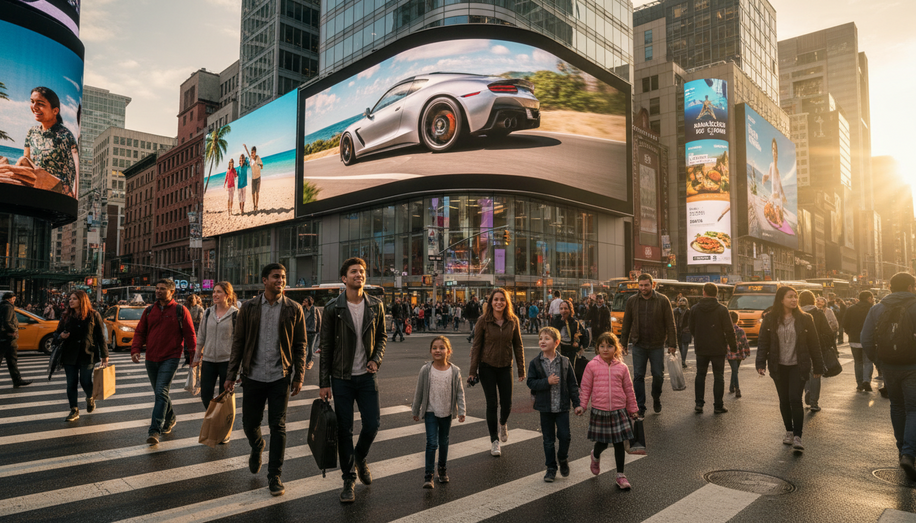

In the bustling urban landscapes where out-of-home (OOH) advertising commands attention, artificial intelligence is redefining how brands connect with consumers. No longer reliant on broad strokes, AI-driven audience segmentation pinpoints hyper-specific personas, blending demographics, psychographics, and behavioral data to craft messages that hit with surgical precision. This shift transforms static billboards into dynamic storytellers, elevating campaign effectiveness in ways traditional methods could only dream of.
At its core, AI excels in dissecting vast datasets to create nuanced segments that go beyond age or income brackets. Algorithms analyze social media interactions, purchase histories, and even geospatial movements to uncover psychographic profiles—values, interests, and lifestyles that reveal what truly motivates a buyer. For instance, a luxury car brand might leverage AI to target affluent drivers not just by high income levels, but by their propensity for premium purchases and preferences for upscale lifestyles. By cross-referencing this with pedestrian traffic patterns and proximity to luxury retail hubs, the brand identifies optimal OOH spots in wealthy neighborhoods, ensuring ads resonate deeply and drive conversions.
Behavioral patterns add another layer of refinement, capturing real-time actions that predict intent. Machine learning models process foot traffic data, historical sales, and even weather influences to segment audiences dynamically. Consider a global retail chain gearing up for the Christmas rush: AI sifts through competitor activity, seasonal trends, and consumer mobility to segment shoppers into high-intent groups—those likely to splurge on gifts versus bargain hunters. This informs not only ad placement in high-traffic malls but also tailored creatives, like festive promotions for impulse buyers, optimizing budgets and boosting sales lift.
Location intelligence amplifies this precision, turning OOH into a context-aware medium. AI tools layer demographic overlays onto mobility data, revealing who frequents specific areas and when. A sportswear brand, for example, uses these insights to place ads near stadiums during major events, targeting fans based on their event attendance history and athletic interests—a psychographic match that fosters emotional connections and brand recall. In dynamic digital out-of-home (DOOH) setups, this evolves further: programmatic buying automates ad swaps based on passing audiences, detected via AI-powered cameras or satellite imagery.
Real-world deployments underscore the power of these segments. PODS, a storage and moving company, deployed AI on a roving digital billboard that adapted content to neighborhoods, factoring in time, weather, traffic, and even subway delays. Using Google’s Gemini platform, the ads segmented passersby into local personas—stressed commuters or relocating families—driving a 60% surge in website visits. Similarly, in Tokyo, a collaboration between Cloudian, Dentsu, and Intel harnessed deep learning on expressway billboards to detect vehicle types and driver profiles in under half a second, delivering targeted content that achieved 94% effectiveness. These cases illustrate how AI treats individuals as “segments of one,” personalizing at scale much like Amazon’s recommendation engine, which powers 35% of its revenue through behavioral nuance.
Psychographics bring emotional depth, segmenting by attitudes and aspirations often invisible in raw demographics. AI unifies data from customer platforms (CDPs) with machine learning to score purchase probability in real time, categorizing users as high-, medium-, or low-conversion likelihood. A beverage brand might exploit this by dynamically swapping ad creatives: scorching heat triggers refreshment pitches for heat-sensitive urbanites, identified via lifestyle data and location pings. This agility ensures relevance, turning fleeting exposures into memorable engagements.
Yet, the true game-changer lies in measurement. AI analytics track impressions, engagement, and downstream outcomes like foot traffic or sales, closing the loop on ROI. Retailers now attribute lifts directly to OOH placements, refining segments iteratively—ditching underperformers and doubling down on winners. Tools like audience meters for digital signage provide demographic breakdowns, enabling networks to sell premium slots backed by data, not guesses.
Challenges persist, from data privacy concerns to the need for quality inputs, but advancements in edge computing and federated learning mitigate these. As AI integrates with IoT and 5G, OOH will evolve into fully responsive ecosystems, where segments shift in real time based on live behaviors.
Brands ignoring this precision risk irrelevance in a fragmented world. Those embracing AI personas don’t just advertise—they converse, forging loyalty through messages that feel personal. In OOH’s high-stakes arena, pinpointing the perfect persona isn’t optional; it’s the edge that separates visibility from impact.