
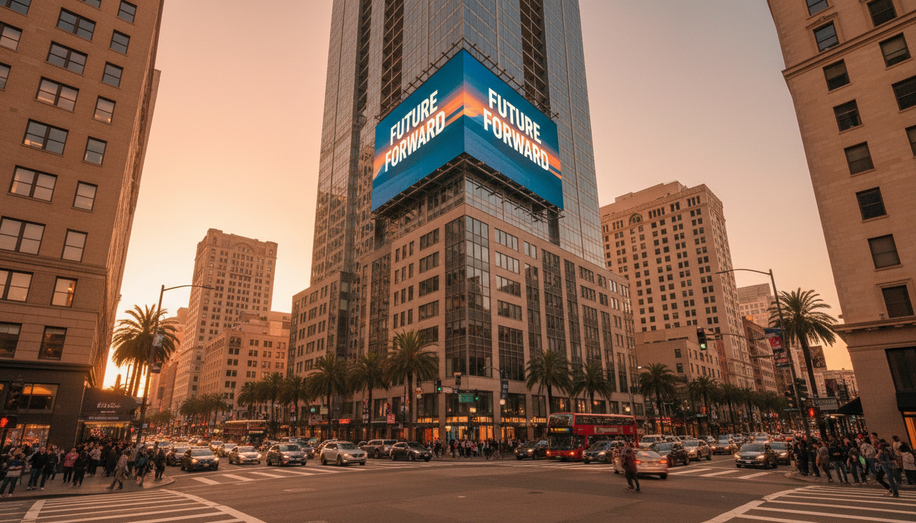

In the bustling arteries of urban life, where commuters rush past towering billboards and shoppers glance up at digital screens in transit hubs, out-of-home (OOH) advertising quietly weaves itself into the fabric of everyday experience. Far from fleeting digital impressions that vanish with a scroll, OOH commands attention in the physical world, fostering deep brand recognition that endures long after the initial encounter. A landmark five-year study by Kantar and Clear Channel Outdoor underscores this power, revealing that OOH outperforms connected TV (CTV) and digital channels in ad awareness by a striking 13.3%, while matching linear TV’s lift in brand favorability and purchase intent—all at a more efficient cost.
This superiority stems from OOH’s unskippable nature. Unlike online ads battling ad blockers and fatigue, OOH meets people in moments of high attentiveness—driving to work, waiting at bus stops, or navigating stadium crowds. Nearly 80% of consumers have engaged with an OOH ad in the past 60 days, amplifying brand visibility across diverse, geographically unique audiences. The medium’s always-on presence in high-traffic zones delivers repeated exposure, turning passive glances into memorable associations. Billboards, for instance, provide sustained brand presence, ideal for etching logos and taglines into collective memory, while transit and street furniture ads reinforce messages in dense urban settings.
Creative execution elevates this exposure from mere visibility to cultural resonance. Brands that dare to be bold reap outsized rewards. Consider Bobbie’s Times Square billboard featuring supermodel Ashley Graham combo-feeding her baby—a provocative visual that sparked nationwide press and social buzz, reinforcing the formula brand’s mission while driving engagement across the marketing funnel. Such campaigns don’t just sell; they position brands as conversation starters, borrowing equity from iconic locations like London’s Marble Arch to attract footfall and embed themselves in public consciousness. Digital out-of-home (DOOH) takes this further with motion, light, and dynamic content, capturing attention in ways static formats cannot.
Consistency across these “big screen” touchpoints is the linchpin for long-term brand equity. OOH’s premium placements create lasting associations that outlive campaigns, boosting search return on ad spend by 40% as 41% of consumers actively seek out brands after exposure. On a dollar-for-dollar basis, it delivers 5.3 times the performance of other channels, bridging the gap between immediate conversions and enduring loyalty. In an era of digital saturation and ad-free streaming, where audiences fragment and privacy restrictions hobble targeting, OOH fills critical voids. It reaches incremental audiences overlooked by algorithms, driving superior lifts in awareness, favorability, and intent—metrics that compound over time into trusted identities.
Marketers navigating economic uncertainty and media chaos increasingly recognize OOH’s dual role. “Out-of-home is not just a complementary channel; it’s an indispensable one that drives serious impact,” asserts Nicole Jones, Kantar’s chief media commercial lead, based on rigorous analysis of thousands of campaigns. Advances in measurement—geolocation for foot traffic, pixel attribution for conversions, and control-group studies for brand lift—have demystified its ROI, proving OOH’s TV-like punch without the premium price. Programmatic DOOH adds precision, enabling demographic targeting and real-time optimization akin to digital platforms.
Yet OOH’s true magic lies in trust-building. Repeated, creative encounters humanize brands, fostering familiarity that digital snippets rarely achieve. When inclusive—reflecting multicultural identities—OOH ads boost noticeability among Black, Asian, and Hispanic consumers by nearly 60%, cultivating affinity in a diverse populace. This isn’t hype; it’s substantiated by data showing OOH’s edge in memorability and action, from heightened branded searches to retail visits.
As brands grapple with AI-driven “click-killing” efficiencies that prioritize performance over presence, OOH reasserts the value of bold, public storytelling. It transforms advertising from interruptive noise into environmental architecture, where a consistent visual language across cityscapes builds equity brick by brick. In fragmented markets, this reliability translates to resilience: audiences may tune out screens at home, but they can’t escape the skyline.
The verdict is clear from the data. OOH doesn’t just capture eyes; it cultivates conviction. For brands committed to the long game, integrating it into balanced mixes yields not fleeting spikes, but fortified identities that weather disruptions. Dan Levi, Clear Channel’s EVP and CMO, sums it up: in a world of uncertainty, OOH’s nimble creativity and proven impact make it essential for standing out and driving action. As 2026 unfolds, expect more marques to claim the big screen, proving that true brand trust is built in plain sight.