
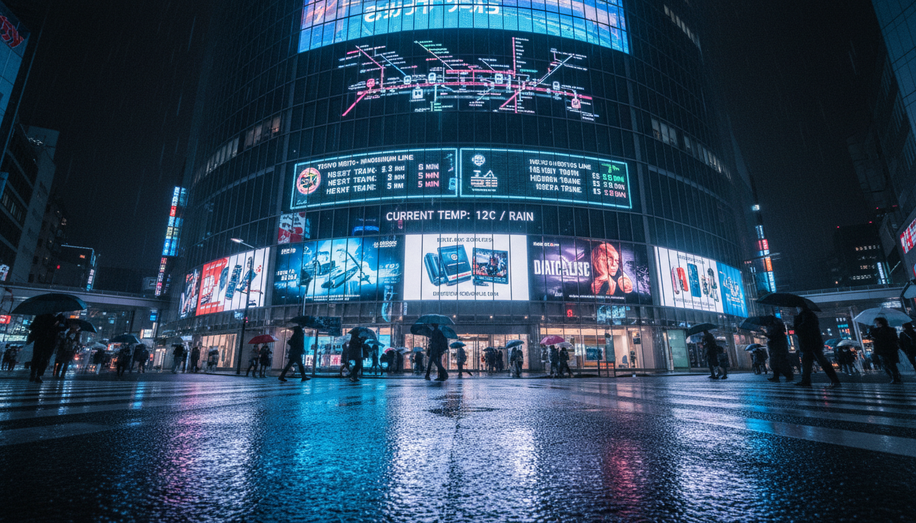

The transformation of outdoor advertising is underway, driven by the emergence of smart cities that demand more sophisticated and integrated communication solutions. Out-of-home media is no longer confined to static billboards delivering one-directional messages. Instead, OOH has evolved into a dynamic, multifunctional component of urban infrastructure that simultaneously serves advertisers, municipalities, and citizens.
At the core of this evolution lies the integration of artificial intelligence, real-time data analytics, and IoT connectivity. AI-powered billboards now analyze traffic patterns, weather conditions, and audience demographics to deliver highly personalized advertising content at the moment when it will have the greatest impact. In Tokyo’s Shibuya district, billboards adjust content based on the age and gender of passing crowds, resulting in significantly higher engagement rates, while Times Square installations display interactive, real-time ads that engage both tourists and residents. These examples demonstrate that smart city OOH extends far beyond traditional advertising—it creates immersive brand experiences that capture attention in increasingly competitive urban environments.
The integration of OOH with smart city infrastructure represents a fundamental shift in how cities communicate with their populations. Digital screens in bus shelters and metro stations now function as dual-purpose systems, displaying advertisements while simultaneously providing real-time arrival times, weather updates, and emergency alerts. New York City’s LinkNYC kiosks exemplify this synergy, combining Wi-Fi hotspots, public service information, and digital advertising screens into a single multifunctional ecosystem. London integrates digital billboards with live traffic data to optimize campaign reach, while Singapore deploys smart transit hubs where DOOH displays provide advertising alongside real-time travel information. This seamless fusion transforms what might otherwise be wasted advertising space into genuine urban utility.
Interactive technology amplifies the value proposition further. Modern outdoor billboards incorporate touch screens, QR codes, NFC technology, and augmented reality experiences that convert passive advertising into two-way brand-consumer interactions. Hybrid display systems combine user interaction capabilities with dynamic advertising content on separate screens, maximizing communication efficiency. These innovations drive higher engagement levels while providing consumers with meaningful experiences rather than mere advertisements. The result is a fundamental transformation from traditional one-way messaging to immersive engagement that benefits both advertisers seeking measurable ROI and consumers seeking relevant, actionable information.
Sustainability considerations increasingly drive smart city OOH adoption. Unlike traditional paper posters, digital screens minimize waste while energy-efficient LED displays powered by renewable energy sources reduce urban carbon footprints. Companies like Soofa Digital have pioneered fully solar-powered digital advertising platforms, demonstrating that environmental responsibility and commercial viability can coexist. As cities prioritize sustainability alongside technological innovation, OOH media represents an alignment between advertising objectives and municipal environmental goals.
The convergence of OOH and smart city infrastructure creates substantial opportunities for municipalities to fund new projects. Public kiosks and digital signage networks generate advertising revenue that directly supports infrastructure development and maintenance. This creates a sustainable funding model where commercial partners contribute to public infrastructure improvements, establishing a symbiotic relationship that strengthens the economic viability of smart city initiatives.
Looking forward, the potential for further integration remains considerable. As smart cities deploy increasingly connected infrastructure, opportunities will expand for synchronizing billboard messaging with event schedules, emergency alerts, and transit data. Emerging facial recognition systems enable real-time content segmentation, adapting messages according to viewer profiles with greater precision. Future developments promise deeper audience interaction through AI-driven personalization and environmental sensing technologies.
The smart city movement demonstrates that OOH advertising’s relevance depends on its ability to evolve beyond commercial messaging. By integrating advertising with public information services, interactive experiences, and urban infrastructure, OOH media becomes essential to contemporary city life. This transformation positions out-of-home media not as an antiquated format but as a sophisticated, data-driven component of intelligent urban ecosystems. For publishers, advertisers, and municipalities alike, smart city OOH represents the future of urban communication—where commercial value, civic utility, and consumer engagement converge seamlessly throughout the cityscape.
To effectively harness the potential of this dynamic urban communication, platforms like Blindspot offer essential tools for strategic optimization. By providing granular audience measurement, location intelligence for prime site selection, and real-time programmatic campaign management, Blindspot empowers advertisers and publishers to deliver highly personalized and impactful OOH experiences that drive measurable ROI within the intricate smart city ecosystem. Discover how at https://seeblindspot.com/