
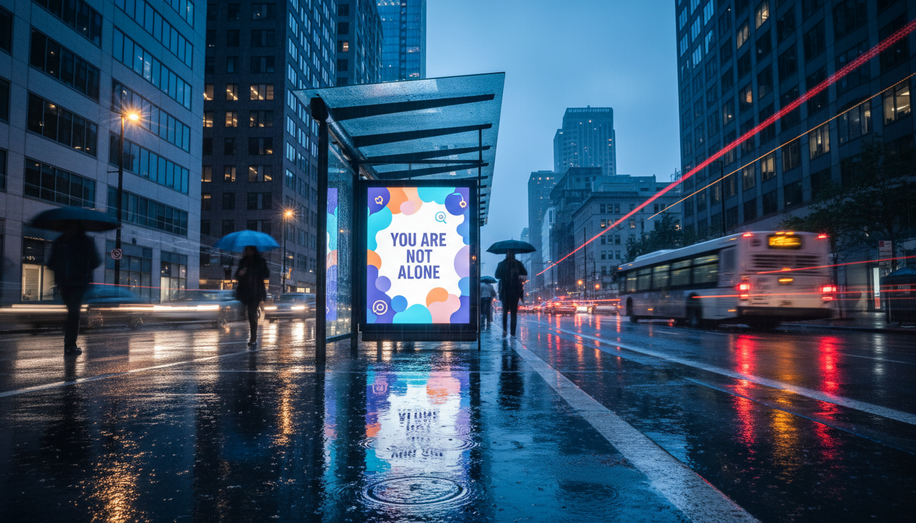

Out-of-home (OOH) advertising has long transcended its commercial roots, emerging as a potent force for social good. By commandeering billboards, digital screens, and transit hubs, campaigns for non-profits and public causes seize public attention in inescapable ways, sparking conversations and driving action on issues from environmental crises to humanitarian emergencies.
In Finland, a stark initiative during the ongoing Ukraine conflict transformed digital OOH networks into urgent beacons of support. Major operators like JCDecaux, Bauer Media Outdoor, and Ocean Outdoor donated screen space across Helsinki, displaying air raid-style alerts that pierced the daily commute. Each notification detailed the plight of Ukrainian children, accompanied by a MobilePay donation link, turning passive viewers into immediate responders. The effort reminded passersby that the war’s toll on the young persisted, amplifying awareness and facilitating direct aid without a penny charged for the media buy.
Environmental campaigns have similarly harnessed OOH’s visceral punch to confront waste and deforestation. Germany’s Aktion Baum rolled out “Trick or Tree?” during Halloween, blanketing billboards and subway stations with eerie, VHS-inspired visuals of barren landscapes devoid of trees. Eerie taglines evoked a Halloween nightmare—a future without forests—paired with QR codes urging donations, tree-planting, or program sign-ups. The seasonal tie-in amplified urgency, transforming a festive moment into a rallying cry for reforestation amid climate threats.
Patagonia, the outdoor apparel brand synonymous with activism, has wielded OOH to challenge consumerism and spotlight planetary peril. Their “Don’t Buy This Jacket” campaign in 2011 flipped traditional advertising on its head, featuring a Black Friday ad imploring consumers to skip impulse buys in favor of sustainability. More recently, the fatalistic “We’re All Screwed” effort deployed billboards with poetic laments on the climate crisis, underscoring the brand’s commitment to causes over sales. These OOH provocations not only boosted Patagonia’s reputation as a sustainability leader but also mobilized communities around air quality and conservation, as seen in tie-ins like the “Running Up For Air” movement.
Public health initiatives have proven OOH’s agility, especially in crises. During the COVID-19 lockdowns, Deliveroo partnered with the UK’s National Society for the Prevention of Cruelty to Children (NSPCC) to combat rising child abuse risks. Delivery bags emblazoned with the NSPCC helpline number reached households nationwide, while thousands of riders received free training to spot abuse signs. The OOH elements extended to visibility on routes, surpassing targets with over 4,000 trainees and heightened helpline awareness when vulnerable children were hidden from view.
Digital out-of-home (DOOH) elevates this impact through real-time relevance. In Sweden, the Alzheimer’s Foundation mimicked loading icons on donated Ocean Outdoor billboards to depict memory loss, using real photos of dementia-affected loved ones. The campaign, amplified across transit and national screens, highlighted that over 160,000 Swedes live with the disease—with numbers projected to double by 2050—and no cure in sight. It fostered empathy at scale, urging support for research and care.
Civic engagement shines in hyper-local efforts like Alberta’s charitable DOOH push in Calgary, where dynamic displays rallied community backing for non-profits. Screens pulsed with stories of local need, driving engagement through proximity and immediacy. Similarly, Vandebron’s “Green Energy Forecast” in the Netherlands targeted EV-heavy zones with data-driven DOOH banners, advising optimal green-charging times to empower sustainable habits and foster collective environmental responsibility.
These campaigns underscore OOH’s unique power: its unskippable presence in shared public spaces ensures broad reach, while dynamic capabilities allow timeliness—weather-triggered ads for Rain-X during downpours or victory celebrations for New Balance post-race. Non-profits benefit from pro bono media often, as in Helsinki or Sweden, lowering barriers to entry. Metrics bear out the results: Patagonia’s efforts enhanced brand loyalty and issue awareness; Deliveroo-NSPCC exceeded training goals; Aktion Baum converted Halloween fright into reforestation pledges.
Beyond metrics, OOH for good reframes public spaces as arenas for dialogue. Billboards that once hawked products now provoke reflection on child survivors in war zones, vanishing forests, or silent epidemics like dementia. By blending stark visuals, clear calls-to-action, and contextual triggers, these efforts prove advertising’s highest calling: not just to sell, but to awaken, unite, and change the world one unignorable glance at a time.