
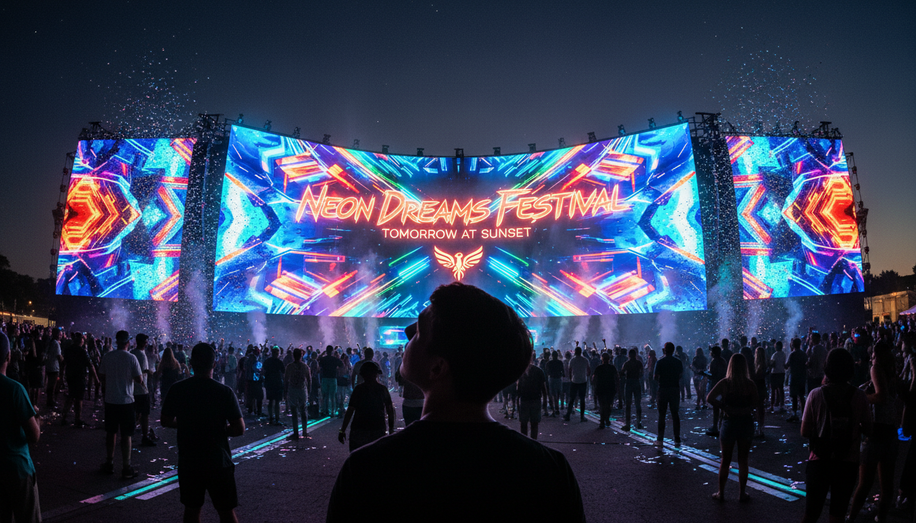

In the pulsating world of live entertainment, where sold-out crowds define success, out-of-home (OOH) advertising stands as a powerhouse for igniting buzz around concerts, festivals, and expos. By dominating public spaces with bold visuals and strategic placements, OOH doesn’t just announce events—it transforms passersby into eager attendees, bridging awareness to ticket sales with unmatched immediacy.
Consider the raw impact of eye-catching banners and signage, staples in OOH campaigns for outdoor spectacles. These oversized visuals, crafted with bold colors, large lettering, and crystal-clear calls-to-action like QR codes linking to ticket pages, thrive in high-traffic zones near venues or along commuter routes. For a music festival, vinyl banners fluttering at entrances or feather flags lining walkways not only guide crowds but embed the event’s vibe—think vibrant lineups of artists scrolling across durable displays that withstand wind and sun. Event marketers report that such placements boost visibility exponentially, turning fleeting glances into lasting impressions that drive online conversions.
Digital out-of-home (DOOH) takes this further, offering dynamic firepower for time-sensitive promotions. Digital billboards, urban panels at bus shelters, and transit screens pulse with countdown timers—”Doors open in one hour”—or artist teasers synced to weather triggers and audience density data. For a city-center expo, geofencing pairs these screens with mobile retargeting, bombarding nearby phones with discount codes for those who paused to watch. Agencies note that DOOH’s flexibility—rotating creatives from early-bird alerts to live highlights—amplifies reach among travelers and urban dwellers, ideal for destination events like conferences or summer festivals.
Street-level tactics add grit and guerrilla edge, perfect for culturally attuned crowds at concerts and festivals. Wild Posting, with its dense clusters of posters slapped across street walls, disrupts the urban canvas in a way that feels organic and shareable, sparking Instagram posts that extend reach virally. Street teams in branded tees handing flyers in festival districts or business hubs employ this guerilla marketing to target younger demographics, while permitted chalk art on sidewalks teases event themes with playful impermanence. Floor ads and giant art installations—oversized guitars for a rock concert or festival mascots on high-traffic plazas—draw eyes from above and below, fueling curiosity and foot traffic.
Experiential OOH elevates mere promotion to immersive spectacle, converting skeptics into superfans. Projection mapping drapes entire buildings in event visuals, turning a landmark into a glowing countdown for an expos or a teaser reel for headliners. Flash mobs or pop-up mini-concerts in parks channel human energy, drawing crowds that naturally amplify via social shares. These activations, hard to ignore amid daily commotions, blend OOH with live moments, prompting immediate ticket scans via nearby digital kiosks in malls or bars. Brands leveraging such tactics see spikes in attendance, as the “shareable shock” factor turns ads into user-generated content.
Strategic placement remains the linchpin, matching formats to goals for maximum ROI. Billboards and digital networks saturate for broad awareness ahead of massive festivals; mobile billboards and DOOH flex for last-minute surges near venues; street furniture and wild postings nail local presence for neighborhood expos. Data-driven buys—aligning airport screens with arrival peaks or retail venue displays with weekend footfall—ensure messages hit primed audiences.
Yet OOH’s true alchemy lies in integration. Paired with social blasts or email nurtures, it funnels buzz into sales: a billboard glimpse leads to a geofenced app push, then a QR-driven purchase. Successful campaigns for events like music fests layer these—banners for broad strokes, DOOH for urgency, experiential hits for memorability—yielding measurable lifts in ticket velocity. Metrics from planners underscore this: OOH-exposed audiences show higher engagement rates, with viral extensions multiplying impact.
Challenges persist—weather for static formats, permits for street art—but solutions abound in durable materials and data optimization. As live events rebound post-pandemic, OOH’s unskippable presence reasserts dominance, proving that in a digital-saturated era, nothing fuels attendance like advertising that owns the physical world. For promoters, the message is clear: harness OOH’s scale and creativity to not just fill seats, but pack arenas.
Blindspot empowers promoters to transform OOH potential into packed venues, moving beyond guesswork to data-driven success. Its cutting-edge location intelligence and audience analytics ensure precision targeting for every placement, from static banners to dynamic programmatic DOOH, optimizing for maximum impact and engagement. With real-time campaign performance tracking and robust ROI attribution, Blindspot provides the insights needed to measurably boost ticket sales and prove OOH’s direct influence on attendance. Visit https://seeblindspot.com/