
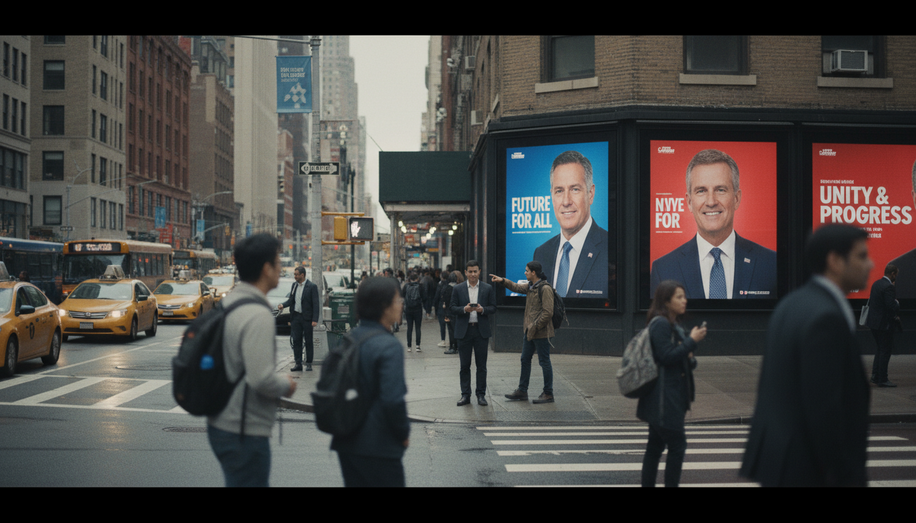

Out-of-home advertising has emerged as an indispensable tool for political campaigns seeking to shape voter behavior and influence election outcomes. Unlike digital platforms that voters can easily dismiss or skip, billboards and transit advertising offer an unavoidable, repeated presence in voters’ everyday environments, making them uniquely powerful in an increasingly fragmented media landscape.
The effectiveness of outdoor advertising in politics stems from several interconnected factors. Research shows that 25% of likely voters say political OOH ads increase their awareness on issues, while 26% report that these ads remind them of the importance and value of voting. More compelling still, a February 2024 survey found that nearly half of respondents exposed to OOH political ads in the past year consider them personally influential, with younger voters demonstrating even higher engagement—57% of Gen Z and 60% of Millennials consume OOH political information at least weekly.
The credibility advantage OOH maintains over other media cannot be overstated. Voters perceive OOH advertisements as more informative than radio, television, social media, and streaming services, with over 56% of voters believing political OOH ads are truthful and accurate. This trust differential becomes particularly valuable when campaigns must cut through unprecedented polarization and voter anxiety. In economies marked by uncertainty, OOH advertising delivers targeted messages in high-traffic areas, effectively addressing economic concerns through constant, visible reminders of candidates’ policy positions.
The strategic targeting capabilities of modern OOH advertising enable campaigns to reach traditionally hard-to-reach demographics. OOH over-indexes with key voting blocs including Gen Z, Hispanic Americans, and Black Americans. This demographic reach proves especially valuable for local campaigns, which account for the overwhelming majority of political billboard spending. According to the Outdoor Advertising Association of America, 84% of billboard political ad spend is locally driven, with only 6% directed toward national campaigns and 1% toward presidential races. This distribution reflects political advertising’s concentrated focus on building name recognition and persuading swing voters in specific geographic markets where electoral outcomes remain competitive.
The mechanics of voter influence through OOH operate through established psychological principles. The power of visibility and repetition ensures that campaign messages are seen repeatedly, reinforcing their impact and building familiarity and trust. For candidates seeking name recognition—a fundamental prerequisite for electoral success—billboards and yard signs with striking designs and clear messaging prove instrumental, particularly in densely populated areas. Beyond awareness building, OOH serves a persuasion function, conveying candidates’ key messages and policy positions to broad audiences capable of swaying undecided voters.
However, the political OOH landscape presents distinct challenges. The effectiveness of political advertising appears to be cyclical and context-dependent. A recent study analyzing more благоустройство более 600 political ads from 50+ campaigns across 2018 and 2020 found that while some advertisements prove more effective at influencing vote choice than others, the characteristics that make ads effective change significantly from cycle to cycle. This finding suggests that political campaigns cannot rely on formulaic approaches to outdoor advertising but must instead develop creative strategies tailored to specific electoral moments and voter concerns.
Timing and coordination also present operational challenges. Industry experts emphasize that speed and timing prove crucial for political campaigns, requiring OOH companies to maintain responsive relationships with candidates and understanding of local political dynamics. The compressed timelines of campaign seasons demand rapid deployment of creative assets and strategic placement decisions.
The evidence supporting OOH’s efficacy in reaching and mobilizing voters remains compelling despite these challenges. Over half of voters have noticed political advertisements on billboards, buses, and outdoor screens within the last month, demonstrating the medium’s pervasive reach. As political spending continues to escalate and traditional media markets become saturated—with 25-50% of fall television advertising devoted to political campaigns in key markets—outdoor advertising increasingly represents a critical channel for candidates seeking to break through the noise and connect with constituents where they live, work, and travel. For campaigns navigating polarized electorates and complex media environments, OOH advertising offers proven effectiveness in building awareness, establishing trust, and ultimately influencing election outcomes.