
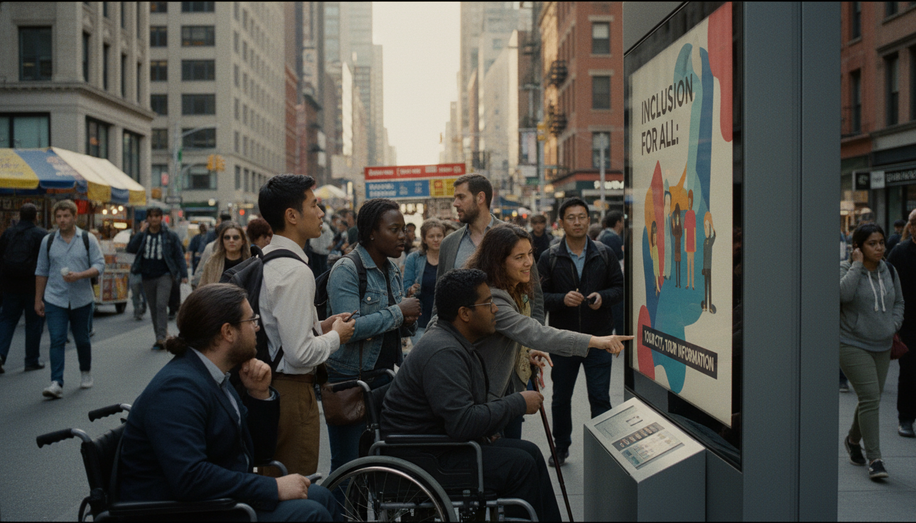

\n\nIn the bustling urban landscapes where out-of-home (OOH) advertising commands attention, inclusivity has emerged as a non-negotiable imperative. Advertisers crafting campaigns for billboards, transit shelters, and digital displays must now prioritize designs that resonate with audiences of all abilities, from those with visual impairments to individuals navigating cognitive challenges. This shift not only aligns with legal mandates like the Americans with Disabilities Act (ADA) but also taps into broader market potential, ensuring messages reach the estimated one billion people worldwide living with disabilities.
OOH’s unique challenge lies in its ephemerality—viewers glance at ads from moving vehicles or sidewalks, often in seconds. Traditional designs heavy on intricate graphics or tiny fonts exclude many, but inclusive practices demand simplicity and clarity from the outset. For visual accessibility, text must dominate with minimum character heights scaled to viewing distance: at least 5/8 inch for signs 40 to 70 inches high viewed from under six feet, escalating by 1/8 inch per additional foot beyond that. Digital billboards, legible from 500 feet, require lettering no smaller than 15 inches to accommodate low vision. High contrast ratios—ideally 4.5:1 between text and background—prevent washout in varying light, a standard borrowed from digital signage guidelines that ensures readability for color-blind viewers or those with light sensitivity.
Beyond legibility, color choices carry weight. Advertisers should avoid relying solely on hue for meaning; red-green distinctions fail the eight percent of men with color vision deficiencies. Instead, pair colors with patterns or shapes, and test against tools like WebAIM’s contrast checker. Lighting regulations further complicate digital OOH: displays cannot exceed ambient levels by more than 0.3 foot-candles at preset distances, with auto-adjusting sensors mitigating glare for photosensitive audiences. These elements combine to make ads not just visible, but perceivable.
For those with hearing impairments or who rely on public transit, static OOH falls short without sensory expansions. While billboards themselves lack audio, integrated campaigns can incorporate nearby digital kiosks with captioning or audio cues, mirroring ADA requirements for outdoor facilities. Transit ads, often viewed in stations, benefit from symbols of accessibility—the International Symbol of Access (ISA) for mobility, or equivalents for hearing aids—rendered in non-glare finishes with stark contrast. These icons, placed prominently, signal inclusivity without overwhelming the core message.
Cognitive accessibility addresses how brains process information amid distractions. Campaigns must strip away complexity: limit text to seven words per line, use familiar sans-serif fonts like Arial at bold weights, and sequence visuals logically—left to right, top to bottom, mimicking reading flow. Avoid jargon or metaphors that puzzle those with dyslexia or intellectual disabilities; instead, employ plain language and hierarchical layouts where key calls-to-action pop first. Exhibits and signage positioned no higher than 44 inches from the ground ensure seated viewers, including wheelchair users, can engage fully. Post-mounted signs protruding into paths must not exceed 12 inches if edges fall between 27 and 80 inches high, preventing hazards for the visually impaired using canes.
Regulatory frameworks reinforce these practices. Zoning laws in many jurisdictions mandate OOH compliance with safety and accessibility standards, including minimum heights to avoid obstructing pedestrian sightlines and permissions from road authorities. The ADA’s 1991 Standards for public accommodations extend to commercial signage, requiring proportional accessible parking signage at 60 inches minimum height with the ISA. While not all OOH qualifies as a “place of public accommodation,” forward-thinking advertisers audit designs against these benchmarks to preempt lawsuits and foster goodwill. Temporary event promotions, often amplified by OOH, must denote accessible routes—at least 36 inches wide with 60-by-60-inch passing spaces every 200 feet—via clear symbols in publicity materials.
Real-world implementation shines in hospitality parallels applicable to OOH. Outdoor venues use Braille on directional signs and concise messaging to guide all guests, principles that translate to billboard plinths or bus shelter panels. Comprehensive communication—detailing accessible features on companion websites or apps—amplifies static ads, allowing users with screen readers to access QR-linked content. Audits evaluate contrast, placement, and compliance, addressing gaps like insufficient headroom under overhead signs (minimum 80 inches).
The payoff transcends compliance. Inclusive OOH broadens reach: in the U.S., 26 percent of adults have disabilities, wielding $490 billion in disposable income. Brands like those in outdoor hospitality report enhanced loyalty when signage aids navigation for all. Yet challenges persist—local ordinances vary, from Texas’s licensing for rural signs to municipal size caps—and retrofitting legacy campaigns demands investment. Still, tools like auto-brightness sensors and free contrast analyzers democratize access.
Ultimately, inclusive design reframes OOH as a public good. By embedding accessibility—legible fonts, bold contrasts, intuitive layouts—advertisers not only meet diverse needs but elevate campaigns to universal appeal. In a medium defined by visibility, true success means being seen, understood, and remembered by everyone.