
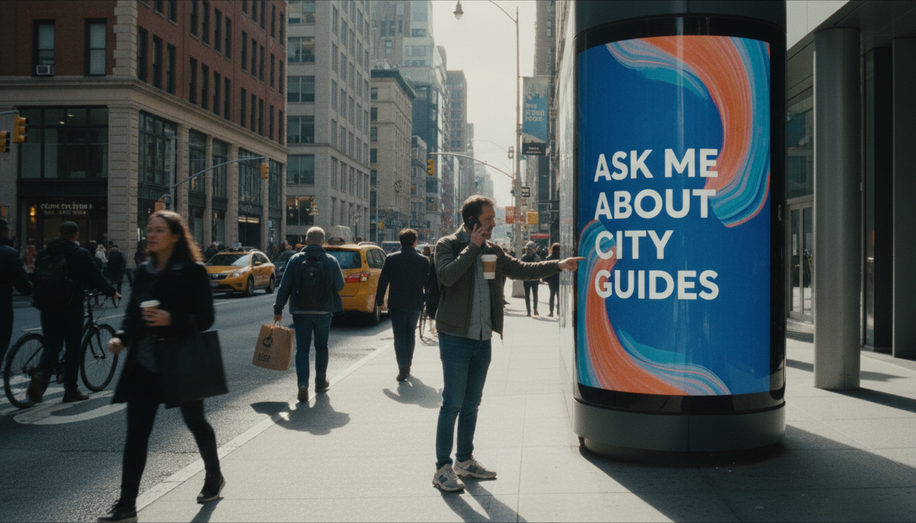

In the bustling streets of major cities, where pedestrians rush past towering digital billboards, a subtle revolution is underway: voice-activated out-of-home (OOH) advertising. Imagine a shopper glancing at a glowing display promoting a new smartphone, then simply saying, “Tell me more,” and watching the screen respond instantly with tailored product details, promotions, or even a direct link to purchase—all without lifting a finger. This hands-free interaction, powered by artificial intelligence and voice recognition, is propelling OOH into a new era of dynamic engagement, blending the physical world of advertising with the conversational ease of smart assistants.
At its core, voice-activated OOH leverages AI-driven media players embedded in digital signage to process natural language commands in real time. These systems integrate voice recognition and natural language processing, enabling displays to answer queries, navigate menus, or deliver location-based information on demand. In public spaces like transit hubs or retail corridors, where touchscreens pose hygiene risks or accessibility barriers, this technology shines. Users engage without physical contact, making it ideal for post-pandemic environments and inclusive for those with disabilities who might struggle with traditional interfaces. Early trials in cities worldwide have tested voice-activated billboards that respond to passersby questions about nearby products or services, demonstrating how spoken words can trigger personalized content on massive screens.
The appeal extends beyond mere convenience. Voice technology fosters deeper personalization, using data on location, demographics, and even past interactions to serve hyper-relevant ads. Advertisers gain improved targeting, leading to higher conversion rates, while collecting valuable insights into consumer interests and responses. This data-driven approach mirrors the programmatic revolution in digital advertising but applies it to the tangible realm of OOH, where audiences are already attuned to their surroundings. For instance, voice-activated displays can shift content fluidly—say “Show me deals” to reveal promotions or “Find nearby stores” for directional guidance—transforming passive viewers into active participants.
Complementing voice commands, directional audio technologies amplify the immersive potential. Companies like Holosonics have deployed Audio Spotlight speakers, which beam sound precisely to targeted zones using ultrasound, creating whispers or music that seem to emanate directly from the ad itself. In Amsterdam, a Nokia campaign paired a giant poster with focused music from the phone’s speakers, drawing crowds without disturbing bystanders. Similarly, a TNT promotion projected roaring racetrack sounds onto a courtyard logo, overlaying AC/DC’s “T.N.T.” to captivate passersby in a multisensory blast. These innovations make ads feel personal, as if speaking directly to the individual, boosting recall and engagement.
Real-world campaigns underscore the commercial impact. In New Zealand supermarkets, Ogilvy used directional speakers at banana stands to mimic a “conscience” voice urging fair-trade purchases, resulting in over 130% sales uplift—heard only by those standing precisely in front. Switzerland’s Graubünden tourism drive featured an interactive screen in Zurich station where a virtual mountaineer prompted yodels from passersby for vacation prizes, blending voice prompts with visuals for viral buzz. Such activations not only grab attention in noisy urban settings but also integrate seamlessly with smart devices, extending OOH reach via voice assistants for follow-up actions like reservations or reminders.
Programmatic audio OOH (AOOH) takes this further, automating ad delivery with data analytics for optimal timing and placement. Platforms enable brands to hit audiences at work, shopping, or travel spots, personalizing messages by demographics or time of day. Motion sensors can activate panels only when eyes are locked on, heightening interactivity, while voice adds personality—think immersive atmospheres evoking brand worlds without overwhelming the environment. Industries from retail to automotive are leading: drivers query smart car systems hands-free, shoppers get tailored recommendations, and healthcare apps prompt medication reminders via voice ads.
Challenges remain, including privacy concerns over voice data and technical hurdles like noisy street environments or accents. Yet, as voice-enabled devices proliferate—smart speakers, phones, cars—the infrastructure is maturing. OOH operators report audiences are more receptive outdoors, primed for environmental stimuli, making voice a natural fit to “bring ads to life.” Integration with AR or IoT could soon enable actions like ordering coffee from a billboard or reserving event tickets mid-stride.
Looking ahead, voice-activated OOH promises to redefine hands-free engagement, turning static displays into conversational hubs. Brands that embrace this shift will forge genuine connections, harnessing AI for experiences that feel intuitive and inclusive. As trials scale from urban experiments to global networks, the medium evolves from interruption to invitation, proving that in advertising’s future, the most compelling voice might just be the one responding to yours.