
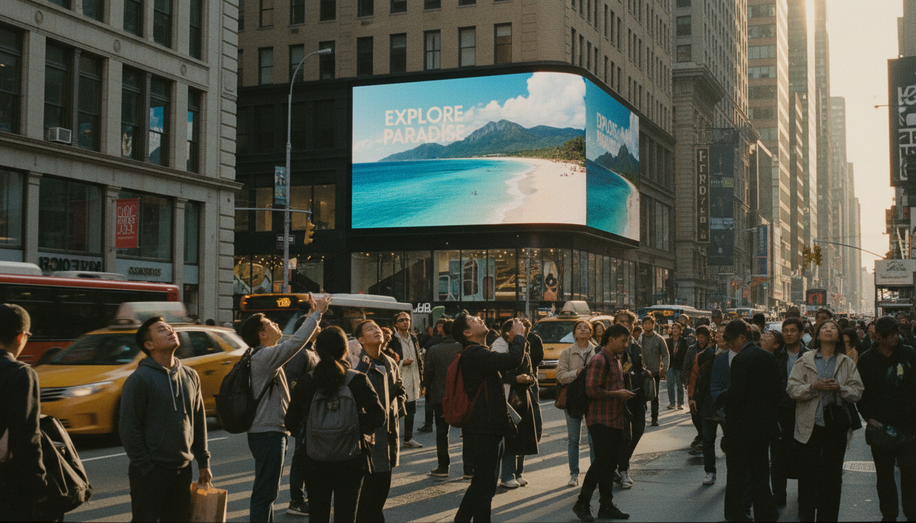

Out-of-home advertising has emerged as a vital tool for destination marketing, enabling cities, regions, and tourism boards to capture travelers’ attention at critical moments in their decision-making journey. With people spending 70% of their time outside of their homes, OOH advertising creates a unique opportunity to connect with both local residents and international visitors in real-world settings where they’re most receptive to travel inspiration.
The power of OOH in tourism marketing lies in its strategic placement within bustling urban centers and travel hubs. By positioning advertisements at airports, train stations, Times Square, and other high-traffic locations, tourism organizations can reach consumers precisely when they’re thinking about travel. This physical presence creates a compelling visual landscape that transforms everyday commutes into moments of wanderlust, turning passive audiences into active planners considering their next destination.
The Bermuda Tourism Authority’s “Lost Yet Found” campaign exemplifies this approach’s effectiveness. By leveraging dimensional OOH technology and full-motion video at strategic New York locations, the campaign generated 28 million impressions while driving a 13% increase in website traffic and a 14% increase in new user visits. The campaign’s success demonstrates how creative execution combined with strategic location selection can deliver measurable results that extend far beyond brand awareness.
Similarly, the Williamsburg Tourism campaign showcased how OOH can target specific feeder markets. By focusing on nearby metropolitan areas including Philadelphia and Washington D.C., the campaign highlighted diverse attractions beyond historical landmarks—including golf, outdoor activities, shopping, and dining. This approach resonated with audiences seeking weekend getaways, resulting in 260 million impressions and a remarkable 192% year-over-year increase in website traffic from New York City alone.
The versatility of OOH formats enables tourism marketers to tailor their messages to specific audiences and locations. From traditional billboards to digital displays, transit advertising, and dimensional installations, each format serves distinct strategic purposes. Digital out-of-home technology, in particular, allows for dynamic content that can be adjusted based on time of day, weather, or real-time travel trends, maximizing relevance and engagement.
Location strategy remains paramount in OOH tourism campaigns. Rather than blanket coverage, successful destinations employ geo-targeting and localization to deliver contextually relevant messages. For instance, a destination known for adventure tourism might emphasize rugged landscapes and exploration, while a city focused on cultural experiences highlights vibrant nightlife and heritage attractions. This precision ensures that advertising budgets are directed toward audiences most likely to convert into actual visitors.
The integration of technology with traditional OOH has further enhanced campaign effectiveness. QR codes and “text to plan” features transform passive billboard viewers into active participants, creating direct pathways from awareness to booking. AirAsia’s dynamic digital billboard campaign promoting “7 weeks of unstoppable deals” at key travel hubs demonstrates how programmatic OOH can drive immediate bookings by combining eye-catching creative with urgency-driven messaging.
Smaller destinations have also found success with OOH advertising. The city of Globe, Arizona, used billboard campaigns combined with search and social media to entice Phoenix residents to make the hourlong drive for a day trip, successfully converting nearby populations into visitors despite operating with limited marketing resources.
The emotional impact of OOH extends beyond immediate conversions. Iconic campaigns such as “Virginia is for Lovers,” “100% Pure New Zealand,” and “Pure Michigan” have transformed into cultural touchstones that shape how destinations are perceived globally. These campaigns leverage stunning visuals and compelling storytelling to create lasting impressions that influence travel decisions for years.
As tourism boards and destination marketing organizations continue evolving their strategies, OOH advertising remains a cornerstone channel for reaching travelers during their journeys—whether commuting through cities, transiting through airports, or exploring new neighborhoods. By combining strategic placement, creative excellence, and technological integration, OOH enables destinations to inspire wanderlust and drive measurable results that benefit local economies and communities.