
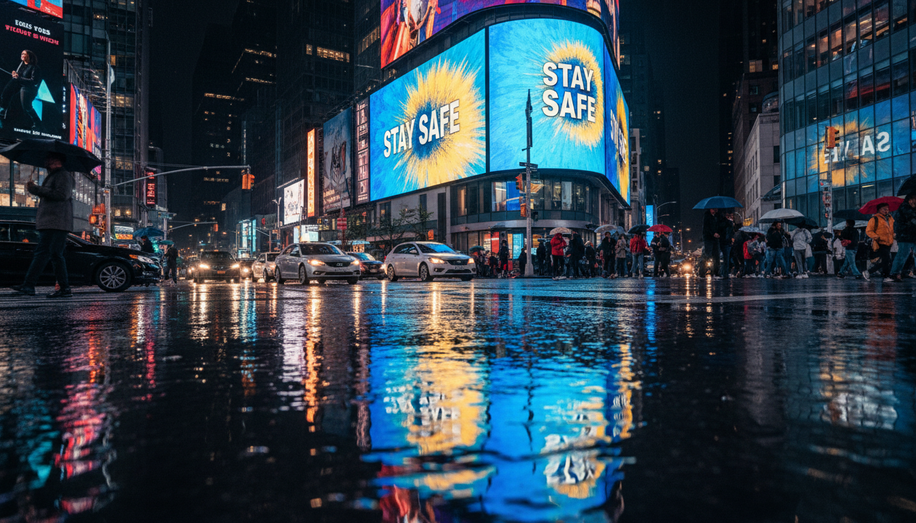

In the shadow of disaster, when panic spreads faster than flames or floods, out-of-home (OOH) advertising emerges as an unblinking sentinel, delivering urgent messages to millions in real time. Unlike digital screens that can be scrolled past or social feeds that drown in noise, towering billboards, transit wraps, and digital displays command attention on highways, streets, and public squares—precisely where people need guidance most. This immediacy proved vital during hurricanes, pandemics, and public health scares, where public-private partnerships turned OOH into a lifeline for safety alerts and evacuation routes, as seen in FEMA’s collaboration with billboard operators to flash weather warnings and escape paths across storm-prone regions.
Consider the COVID-19 crisis, when cruise lines like Royal Caribbean faced an existential threat from the Centers for Disease Control’s “No Sail Order.” Branded as “Floating Petri Dishes” in the court of public opinion, the industry teetered on bankruptcy. Royal Caribbean’s communications team orchestrated a multifaceted campaign to flip the narrative to “Safer than Main Street,” leveraging OOH alongside other channels to blanket cities with assurances of enhanced safety protocols. Billboards and transit ads proclaimed rigorous cleaning, testing, and ventilation upgrades, reaching commuters and travelers at decision points—airports, ports, and urban arteries. This visible commitment helped restore confidence, coaxing passengers back aboard and stabilizing an industry on the brink.
OOH’s power in public safety extends beyond corporate recovery to outright lifesaving. During the infamous Tide Pod Challenge, where teens ingested laundry detergent pods in a viral stunt, Procter & Gamble swiftly mobilized. NFL star Rob Gronkowski starred in spots warning “Use Tide Pods for washing, not eating,” but the real reach came from OOH blitzes on digital billboards and bus shelters near schools and malls. These unmissable visuals amplified earned media and platform takedowns, curbing hospitalizations and setting a benchmark for rapid response. The campaign’s street-level presence ensured the message pierced echo chambers, protecting vulnerable youth while safeguarding the brand.
Brand recovery after scandals demands similar boldness. Johnson & Johnson’s 1982 Tylenol tampering crisis—seven deaths from cyanide-laced capsules—could have buried the company. Instead, executives yanked 31 million bottles nationwide, costing millions, and launched a hotline for public fears. OOH played a pivotal role in the comeback: full-page newspaper ads morphed into billboard barrages touting tamper-proof packaging and a $100,000 reward for information. Displayed on major thoroughfares, these ads signaled unwavering accountability, rebuilding trust so effectively that Tylenol recaptured 30% market share within months and remains a household staple today. The lesson endures: OOH’s permanence cuts through skepticism, turning mea culpas into milestones.
Fast food giants have wielded OOH to humorous, redemptive effect. KFC’s 2018 UK chicken shortage shuttered hundreds of outlets amid public outrage. Rather than hide, they owned the fiasco with bucket-shaped billboards apologizing profusely—”FCK”—and poking fun at the mess. Plastered across London and beyond, these cheeky displays went viral, boosting brand recognition and emerging stronger, proving self-deprecation via OOH can transmute crisis into cultural moment. Similarly, Chipotle’s E. coli outbreak prompted CEO Steve Ells to buy full-page ads and appear on morning shows, but OOH extensions on urban billboards kept apologies circulating, directly addressing affected communities in Seattle and Portland. Transparent updates via street-level screens sustained customer dialogue until locations reopened safely.
Public sector triumphs underscore OOH’s impartial reach. Austin Resource Recovery’s 2021 composting rollout used a year-long OOH blitz—billboards, benches, transit—to slash contamination by over half, from 2.8% to 1.25%, while boosting participation citywide. Tailored for environmental justice, ads hit diverse neighborhoods, proving OOH’s equity in behavior change. In San Diego, ambulance provider Falck unseated a 20-year incumbent through a public affairs push heavy on OOH, countering misinformation with displays highlighting superior response times and community ties. A unanimous city council vote followed, crediting the visible coalition-building.
Yet OOH’s edge in crises lies in its fusion with data and digital. Modern digital billboards dynamically update—amber alerts one hour, flu shot reminders the next—via geo-targeting and real-time feeds. A Chicago contest drove 45,000 entries through strategically placed screens near venues, illustrating measurable uplift even in normal times; imagine that precision for evacuations. Studies affirm OOH’s response trigger: Nigeria’s Outdoor Advertising Association found it second only to TV in prompting action, ideal for crises demanding immediate compliance.
Critics might argue OOH risks overload in ad-saturated cities, but data counters: its dwell time—drivers stuck in traffic, pedestrians at stops—forces engagement, with 98% notice rates. During recovery, this builds emotional resonance; Royal Caribbean’s safety pledges lingered on commutes, embedding trust subconsciously. As climate volatility and geopolitical shocks intensify, OOH stands ready—not as a luxury, but infrastructure for resilience.
In an era of fleeting digital discourse, OOH’s physicality endures, bridging public safety imperatives with brand redemption. From FEMA’s warnings to KFC’s contrition, it proves that in crisis, the boldest voices rise highest—etched in steel and light, impossible to ignore.