
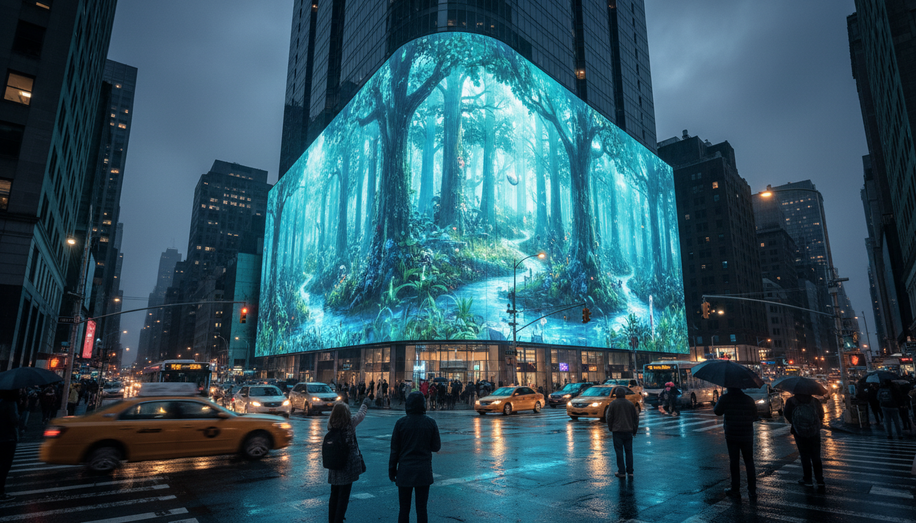

The outdoor advertising industry stands at a technological inflection point, with virtual reality emerging as a transformative force capable of reimagining how brands engage audiences in public spaces. While augmented reality has already demonstrated considerable success in converting passive billboard viewers into active participants, virtual reality represents the next evolutionary leap—one that promises to transport consumers into entirely immersive brand worlds, fundamentally altering the relationship between advertisement and observer.
Virtual reality’s potential in out-of-home advertising lies in its capacity to create experiences that transcend the physical limitations of traditional billboards and transit advertisements. Unlike augmented reality, which overlays digital content onto the real world through smartphone screens, virtual reality immerses viewers in completely constructed environments, offering a level of engagement that static and even interactive digital displays cannot match. This distinction becomes increasingly important as brands compete for attention in saturated advertising markets where conventional approaches yield diminishing returns.
The mechanics of implementing virtual reality in OOH environments differ significantly from current AR campaigns, yet they build upon established technological foundations. While AR billboards have achieved documented success—Vodafone’s German campaign reached 50 million people and drove 40 percent of engaged users into physical retail locations—VR experiences could deepen this engagement by creating more memorable, narrative-driven interactions. Rather than scanning a QR code to activate a brief animated experience, consumers could don headsets at transit stations or branded installations to participate in extended brand narratives, product demonstrations, or entertainment experiences that forge stronger emotional connections.
The practical implementation of VR in OOH advertising requires strategic placement and technological infrastructure. Transit hubs, shopping centers, and high-traffic urban environments offer ideal locations for VR installations, where captive audiences—commuters waiting for buses or trains—have time to engage with immersive content. These locations naturally accommodate the temporary nature of VR experiences, which typically require headsets and dedicated physical space. Brands could create pop-up VR experiences that generate social media buzz and drive foot traffic, transforming routine commutes into opportunities for brand interaction.
Mixed reality technologies add another dimension to this emerging landscape, blending physical and digital worlds in ways that bridge augmented and virtual reality experiences. These hybrid approaches could allow consumers to interact with both real and digital elements simultaneously, creating experiences more accessible than full VR immersion while offering greater depth than traditional AR. Such flexibility enables brands to meet consumers at various technological comfort levels while maintaining sophisticated, engaging campaigns.
The financial and creative implications of VR-enhanced OOH advertising warrant careful consideration. Virtual reality experiences require more significant infrastructure investment than QR code-activated AR campaigns, yet they offer corresponding returns through enhanced brand recall and consumer engagement metrics. Early AR successes suggest that immersive experiences drive measurable business outcomes—increased store visits, higher consideration rates, and greater social amplification. VR experiences, with their greater intensity and memorability, could amplify these effects substantially.
However, the industry must address practical challenges before VR becomes mainstream in OOH advertising. Hygiene concerns surrounding shared headsets, accessibility requirements for diverse consumer populations, and the need for reliable technical infrastructure all demand solutions. Additionally, the transition from novel experience to normalized expectation will require ongoing innovation to maintain consumer interest as VR becomes more commonplace.
The future trajectory suggests that VR will not replace augmented reality in OOH advertising but rather complement it as part of a diversified immersive advertising ecosystem. Lower-barrier AR experiences via smartphone will continue reaching mass audiences, while VR installations will serve as premium brand experiences in high-value locations. This tiered approach allows advertisers to maximize reach while creating flagship experiences that generate press coverage and social sharing.
As consumer expectations for interactive brand experiences continue rising, virtual reality’s capacity to deliver genuine immersion positions it as an essential tool in the modern OOH advertiser’s arsenal. The brands that successfully pioneer VR integration in outdoor environments will establish themselves as innovation leaders while capturing the attention of audiences increasingly indifferent to static messaging.