
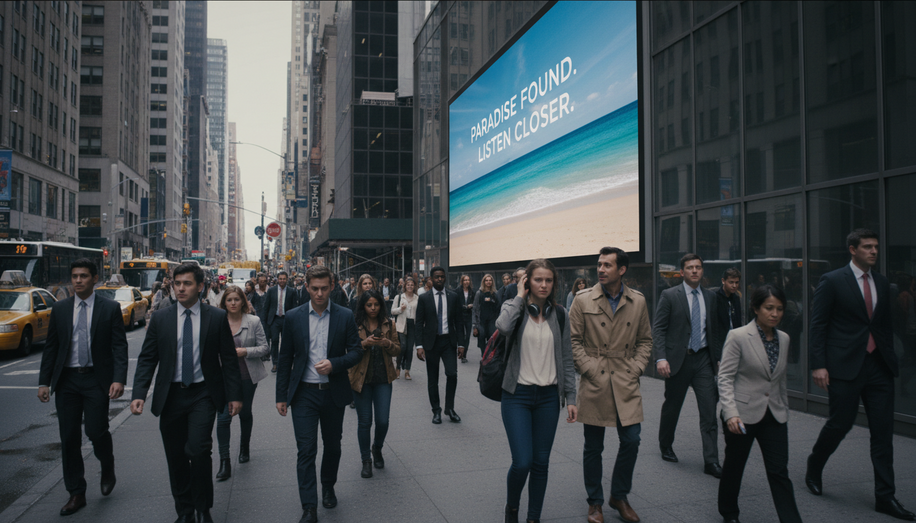

In the evolving landscape of out-of-home (OOH) advertising, where billboards and digital screens dominate urban vistas, a quiet revolution is underway: the integration of audio. Long confined to radio and podcasts, sound is emerging as a potent enhancer for static OOH formats, capturing consumer attention in ways visuals alone cannot. Recent studies reveal that audio-infused OOH campaigns boost recall and purchase intent, challenging the medium’s traditional reliance on sight.
Traditional OOH excels at reach, blanketing commuters with up to 5,000 ad impressions monthly in major cities, where 71 percent of consumers report noticing billboards during travel. Drivers log about 300 hours annually behind the wheel, prime time for roadside exposure, especially during peak commuting windows from 7 to 9 a.m. and 4 to 7 p.m. Digital out-of-home (DOOH) amplifies this with dynamic messaging, delivering 1,000 to 10,000 impressions per cycle and longer dwell times that improve retention by around 40 percent. Yet, for all its scale, OOH’s effectiveness has historically hinged on fleeting glances—73 percent of viewers remember a message after one exposure, and 65 percent search online afterward, with 40 percent acting within minutes. These metrics are strong, but they pale against audio’s immersive pull.
Enter audio, which a 2024 Veritonic study of U.S. podcast listeners positions as superior to billboards in key engagement metrics. Fully 60 percent of respondents deemed audio ads more memorable than billboards, with 51 percent more likely to purchase after hearing one compared to seeing a static board. Audio also led in product discovery preference at 54 percent over OOH visuals. This edge stems from sound’s ability to penetrate distractions; unlike visuals competing with traffic or phone screens, audio commands undivided attention, particularly in cars where 44 percent of AM/FM listening occurs and few drivers switch stations mid-message. Cumulus Media/Westwood One data underscores this synergy: 65 percent of radio consumption happens out-of-home, adding frequency to OOH’s one-and-done exposures and lifting overall recall when paired.
The post-pandemic commute resurgence—85 percent of Americans now driving to work—has supercharged this convergence. OOH ad spend is climbing as vehicles reclaim roads, but weather or traffic can obscure visuals while boosting radio tuning for updates. Audio’s ROI further bolsters the case. Nielsen’s 2025 Annual Marketing Report pegs radio at $2 per dollar spent, trailing only social media ($2.22) and outpacing display ($1.52), search ($1.16), and connected TV ($1.15). Despite CMOs ranking radio low on perceived effectiveness (46 percent), hard data reveals a “massive disconnect,” with tools like Media Impact showing a 20 percent reach spike from reallocating just 10 percent of TV/digital budgets to audio. OOH itself delivers $2.80 in sales per dollar, topping TV and print, per BrandScience analysis.
Innovators are testing audio-OOH hybrids to harness these strengths. Digital billboards with embedded speakers, QR-triggered soundscapes via apps, or roadside audio zones paired with screens are gaining traction, especially in high-dwell venues like airports or malls, where exposure lingers 10 to 30 times longer than highways. Such integrations tap audio’s trust factor—podcasts and AM/FM tie for second in ad claim believability at 48 percent, edging social media—while OOH provides contextual relevance. Veritonic found audio recall 49 percent higher than display ads, 48 percent over video, and 33 percent above social, with purchase intent leading at 40 percent versus competitors.
Consumer behavior data paints a vivid picture of audio’s influence. In-car dominance is key: radio claims 86 percent of ad-supported audio time there, aligning perfectly with OOH’s roadside forte. Combining them counters OOH vulnerabilities—inclement weather dims billboards but amplifies radio reliance—while simple, high-contrast OOH creatives already boost recall by 60 percent; audio could push that higher. Geo-fenced retargeting post-DOOH exposure lifts conversions 20 to 30 percent, and audio layers could personalize further with dayparted messaging.
Skeptics might argue OOH’s visual punch suffices, citing 73 percent favorability for DOOH, tops among media. Yet perception gaps persist; Nielsen notes radio’s undervaluation despite superior metrics. Emerging measurement like Nielsen’s three-minute Portable People Meter windows and Media Monitors’ geo-details will refine audio-OOH attribution, proving blended campaigns’ worth.
Ultimately, audio transforms OOH from passive backdrop to active engager. As urban mobility rebounds and ad tech evolves, sound’s memorability, trust, and ROI position it as the missing frequency in OOH’s visual symphony. Marketers ignoring this fusion risk muting their message amid the noise. Early adopters blending audio with billboards report heightened engagement, signaling a sonic shift in out-of-home’s future. To navigate this sonic shift, platforms like Blindspot become indispensable, offering the granular data necessary to optimize these blended campaigns. By leveraging its location intelligence for strategic site selection and robust ROI measurement, marketers can precisely track the enhanced engagement and attribution of audio-infused OOH, transforming passive backdrops into active, measurable, and highly effective consumer touchpoints. Learn more at https://seeblindspot.com/