
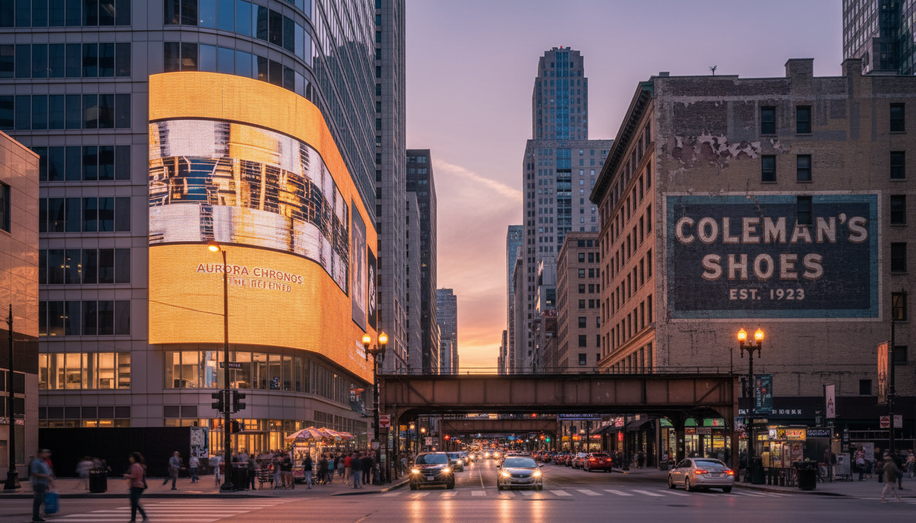

In the dim glow of 19th-century streetlamps, out-of-home (OOH) advertising flickered to life, propelled by a lithographic breakthrough in 1796 that enabled the mass production of illustrated posters on smooth stone or metal plates. This innovation, building on Gutenberg’s movable type from 1450, allowed advertisers to blanket urban landscapes with vivid imagery, marking the dawn of OOH as a visual force. By 1835, Jared Bell had plastered New York with the first dedicated outdoor posters promoting a circus, scaling them to 50 square feet and setting the stage for billboards as we know them. Street railways soon bore exterior ads by 1850, and by 1870, nearly 300 posting companies dotted America, leasing boards and painting fences to hawk local wares.
The early 20th century solidified OOH’s infrastructure amid rapid industrialization. In 1915, the National Outdoor Advertising Bureau emerged to assist agencies, while illuminated displays debuted in San Francisco by 1916, harnessing electric lights to extend visibility into the night. Trade groups consolidated power: the 1925 merger of the Poster Advertising Association and Painted Outdoor Advertising Association birthed the Outdoor Advertising Association of America (OAAA), alongside the era’s first major company merger into General Outdoor Advertising Company. Standardization followed, with the 1934 launch of the Traffic Audit Bureau (TAB) delivering audience data—crucial third-party validation that quelled skeptics and attracted national brands like Palmolive, Kellogg, and Coca-Cola. Yet regulations loomed; the 1965 Highway Beautification Act curtailed billboards on interstates, confining them to commercial zones and mandating size, lighting, and spacing rules.
Technological leaps in materials and mechanics refined these static giants. Vinyl supplanted paint in the 1970s, slashing production time and weathering elements better. Posting evolved too: power-driven boom trucks in 1946 hoisted panels effortlessly, while 1956 introduced slimline fluorescent lighting for brighter, slimmer illumination on Long Beach panels. Reflective Scotchlite in 1946 enhanced nighttime highway bulletins in Arizona and California, and by 1962, the first ad-funded bus shelters dotted cities, proving revenue could sustain public amenities. A 1975 OAAA campaign featuring Miss America Shirley Cochran skyrocketed her name recognition by 940 percent, empirically validating OOH’s reach. Nielsen studies from 1960 onward quantified frequency and awareness, cementing data-driven credibility.
The digital revolution ignited around 2000, when LED advancements and plummeting electronics costs birthed viable large-format screens. Lamar Advertising’s 2001 installation of the industry’s first low-resolution digital billboard in Baton Rouge, Louisiana, was a seismic pilot, proving dynamic content could thrive outdoors. By 2005, the first digital networks rolled out, enabling remote content swaps and slashing downtime. The 2010 shift to ecoflex posters from traditional 30-sheets prioritized eco-friendliness and speed. Smartphones, proliferating post-2007, supercharged this pivot: networked signage integrated live data feeds for contextual ads—like coffee promotions on chilly mornings or real-time sports scores—blurring OOH with digital precision.
Programmatic buying accelerated the transformation. Around 2012, platforms and exchanges debuted, automating digital billboard purchases via demand-side tools, mirroring online ad ecosystems. Clear Channel Outdoor’s 2004 push into remotely changeable static signage evolved into full digital networks, like Manhattan’s 80-screen “Digital Street Network.” Measurement matured too: Arbitron and Nielsen tested outdoor ratings in 2002, evolving TAB’s traffic audits into granular metrics. Foster & Kleiser’s milestones—from 1961’s prefabricated panels to 1980’s four-color digital imaging—foreshadowed this scalability, as the firm ballooned to 40,000 facings.
Today, these threads weave into hybrid strategies. Proximity-based digital out-of-home (pDOOH) leverages geofencing and AI for hyper-targeted campaigns, syncing billboards with mobile data. Transit formats—from 1850s railway ads to modern wrapped buses and street furniture—now pulse with QR codes and augmented reality, bridging physical impressions to online conversions. Environmental mandates, echoing 2010’s ecoflex, drive solar-powered displays and recyclable vinyls. Yet challenges persist: regulatory hurdles and data privacy debates temper unbridled innovation.
Looking ahead, OOH’s evolution promises fusion with emerging tech. AI-driven personalization, 5G-enabled interactivity, and immersive holograms could redefine “out-of-home” as an always-on ecosystem. From lithography’s stone plates to programmatic pixels, technology has not just enhanced OOH but redefined its relevance, proving static posters could dance with data in a connected world.